
Soft Images: toward a less certain penis
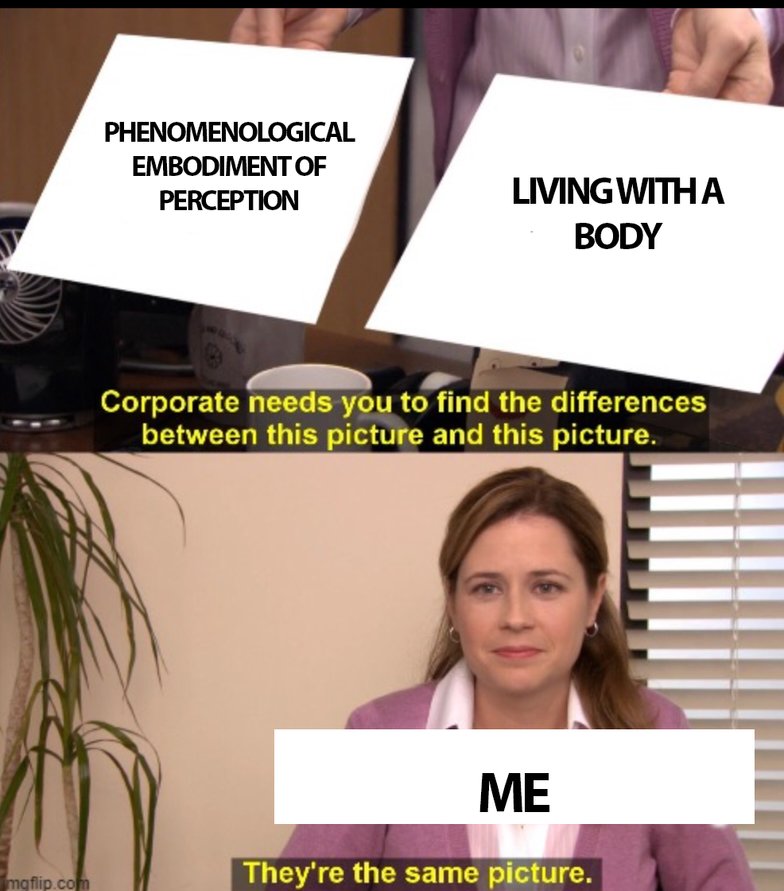
Fleshly bodies are in a constant state of slippage and glitch. They refuse to be simple or easy to label, define, represent, or symbolize. As soon as we give them shape, color, or language, nuance and complexity are erased—assumptions are assigned.
This is accelerated by the rapid transmission and algorithmic reward for images that are easily legible and quickly interpreted.
These systems don’t just circulate meaning—they construct it.
But like bodies, and everything really, this generates feedback loops. Assumptions and flattened understandings slip and leak back into our fleshly, corporeal bodies. We are moved and oriented—how we speak, write, make images, and engage with others is shaped by these mediated constructions.

Today, and many days frankly, I’m looking at how this process constructs one body part in particular: the penis.
My work professionally and academically is in excavating and unearthing assumptions of the body that I—and we—adopt culturally, especially in the US.
By default, this has meant working through media studies, because our phenomenologies of perception are so deeply entangled with the near-constant perceptual visual and sound mediations we engage with.
These interpretations become lived in our bodies and spill outward—into texts between friends, Instagram comments, drawings in margins, textbooks, and, often unfortunately, our medical practices and policies.
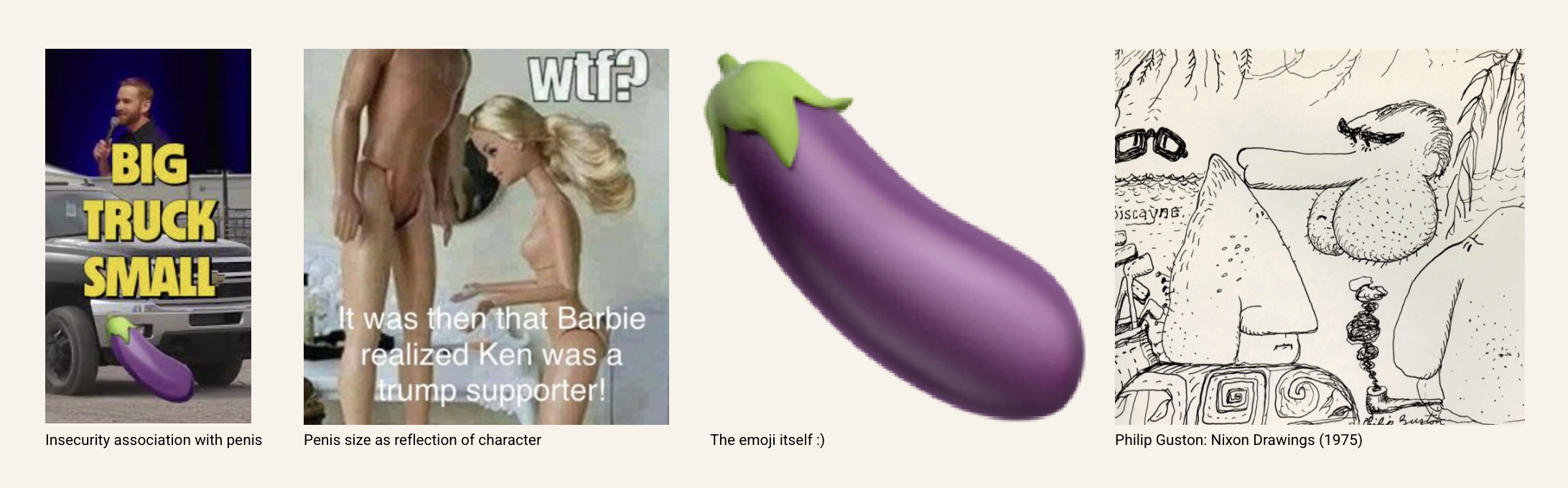
I’ve become particularly interested in the penis—not as a Freudian Phallus, but as a body part that has been fragmented from the body, that it has a life of its own.
We often encounter the penis as a symbol before—or instead of—its fleshly origin.
Instead of flesh made of blood and skin, it becomes an eggplant emoji, communicating thirst or jokes.
It becomes shorthand for misogyny on subway walls, or in art. (This one by Pussyfoot)
An unsolicited Dick Pic on our phones, a tool of power play.
It becomes a tool of ridicule in political cartoons and in our everyday colloquialisms.
Its representations are employed as tools that communicate broader ideas rather than communicating the actual body part.
Perhaps the most entrenched symbolic construction is the penis as a primary tool and communicator of violence, domination, and rape.
Nicholas Mirzoeff, drawing on Sarah Deer, writes that rape can function as a metaphor for colonialism—but is also an everyday practice of racial capitalism.
In this context, the Phallus is not just anatomy—it is the penis within a structure of violence.
But this symbolic weight expands outward into how we interpret sex and nudity more broadly.
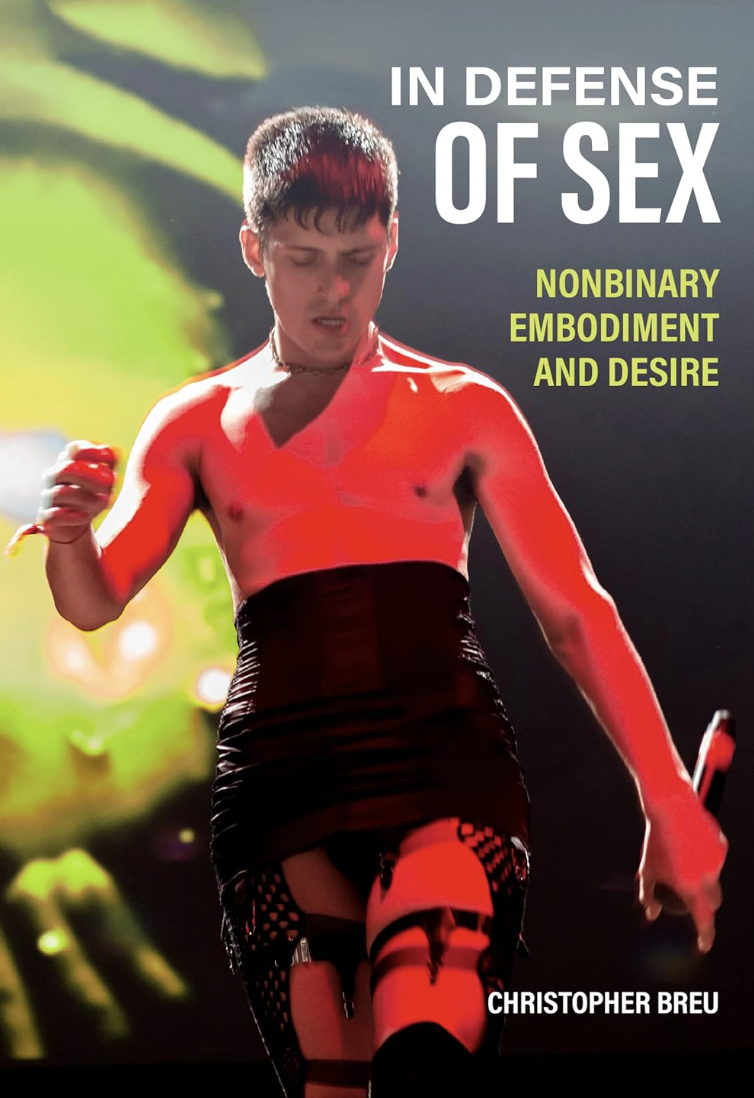
In In Defense of Sex, Christopher Breu describes a cultural condition in which even nudity itself becomes potentially traumatizing—where the presence of the body is already read through the possibility of harm.
Christopher states that not only is sex now associative with trauma, but “Nudity itself has now become potentially traumatizing. I am not talking about the obviously aggressive and intentionally traumatizing actions that fall under the category of indecent exposure. We live in a culture where sexual violence and the straight, cis, male control of public space, through acts of symbolic and physical violence, are still much too prevalent. However, I am talking about the way in which even animal nudity is regularly blurred out on Facebook posts or moments in which the panopoly of meanings attaching to the artistic display of nudity or scanty dress gets read as de facto traumatizing...”

The example that Christopher gives is of Tony Matelli’s sculpture “Sleepwalker,” a figure of a presumed man clad only in underwear, one they describe as “vulnerable and older.” The lifelike sculpture was placed on a college campus and was taken down due to folks interpreting it as trauma-inducing.
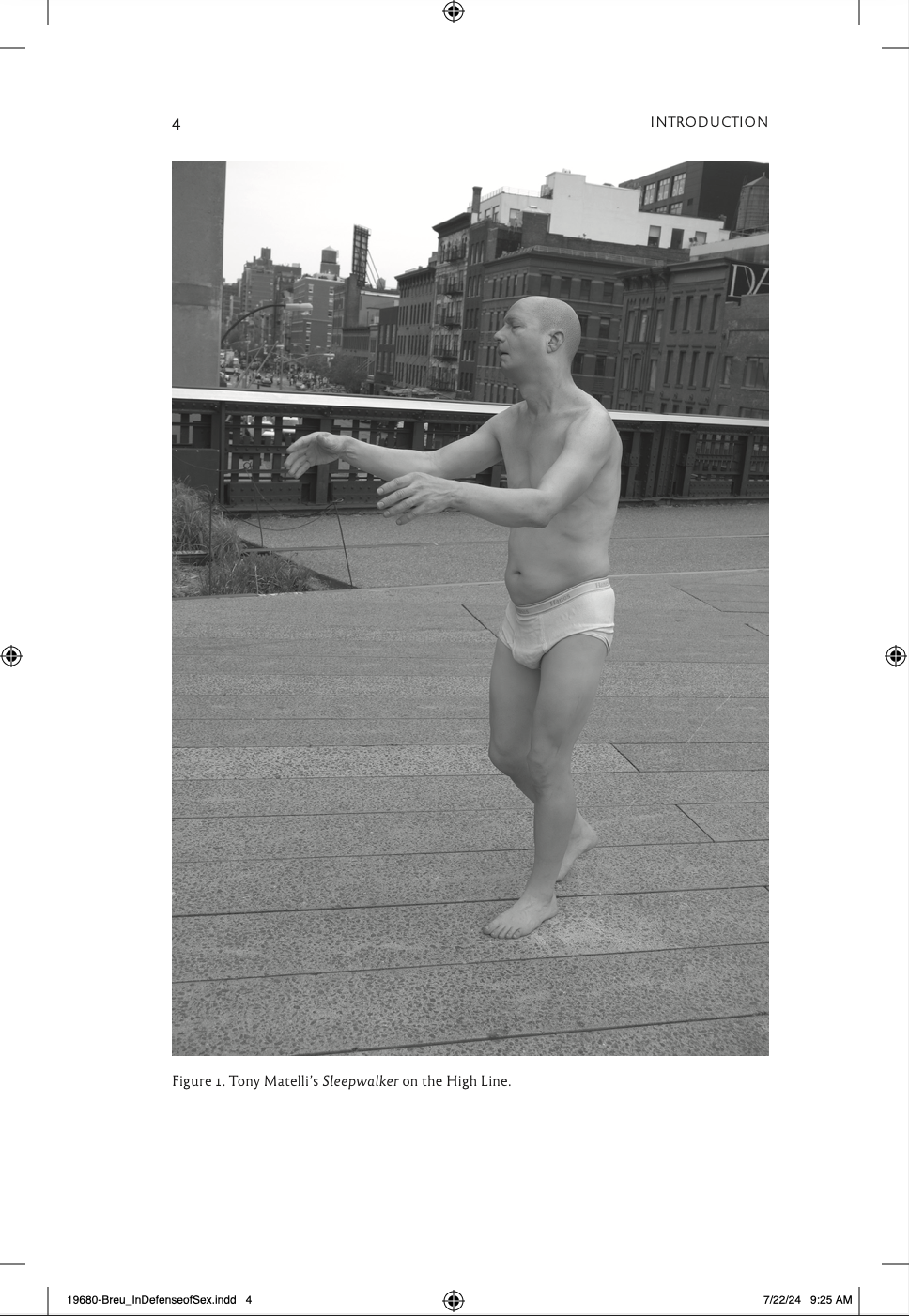
Institutional organizers likely would not, and do not, receive accounts of the countless nude sculptures and images of female coded (ie breasted and with vaginal genitalia) as traumatizing. We see it everywhere. This distinction is missed, or at least not explicitly stated, in Christopher's assessment. It is the penis, even a sculpted penis, hidden behind sculpted underwear, in a vulnerable position, that is considered Phallic. In this, It is not just a covered penis, but a slyly hidden symbol of innate sexual White non-trans male violence.
Even when it is not acting, not visible, or even concealed, the thought penis is still read through this symbolic frame.
Even the penis in representations of vulnerability are read as threat.
We need to return to the body as a neutral site.
No body part is inherently moral.
No body part is inherently violent.
It is flesh—benign, variable, contingent, and attached to very real and variety of humans.
One of the most harmful effects of this symbolic construction is the essentialization of the penis that is innate in these framings.
In shaming it, fearing it, and equating it with rape and violence, we:
erase or shame intersex bodies
erase trans women who keep their penis, by choice or circumstance
shame trans masculine people who pack or want to pack [INSERT PIC}
reinforce racialized stereotypes, like those of Black men
and also often mistakenly attribute power where there less (ie - a gay black man with a penis, is often going to be more oppressed than a white woman without a penis)
These symbolic constructions of the penis assume a stable, non-trans body—and often racialize that body in contradictory and harmful ways.
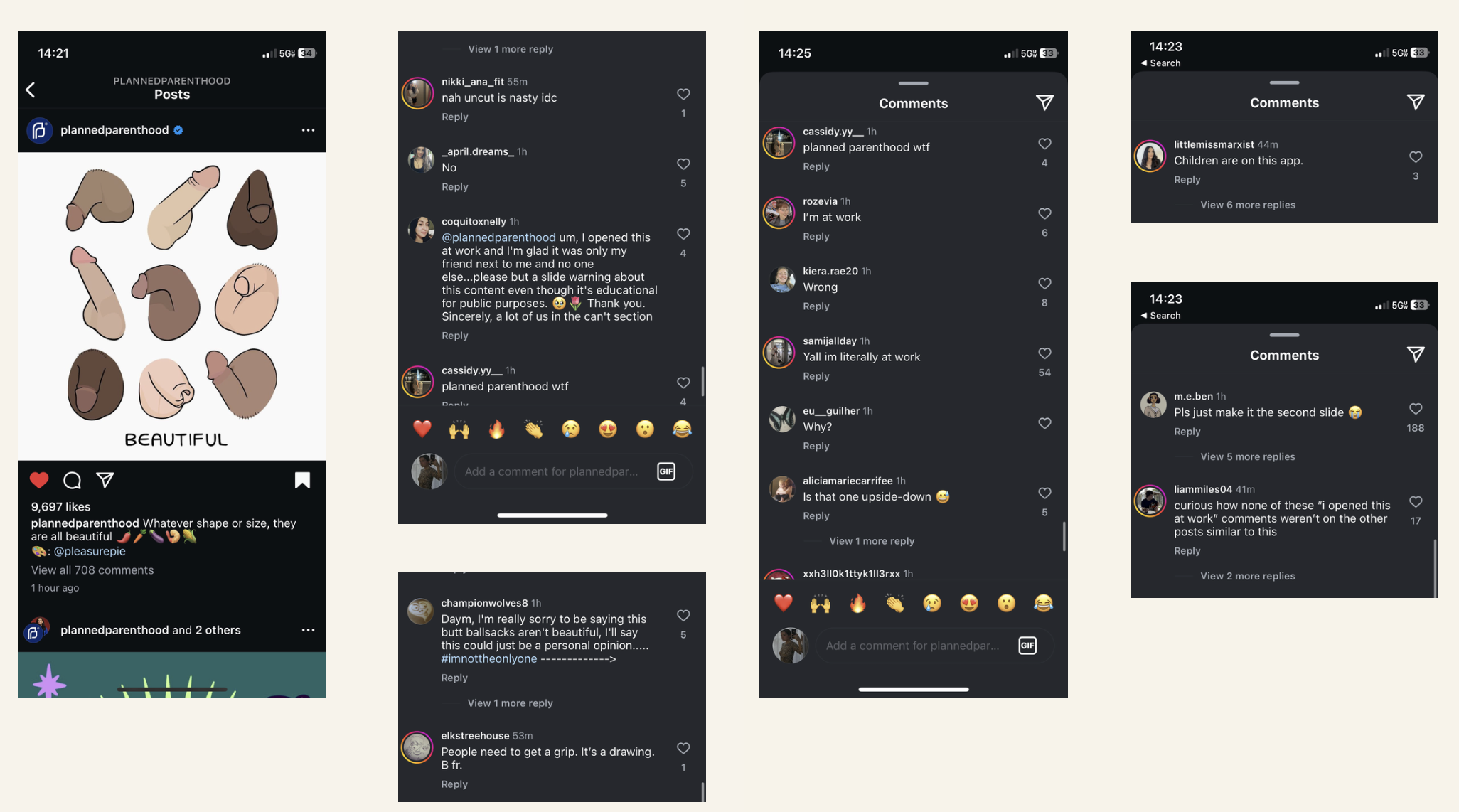
These instagram comments, taking offense at cartoon penises, often calling them gross, are talking about real people. Disgust of others bodies should never be accepted. Especially under the guise of feminism, fighting racial patriarchal capitalism too important.
A friend recently asked me how one makes the penis non-phallic.

And the answer is actually quite simple:
The penis is not phallic most of the time.
It is made phallic.
It most often exists as soft, flaccid, non-performative.
An erect penis is not the norm—but generally brief moments, as millions in research for things like viagra can attest.
To see the penis as non-phallic, we have to stop attributing fixed meaning to it.
We are assuming:
that the penis belongs to a non-trans person
that the penis perpetrates harm, rather than sometimes being a vehicle and subject within systems of harm
that it carries stable racial meaning in the context of cisness
that it is erect, or capable of staying erect
that body shaming constitutes critique
This part becomes a little dense. But I’m going to provide a bibliography for those who are interested.
These assumptions rely on a broader framework of how we understand bodies, gender, and power.
And Marquis Bey reminds us that cisness is not neutral—it is historically structured through whiteness. What we expect in cisness is most often a White cisness. (Define his framework)
Black bodies, through the violence of the transatlantic slave trade and its afterlives, have been both hypersexualized and quite literally ungendered and denied gender/sex—positioned differently within these relational frameworks of power. (Reference whatsherface black on both sides)
Building on this, Perry Zurn proposes the term “non-trans” instead of “cisgender,” as “cisgender” itself reinforces a binary that erases intersex and other non-normative experiences. (Explain this)
I want to mention Emma Heaney’s concept of penetration as a way to think through this differently. I know the phrasing sounds a little aggressive, but conceptually it works. (Explain this/ define the phrase)
Heaney uses the term penetration not as a literal act, but as a conceptual process for understanding hierarchy and relationality.
Within this framework, bodies are not fixed as identities cis and non cis or male and female, but are positioned in relation— a network of
as penetrated and penetrator. If you’re interested in learning - she has a book called Feminisms against cisness which is free online.
It unsettles the assumed coherence of assumption of cisness, which relies on fixed, binary, and stable bodies.
So when we talk about the penis as symbol, and more importantly, when we use it as such and embrace it, we are not just talking about a body part—
we are also embracing a set of assumptions we ourselves are making, built on unstable, racialized, and historically constructed categories of gender and power.
Reclamation of the penis does not mean ignoring harm or rape.
It means speaking about harm without collapsing it into a body part.
It means understanding that violence does not live in the penis itself, but in the systems, structures, and contexts in which it operates esp with non trans white men in patriarchies.
A reclamation might look like assuming a penis:
that is non-cis, non-gendered, racially expansive, and often flaccid.
This is not a minimizing of harm—it is a more precise account of where harm actually lives, and an embodied acceptance for a variety of ways of living with a body, including a penised one.
We must collectively reckon with how often we essentialize and flatten bodies—including bodies with penises.
What this looks like in practice:
physically drawing or looking what makes us uncomfortable (not shying away from it in museums, public spaces, looking at ones own or partners body)
wearing brands like Carne Bollente that embrace penises
shifting language away from “big dick energy” or “small dick energy”
engaging representations that complicate rather than reinforce
In my work, I’ve done this a few ways…
Figuring Flesh workshops
Workshops where drawing becomes a method for slowing down perception and collectively unpacking the assumptions we place onto bodies.
The Nude (but male-ish)
An ongoing project of nude portraits, anonymous interviews, and multidisciplinary works that reframe the penis outside of fixed identities and symbolic expectations.
@theproblempen_s (Instagram)
An archive of penis imagery encountered in everyday life that tracks how the penis circulates as symbol across casual, digital, and social spaces.
Photographing every penis in the Met (ongoing)
An ongoing study of how the penis has historically been represented in art, approached as a form of social and visual relearning.
If the penis has been constructed as a symbols for misogyny and violence, then it can be constructed otherwise.
And that work begins by returning it to flesh, a flesh that belongs to bodies that glitch.
Bibliography + Recs
Ahmed, Sara. Queer Phenomenology: Orientations, Objects, Others. Durham: Duke University Press, 2006.
Berlant, Lauren. Desire/Love. Brooklyn: Dead Letter Office / Punctum Books, 2012.
Beu, Marquis. Cistem Failure: Essays on Blackness and Cisgender. Durham: Duke University Press, 2022.
Breu, Christopher. In Defense of Sex: Nonbinary Embodiment and Desire. New York: Fordham University Press, 2024.
Cotten, Trystan T., ed. Hung Jury: Testimonies of Genital Surgery by Transsexual Men. Oakland: Transgress Press, 2012.
Deer, Sarah. The Beginning and End of Rape: Confronting Sexual Violence in Native America. Minneapolis: University of Minnesota Press, 2015.
Freud, Sigmund. "The Infantile Genital Organization (An Interpolation into the Theory of Sexuality)." 1923. In The Standard Edition of the Complete Psychological Works of Sigmund Freud, vol. 19, translated and edited by James Strachey, 141–148. London: Hogarth Press, 1961.
Gleeson, Juliana. Hermaphrodite Logic: A History of Intersex Liberation. London: Verso Books, 2025.
Grosz, Elizabeth. Volatile Bodies: Toward a Corporeal Feminism. Bloomington: Indiana University Press, 1994.
Heaney, Emma, ed. Feminism Against Cisness. Durham: Duke University Press, 2024.
Merleau-Ponty, Maurice. Phenomenology of Perception. 1945. Translated by Donald A. Landes. London: Routledge, 2012.
Mirzoeff, Nicholas. White Sight: Visual Politics and Practices of Whiteness. Cambridge: MIT Press, 2023.
Russell, Legacy. Glitch Feminism: A Manifesto. London: Verso Books, 2020.
Snorton, C. Riley. Black on Both Sides: A Racial History of Trans Identity. Minneapolis: University of Minnesota Press, 2017.
Spillers, Hortense J. "Mama's Baby, Papa's Maybe: An American Grammar Book." Diacritics 17, no. 2 (1987): 65–81.
Steyerl, Hito. "In Defense of the Poor Image." e-flux 10 (November 2009). https://www.e-flux.com/journal/10/61362/in-defense-of-the-poor-image/. Also collected in The Wretched of the Screen. Berlin: Sternberg Press, 2012.
Zurn, Perry. Cisgender: Disorienting a Category. Durham: Duke University Press, forthcoming 2026.