
Conversations with Ghosts
This is where I collect write after encounters with ghosts. Every book, artwork, gallery floor, landscape, every sentence typed…carries the imprint of another being, their thoughts, their memory, their words, their paint, their fleshy fingers. Often I find I cannot write because the topic of yesterday’s reading slips away, I’ve latched on to a more recent thought or idea. SO, alongside collecting word-works, this is also a space where I write new scraps with: the thing I'm reading now. The work I saw today. The phrase someone said that won't stop circling. Each pixelpage is a trace of that meeting, between the living and their hauntings. In Fragments, typos will be had. Errors made. Revisions necessary.
Fragment by fragment, ghost by ghost. I encounter them and something moves between us, a conversation that started before I arrived.
Selections (keep scrolling for the full list)
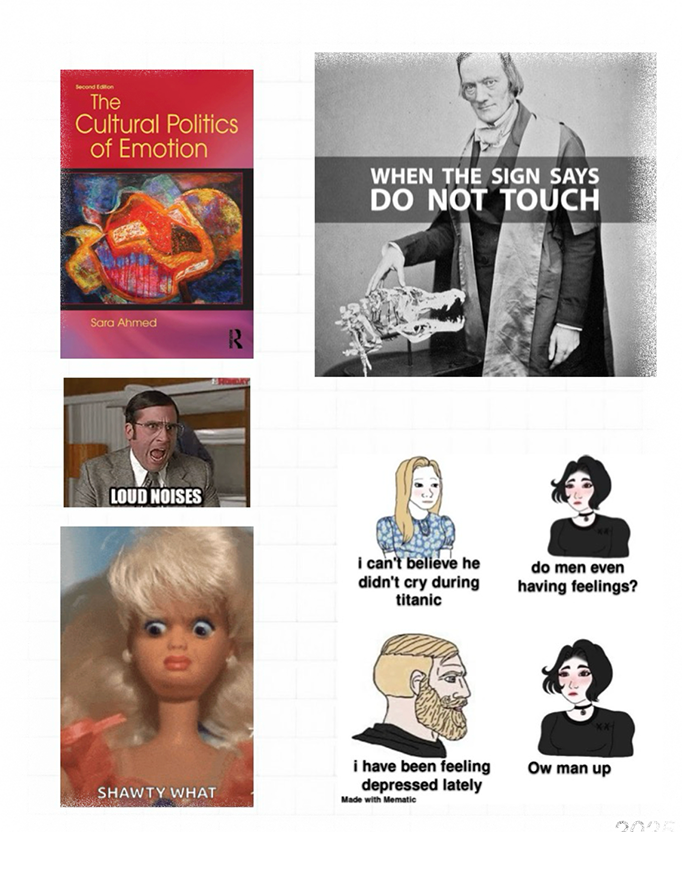
Conference Lecture

Zine, Drawings + Essay
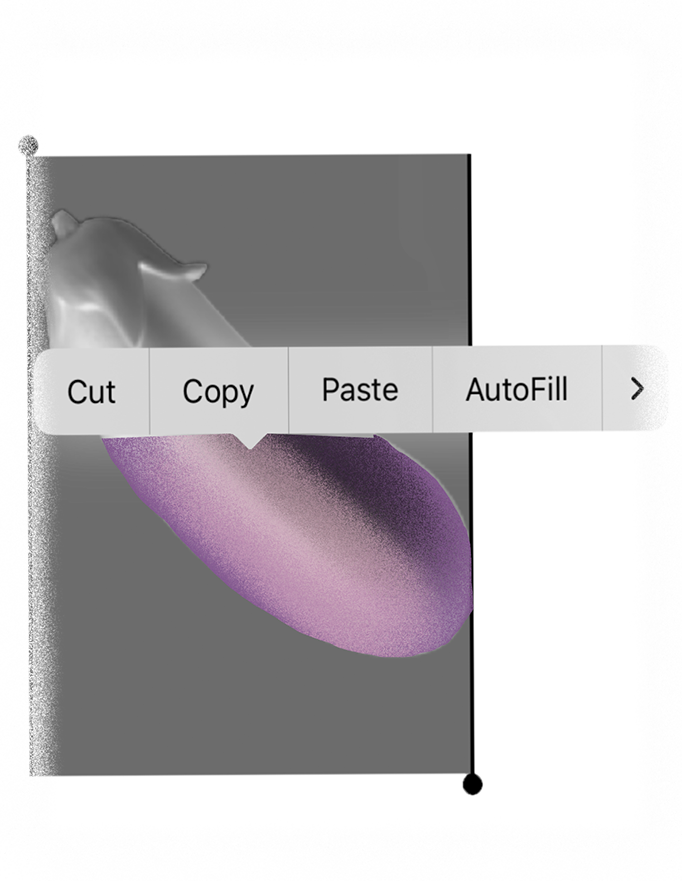
Essay, sample of MA Thesis
Duck
poetry
duck
fuck
motherfucker
mother fucker
The shame of fucking mothers
mother fucking fuckers
do they fuck your mother
do they fuck their mother
do they fuck a mother
do they fuck the mother of their child
do they fuck another mother
do they fuck mothers
does the fucking hurt
does the fucking fuck tender
motherfucker
no matter
mothers fuck
The Purge
poetry
I watch the Purge to purge
myself
anarchy cries
tires squeal
I see my old apartment
skull woke the wind
the wind woke the anger
in my Lexapro nothing
what were you doing outside?
feels like the curfews and quarantines
running red lights
running mouths
running hot

liquor dripping thick
wax hearts into heavy stomachs
weighing down
run! motherfucking run!
bullets
ran away from me
through the heart
of our fire
together we scream
run motherfucker!
as the gun stays locked
safe
in the box I dont know the code of
safe from me for you for all of us
to keep us safe
Soft Images: toward a less certain penis
irl lecture
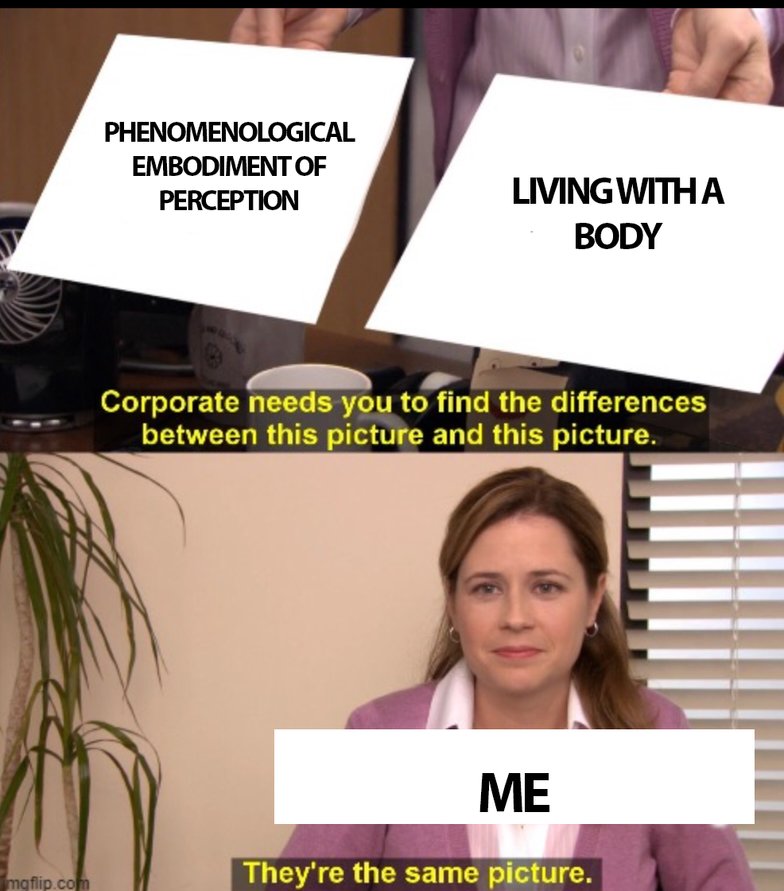
Fleshly bodies are in a constant state of slippage and glitch. They refuse to be simple or easy to label, define, represent, or symbolize. As soon as we give them shape, color, or language, nuance and complexity are erased—assumptions are assigned.
This is accelerated by the rapid transmission and algorithmic reward for images that are easily legible and quickly interpreted.
These systems don’t just circulate meaning—they construct it.
But like bodies, and everything really, this generates feedback loops. Assumptions and flattened understandings slip and leak back into our fleshly, corporeal bodies. We are moved and oriented—how we speak, write, make images, and engage with others is shaped by these mediated constructions.

Today, and many days frankly, I’m looking at how this process constructs one body part in particular: the penis.
My work professionally and academically is in excavating and unearthing assumptions of the body that I—and we—adopt culturally, especially in the US.
By default, this has meant working through media studies, because our phenomenologies of perception are so deeply entangled with the near-constant perceptual visual and sound mediations we engage with.
These interpretations become lived in our bodies and spill outward—into texts between friends, Instagram comments, drawings in margins, textbooks, and, often unfortunately, our medical practices and policies.
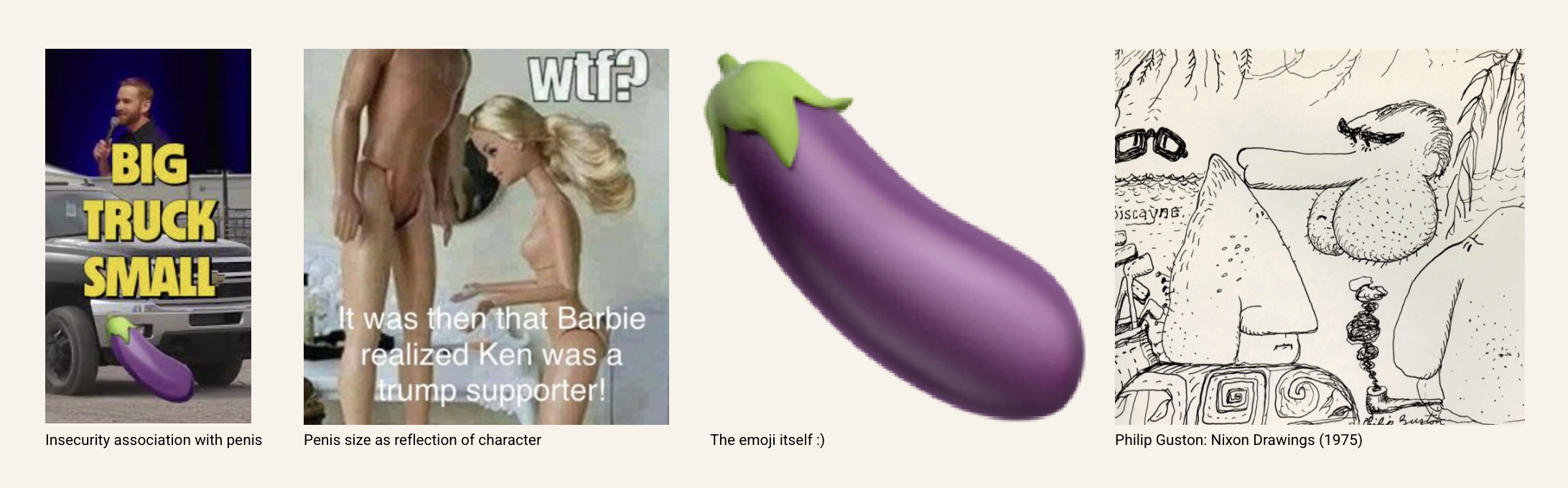
I’ve become particularly interested in the penis—not as a Freudian Phallus, but as a body part that has been fragmented from the body, that it has a life of its own.
We often encounter the penis as a symbol before—or instead of—its fleshly origin.
Instead of flesh made of blood and skin, it becomes an eggplant emoji, communicating thirst or jokes.
It becomes shorthand for misogyny on subway walls, or in art. (This one by Pussyfoot)
An unsolicited Dick Pic on our phones, a tool of power play.
It becomes a tool of ridicule in political cartoons and in our everyday colloquialisms.
Its representations are employed as tools that communicate broader ideas rather than communicating the actual body part.
Perhaps the most entrenched symbolic construction is the penis as a primary tool and communicator of violence, domination, and rape.
Nicholas Mirzoeff, drawing on Sarah Deer, writes that rape can function as a metaphor for colonialism—but is also an everyday practice of racial capitalism.
In this context, the Phallus is not just anatomy—it is the penis within a structure of violence.
But this symbolic weight expands outward into how we interpret sex and nudity more broadly.
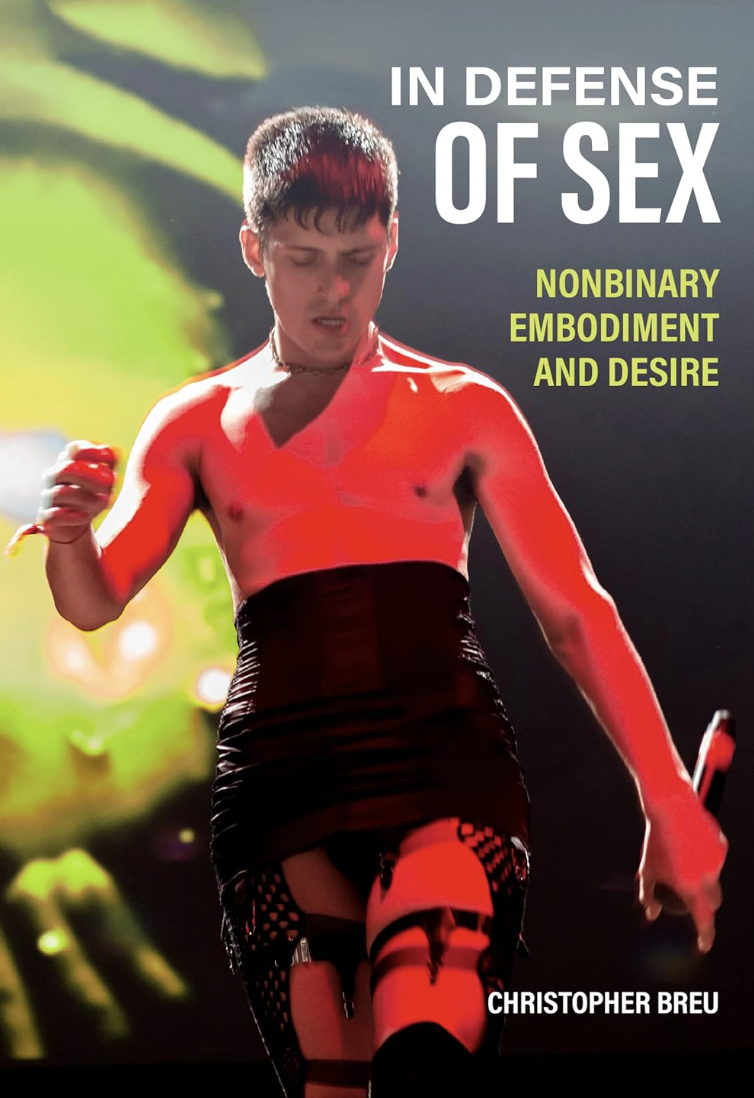
In In Defense of Sex, Christopher Breu describes a cultural condition in which even nudity itself becomes potentially traumatizing—where the presence of the body is already read through the possibility of harm.
Christopher states that not only is sex now associative with trauma, but “Nudity itself has now become potentially traumatizing. I am not talking about the obviously aggressive and intentionally traumatizing actions that fall under the category of indecent exposure. We live in a culture where sexual violence and the straight, cis, male control of public space, through acts of symbolic and physical violence, are still much too prevalent. However, I am talking about the way in which even animal nudity is regularly blurred out on Facebook posts or moments in which the panopoly of meanings attaching to the artistic display of nudity or scanty dress gets read as de facto traumatizing...”

The example that Christopher gives is of Tony Matelli’s sculpture “Sleepwalker,” a figure of a presumed man clad only in underwear, one they describe as “vulnerable and older.” The lifelike sculpture was placed on a college campus and was taken down due to folks interpreting it as trauma-inducing.
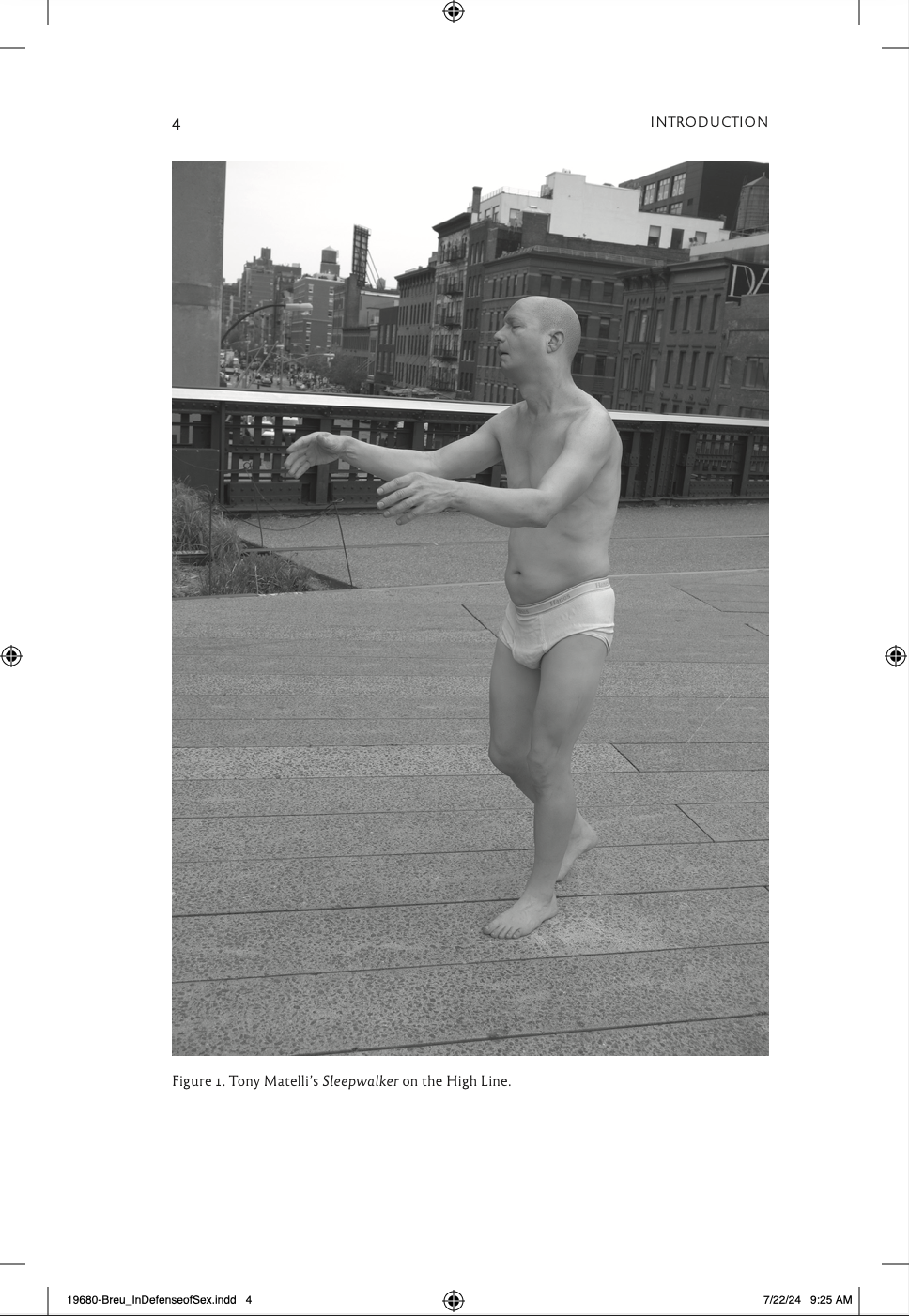
Institutional organizers likely would not, and do not, receive accounts of the countless nude sculptures and images of female coded (ie breasted and with vaginal genitalia) as traumatizing. We see it everywhere. This distinction is missed, or at least not explicitly stated, in Christopher's assessment. It is the penis, even a sculpted penis, hidden behind sculpted underwear, in a vulnerable position, that is considered Phallic. In this, It is not just a covered penis, but a slyly hidden symbol of innate sexual White non-trans male violence.
Even when it is not acting, not visible, or even concealed, the thought penis is still read through this symbolic frame.
Even the penis in representations of vulnerability are read as threat.
We need to return to the body as a neutral site.
No body part is inherently moral.
No body part is inherently violent.
It is flesh—benign, variable, contingent, and attached to very real and variety of humans.
One of the most harmful effects of this symbolic construction is the essentialization of the penis that is innate in these framings.
In shaming it, fearing it, and equating it with rape and violence, we:
erase or shame intersex bodies
erase trans women who keep their penis, by choice or circumstance
shame trans masculine people who pack or want to pack [INSERT PIC}
reinforce racialized stereotypes, like those of Black men
and also often mistakenly attribute power where there less (ie - a gay black man with a penis, is often going to be more oppressed than a white woman without a penis)
These symbolic constructions of the penis assume a stable, non-trans body—and often racialize that body in contradictory and harmful ways.
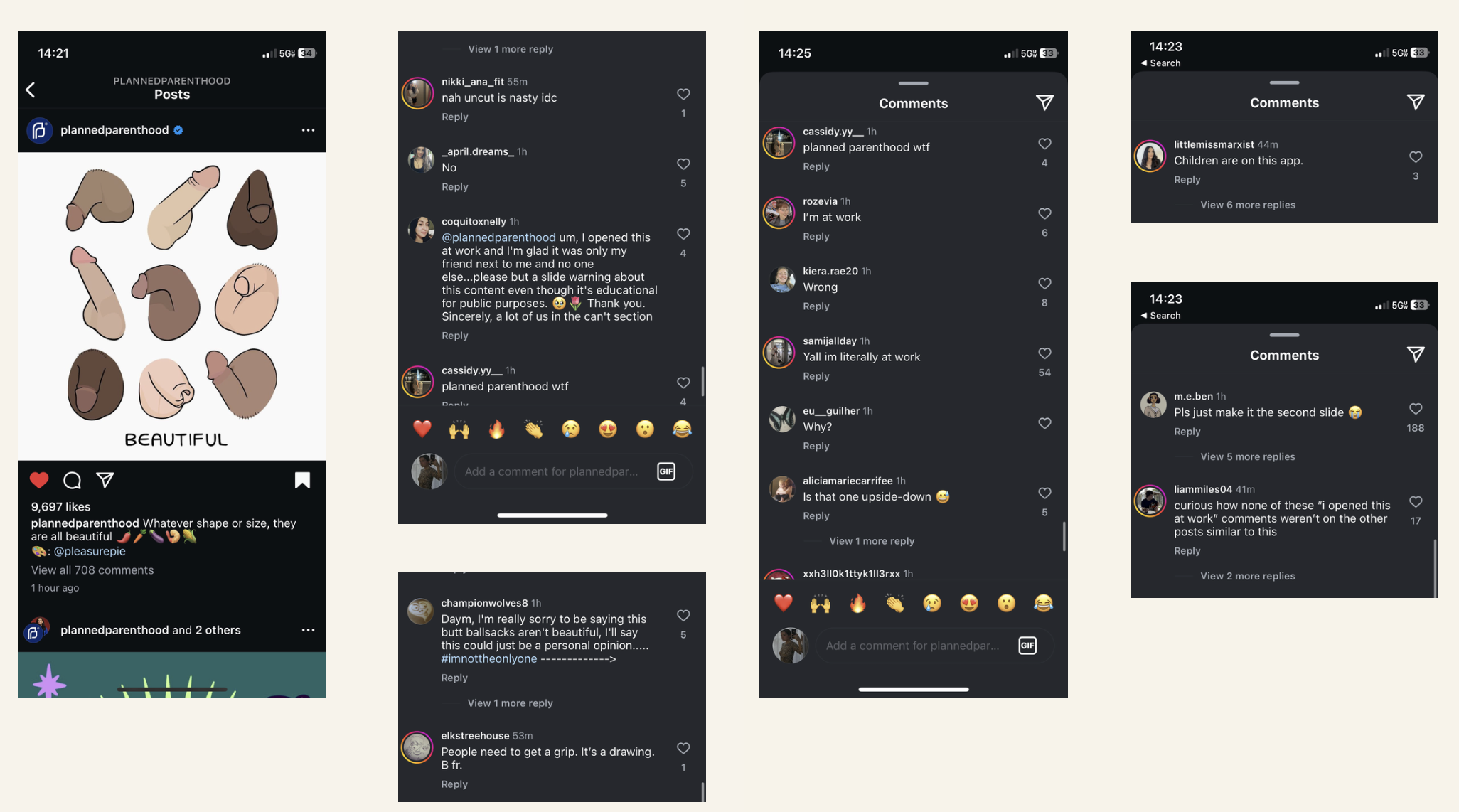
These instagram comments, taking offense at cartoon penises, often calling them gross, are talking about real people. Disgust of others bodies should never be accepted. Especially under the guise of feminism, fighting racial patriarchal capitalism too important.
A friend recently asked me how one makes the penis non-phallic.

And the answer is actually quite simple:
The penis is not phallic most of the time.
It is made phallic.
It most often exists as soft, flaccid, non-performative.
An erect penis is not the norm—but generally brief moments, as millions in research for things like viagra can attest.
To see the penis as non-phallic, we have to stop attributing fixed meaning to it.
We are assuming:
that the penis belongs to a non-trans person
that the penis perpetrates harm, rather than sometimes being a vehicle and subject within systems of harm
that it carries stable racial meaning in the context of cisness
that it is erect, or capable of staying erect
that body shaming constitutes critique
This part becomes a little dense. But I’m going to provide a bibliography for those who are interested.
These assumptions rely on a broader framework of how we understand bodies, gender, and power.
And Marquis Bey reminds us that cisness is not neutral—it is historically structured through whiteness. What we expect in cisness is most often a White cisness. (Define his framework)
Black bodies, through the violence of the transatlantic slave trade and its afterlives, have been both hypersexualized and quite literally ungendered and denied gender/sex—positioned differently within these relational frameworks of power. (Reference whatsherface black on both sides)
Building on this, Perry Zurn proposes the term “non-trans” instead of “cisgender,” as “cisgender” itself reinforces a binary that erases intersex and other non-normative experiences. (Explain this)
I want to mention Emma Heaney’s concept of penetration as a way to think through this differently. I know the phrasing sounds a little aggressive, but conceptually it works. (Explain this/ define the phrase)
Heaney uses the term penetration not as a literal act, but as a conceptual process for understanding hierarchy and relationality.
Within this framework, bodies are not fixed as identities cis and non cis or male and female, but are positioned in relation— a network of
as penetrated and penetrator. If you’re interested in learning - she has a book called Feminisms against cisness which is free online.
It unsettles the assumed coherence of assumption of cisness, which relies on fixed, binary, and stable bodies.
So when we talk about the penis as symbol, and more importantly, when we use it as such and embrace it, we are not just talking about a body part—
we are also embracing a set of assumptions we ourselves are making, built on unstable, racialized, and historically constructed categories of gender and power.
Reclamation of the penis does not mean ignoring harm or rape.
It means speaking about harm without collapsing it into a body part.
It means understanding that violence does not live in the penis itself, but in the systems, structures, and contexts in which it operates esp with non trans white men in patriarchies.
A reclamation might look like assuming a penis:
that is non-cis, non-gendered, racially expansive, and often flaccid.
This is not a minimizing of harm—it is a more precise account of where harm actually lives, and an embodied acceptance for a variety of ways of living with a body, including a penised one.
We must collectively reckon with how often we essentialize and flatten bodies—including bodies with penises.
What this looks like in practice:
physically drawing or looking what makes us uncomfortable (not shying away from it in museums, public spaces, looking at ones own or partners body)
wearing brands like Carne Bollente that embrace penises
shifting language away from “big dick energy” or “small dick energy”
engaging representations that complicate rather than reinforce
In my work, I’ve done this a few ways…
Figuring Flesh workshops
Workshops where drawing becomes a method for slowing down perception and collectively unpacking the assumptions we place onto bodies.
The Nude (but male-ish)
An ongoing project of nude portraits, anonymous interviews, and multidisciplinary works that reframe the penis outside of fixed identities and symbolic expectations.
@theproblempen_s (Instagram)
An archive of penis imagery encountered in everyday life that tracks how the penis circulates as symbol across casual, digital, and social spaces.
Photographing every penis in the Met (ongoing)
An ongoing study of how the penis has historically been represented in art, approached as a form of social and visual relearning.
If the penis has been constructed as a symbols for misogyny and violence, then it can be constructed otherwise.
And that work begins by returning it to flesh, a flesh that belongs to bodies that glitch.
Bibliography + Recs
Ahmed, Sara. Queer Phenomenology: Orientations, Objects, Others. Durham: Duke University Press, 2006.
Berlant, Lauren. Desire/Love. Brooklyn: Dead Letter Office / Punctum Books, 2012.
Beu, Marquis. Cistem Failure: Essays on Blackness and Cisgender. Durham: Duke University Press, 2022.
Breu, Christopher. In Defense of Sex: Nonbinary Embodiment and Desire. New York: Fordham University Press, 2024.
Cotten, Trystan T., ed. Hung Jury: Testimonies of Genital Surgery by Transsexual Men. Oakland: Transgress Press, 2012.
Deer, Sarah. The Beginning and End of Rape: Confronting Sexual Violence in Native America. Minneapolis: University of Minnesota Press, 2015.
Freud, Sigmund. "The Infantile Genital Organization (An Interpolation into the Theory of Sexuality)." 1923. In The Standard Edition of the Complete Psychological Works of Sigmund Freud, vol. 19, translated and edited by James Strachey, 141–148. London: Hogarth Press, 1961.
Gleeson, Juliana. Hermaphrodite Logic: A History of Intersex Liberation. London: Verso Books, 2025.
Grosz, Elizabeth. Volatile Bodies: Toward a Corporeal Feminism. Bloomington: Indiana University Press, 1994.
Heaney, Emma, ed. Feminism Against Cisness. Durham: Duke University Press, 2024.
Merleau-Ponty, Maurice. Phenomenology of Perception. 1945. Translated by Donald A. Landes. London: Routledge, 2012.
Mirzoeff, Nicholas. White Sight: Visual Politics and Practices of Whiteness. Cambridge: MIT Press, 2023.
Russell, Legacy. Glitch Feminism: A Manifesto. London: Verso Books, 2020.
Snorton, C. Riley. Black on Both Sides: A Racial History of Trans Identity. Minneapolis: University of Minnesota Press, 2017.
Spillers, Hortense J. "Mama's Baby, Papa's Maybe: An American Grammar Book." Diacritics 17, no. 2 (1987): 65–81.
Steyerl, Hito. "In Defense of the Poor Image." e-flux 10 (November 2009). https://www.e-flux.com/journal/10/61362/in-defense-of-the-poor-image/. Also collected in The Wretched of the Screen. Berlin: Sternberg Press, 2012.
Zurn, Perry. Cisgender: Disorienting a Category. Durham: Duke University Press, forthcoming 2026.
Muted Spaces, Resonant Bodies
irl lecture, essay
Sound In Museums Conference - 2025 - Mafra, Portugal -
Sound In Museums Conference - 2025 - Mafra, Portugal -
Curated Bodily Wrongness
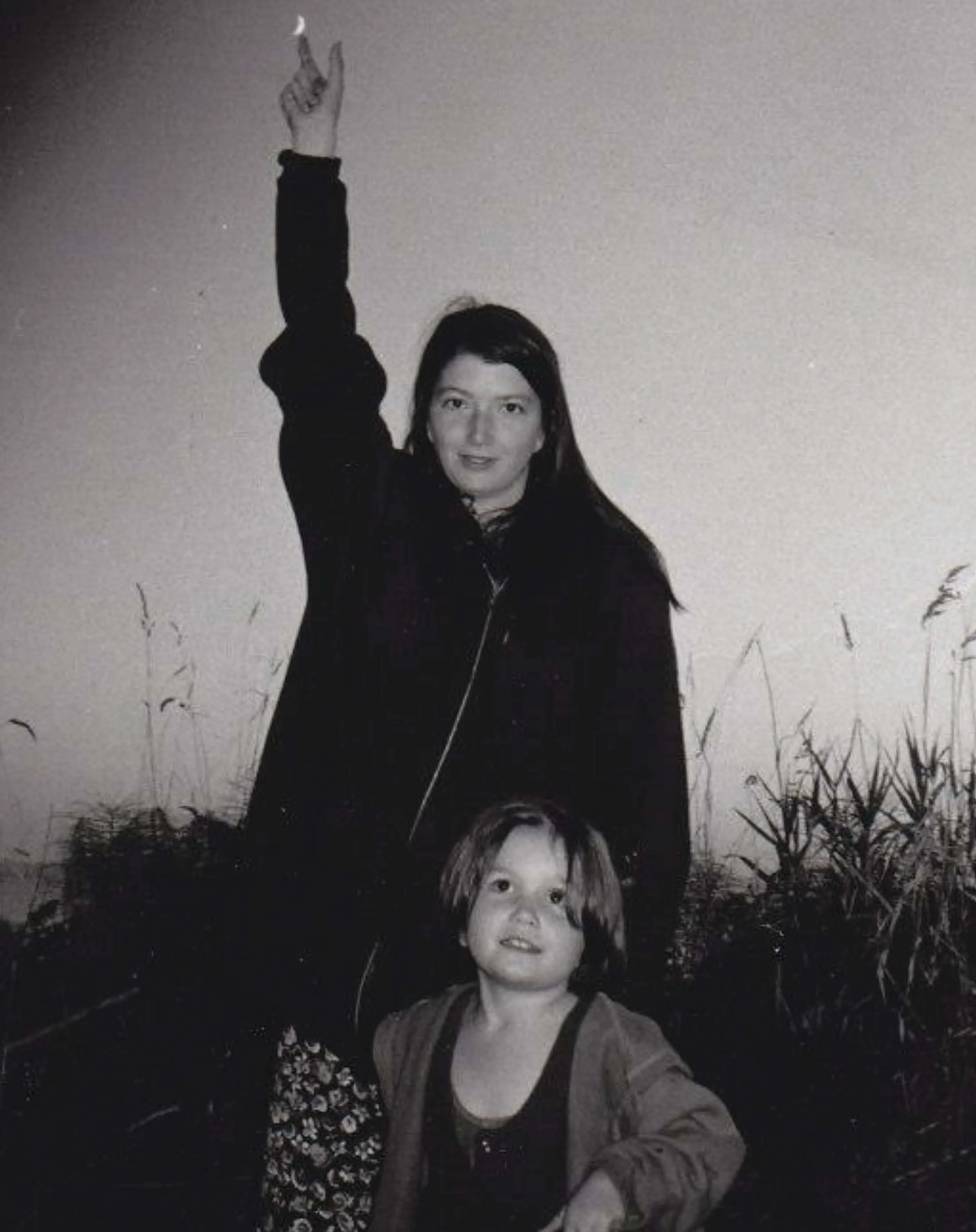
There was a time not long ago, before my mom and I knew we were autistic. A time before we knew how trauma, Complex PTSD, and autism directed our bodies a little differently than those around us.
I now understand how we stand is a little too close to the art on the walls. How when we speak it's a little too soft. And that I shut the door a little too heavily. How our desire to touch can precede the asked-for preservation of materials. How we laugh a little too loud, or whisper at just the wrong time.
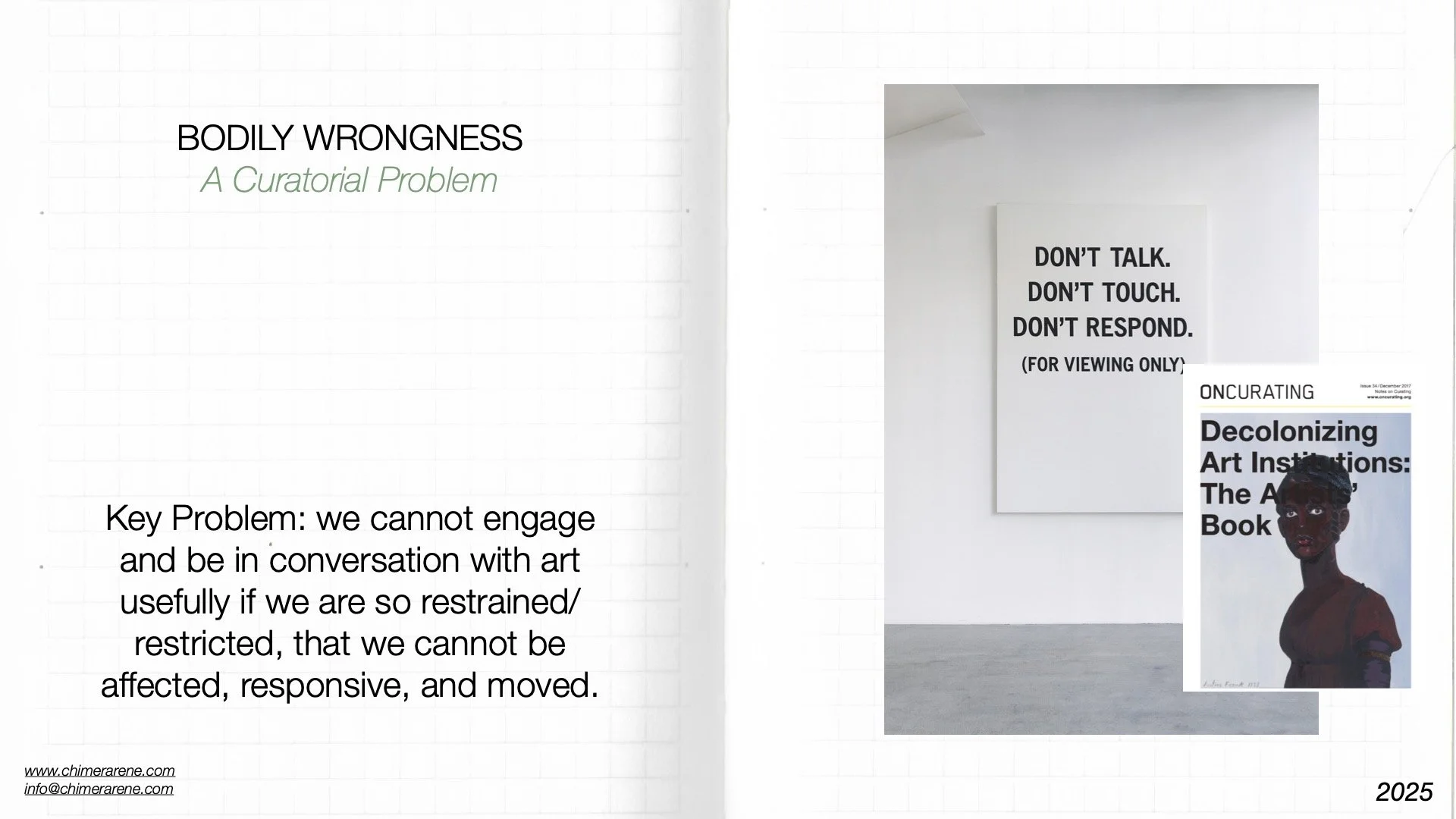
We could feel the wrongness of our bodies in space and time, a wrongness that extends and is felt by so many in their own bodies in various ways. This wrongness is especially pronounced in art exhibition spaces: an issue of curation and institutional expectation. The particular strength of expectations of "rightness" in exhibition spaces makes this wrongness exist in the many, not just my mom and I.
This discomfort is so widely experienced that it becomes a primary focus in "Decolonizing Art Institutions: the Artists Book" (issue 34 of On Curating). In describing her experience at Lina Bo Bardi's Museo de Arte de São Paulo, Maria Thereza Alves explains how her mother was terrified to enter—certain the guards would shout at them to leave, dragging her feet even after they'd bought tickets, whispering that they wouldn't be allowed inside. The fear of public embarrassment, of not belonging, held her back even at the threshold.
It's a feeling so many of us are familiar with in art curatorial spaces. Of feeling like we don't belong. It is readily apparent that this is because of classist, elitist expectations. What I think is less noted is the specific tangibilities in which this becomes apparent, and that's what I will be addressing today.
Giovanna Bragaglia asks: "Museums have, or at least should have, very different aims; however, how can they continue using the same structure as before? There is a need to rethink its nature as a social space, as a space of representation, observation, display, and regulation. How to build a place that people are not afraid of? How to engage people to be part of it? In order to make contemporary art more open to the world, perhaps the solution is to try to transform it into a home, where visitors and artists are not received as numbers or even guests, but in a place that they can feel at home."
While I share many of the same questions, I don't particularly desire to make it home. It assumes too much about home and comfort, and assumes too little of non-private and public spaces as inherently uncomfortable. It is for this reason I point to bodily wrongness versus discomfort. Many growings and learnings are deeply uncomfortable. So instead, I ask: how can we create these spaces to be ones in which we can engage art? And we cannot engage art if we are so restrained, so restricted, that we cannot be affected, responsive, and moved.
Art as Movement - An Emotive Force
I used to dread entering these spaces. Not because of their starkness, but because of how watched I felt, how restricted. Body physically tightening.
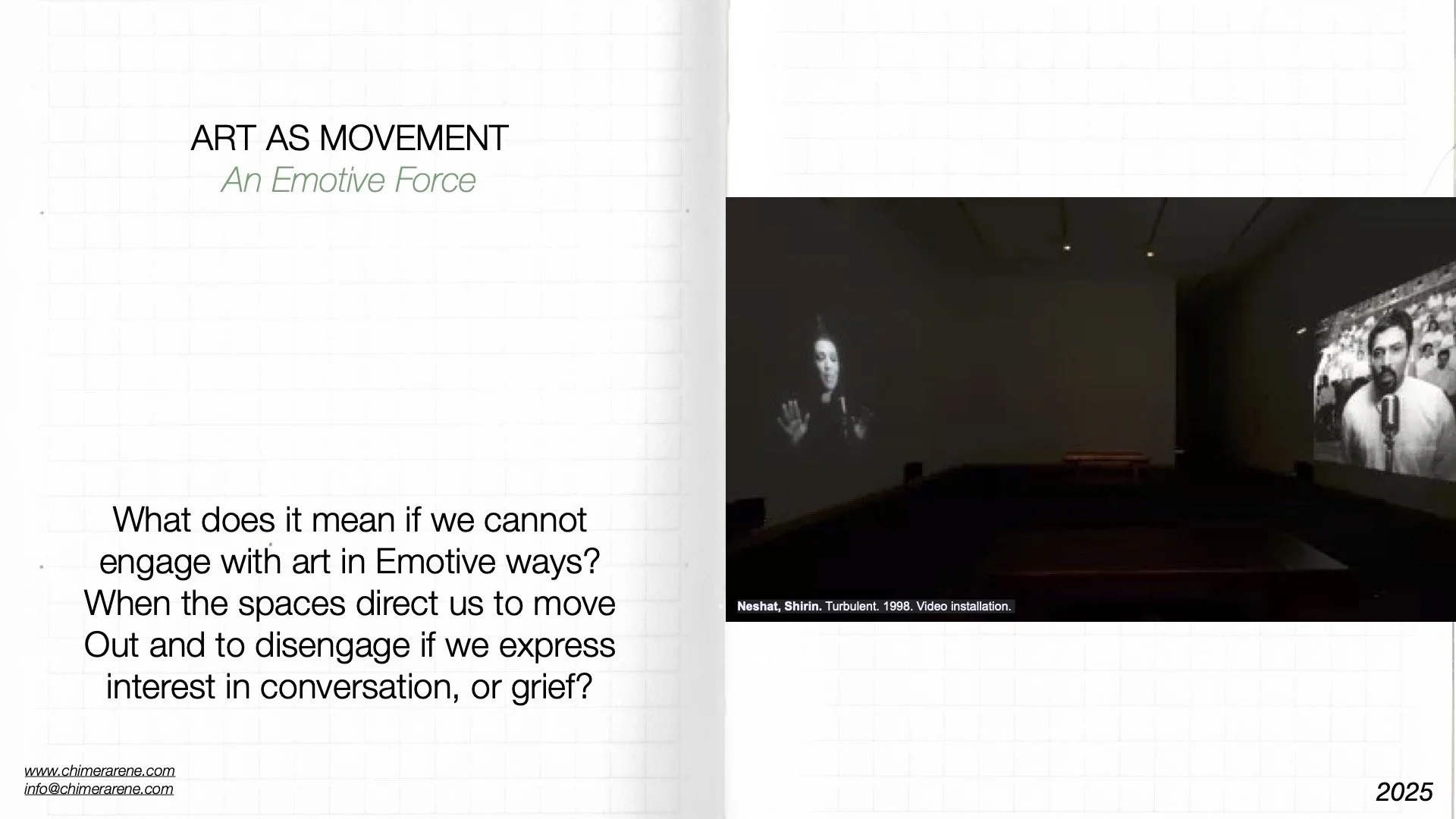
A particularly memorable moment: many years ago, my body crumpled in uncontrollable, body-vibrating sobs, echoing the cries of the song sung in Shirin Neshat's Turbulent. The screens and screams cocooned me in a dark museum room, eliciting immense grief. I later learned this was a PTSD response that the work had triggered.
I am deeply grateful to this terrifying experience. Grateful because it shifted grief that had stoppered inside for so long that I now will spend the rest of my life uncovering it. I was physiologically impacted by this emotional and emotive experience.
But I was not only moved to uncover grief—I was also moved, externally re-oriented, by the pressures of the institutional space. At The Broad, though it is not specific to just this institution, I turned away from the artwork and fled.
What is art but an empty aesthetic object if when it speaks to us, we cannot respond? If we are embarrassed? An emotive body can be silent, struck with awe. But it can also make sound. Sobs.
Art is like the tides in that it moves us, lifts us, and takes us with it. An outside force often outside of our control. The stifling hums of our vagus nerve, the squeaking pacing steps—the way we have constricted our museum spaces is in resistance to our own metronomic tides.
We need to create embodied curations that allow the tides to move us. In order to do this, we need to prioritize other forms of engaging art beyond the silent gaze. While there is use for silence at times, the decibel level in many museums—particularly in NYC—is that of a scream held in.
The tides move us in waves, rocking us to and fro in the rhythms we use to soothe babies, the paths our feet walk when we pace. My mom does this already. Her feet tap in rhythms. It does not stop when she sleeps, which as a nervous child would drive me crazy.
But First: What Is Art?
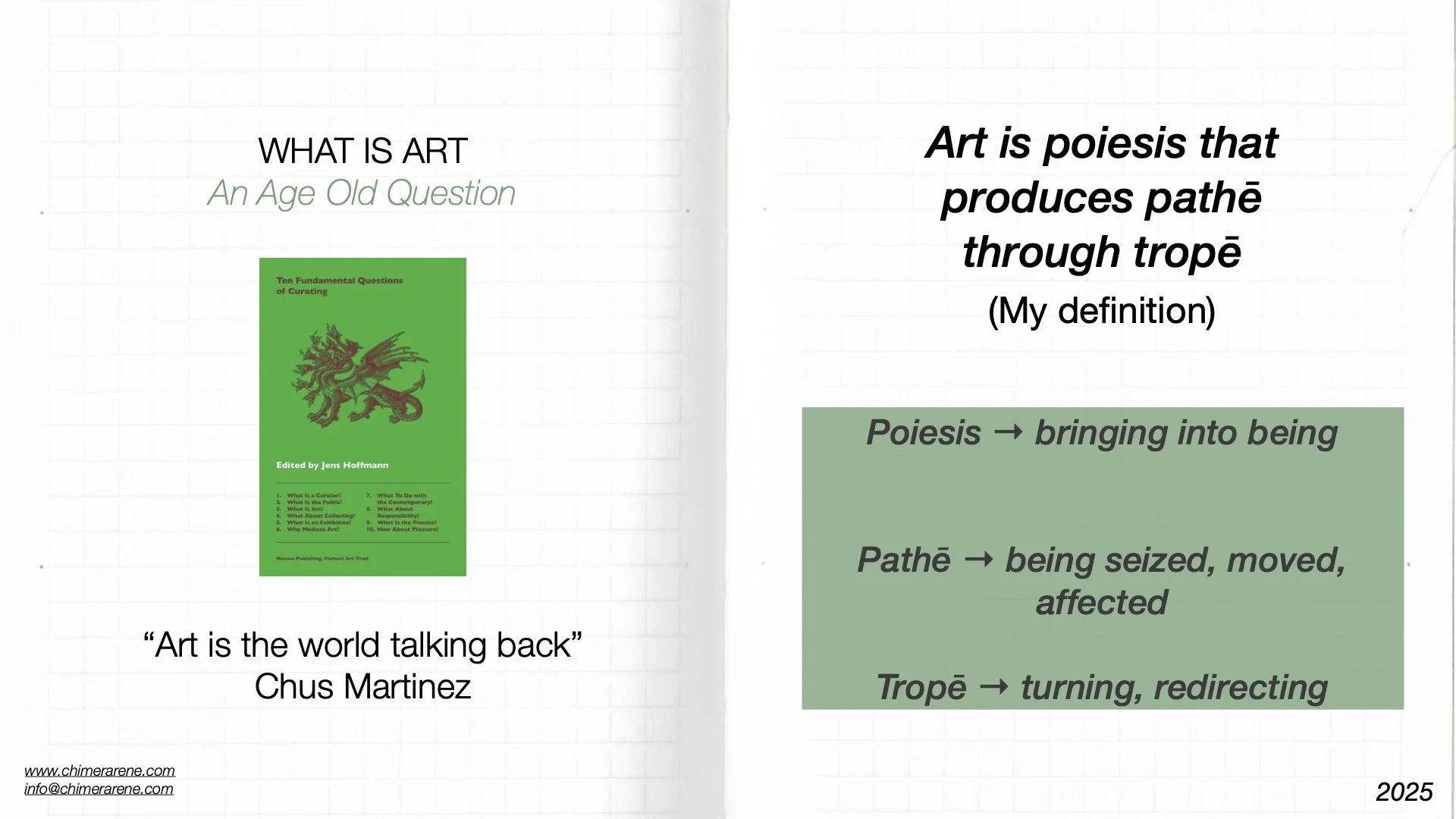
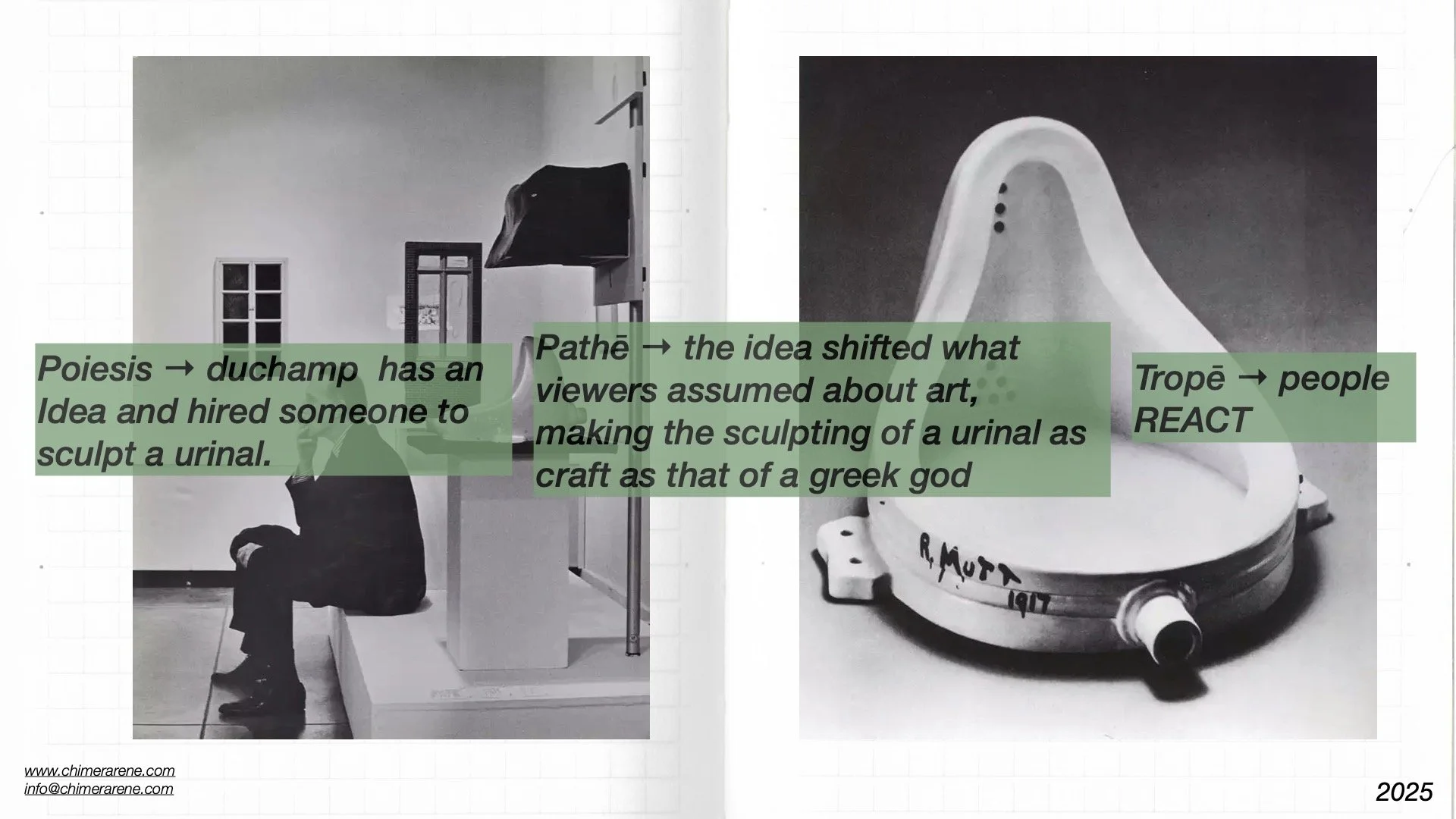
Art is defined by its relationship between (sorry greek terms, they dont exist in english) poiesis (POY-ES-ISS), pathos, and tropē. Art historically has been so hard to define because it is defined by a moving relational network. Art is poiesis (poy-es-iss) that produces pathē (PAH-thay) through tropē (TROH-pay).
In poiesis, something is brought into being—whether shared publicly or experienced privately, the essential act is one of making, of creation. Often this is done via "thinking through things," where language or thought alone fall short and something must be made. Artistic poiesis differs from mere craft in its orientation: it aims toward pathos, toward affecting the experiencer.
Pathē are not emotions we choose but states that seize us—bodily, visceral, involuntary responses to what stands before us. We are acted upon, moved, impressed. Yet the pathē (PAH-thay) of art aren't arbitrary sensations. They operate through tropē: art turns us, redirects our consciousness, reorients our understanding.
Where a utilitarian object—like my coffee mug I sit and drink from as I wrote this—confirms existing patterns (the mug delivers coffee as expected), art disrupts and redirects, though not always in constance. It is, like the tides, moving us. It uncovers what was hidden while simultaneously guiding us toward new territories of experience. Art, then, is making that which moves us by turning us—poiesis producing pathē through tropē.
A very clear example is Duchamp's urinal. Duchamp brings something into being—not by traditional making (sculpting, painting), but by selecting and recontextualizing. The act of signing "R. Mutt," the sculptor (as so many urinals are or were made), titling it Fountain, and submitting it to an exhibition is the creative gesture. The poiesis here is conceptual displacement.
Viewers undergo something visceral: the collision between "sacred or elite art space" and "hidden bathroom fixture" creates a bodily, intellectual jolt.
This is where Fountain becomes genuinely artistic rather than mere provocation. It turns your understanding—it reorients what counts as art, what counts as creation, where aesthetic value resides. You can't look at art the same way after encountering it. It redirects consciousness from "art = skilled handcraft producing beauty" toward "art = framing, context, concept, questioning." The urinal doesn't just shock—it pivots the entire discourse, makes you face a different direction.
"Art is the world talking back." (Chus Martinez in “What is Art” in Ten Fundamentals of Curating.
Emotive Ambient Sounds
The silences in most art exhibit spaces, curatorial spaces, museums, emphasize the sounds that are present. Stones caught in sneakers scrape across cement and wood floors. An old man's phone rings. His zipper unzipping as he scrambles—a little too slowly, albeit frantically—to silence it. Voices are hushed. Parents shush their children. People talk in whispers, always whispers. Ambient sounds outside of the art are stifled.
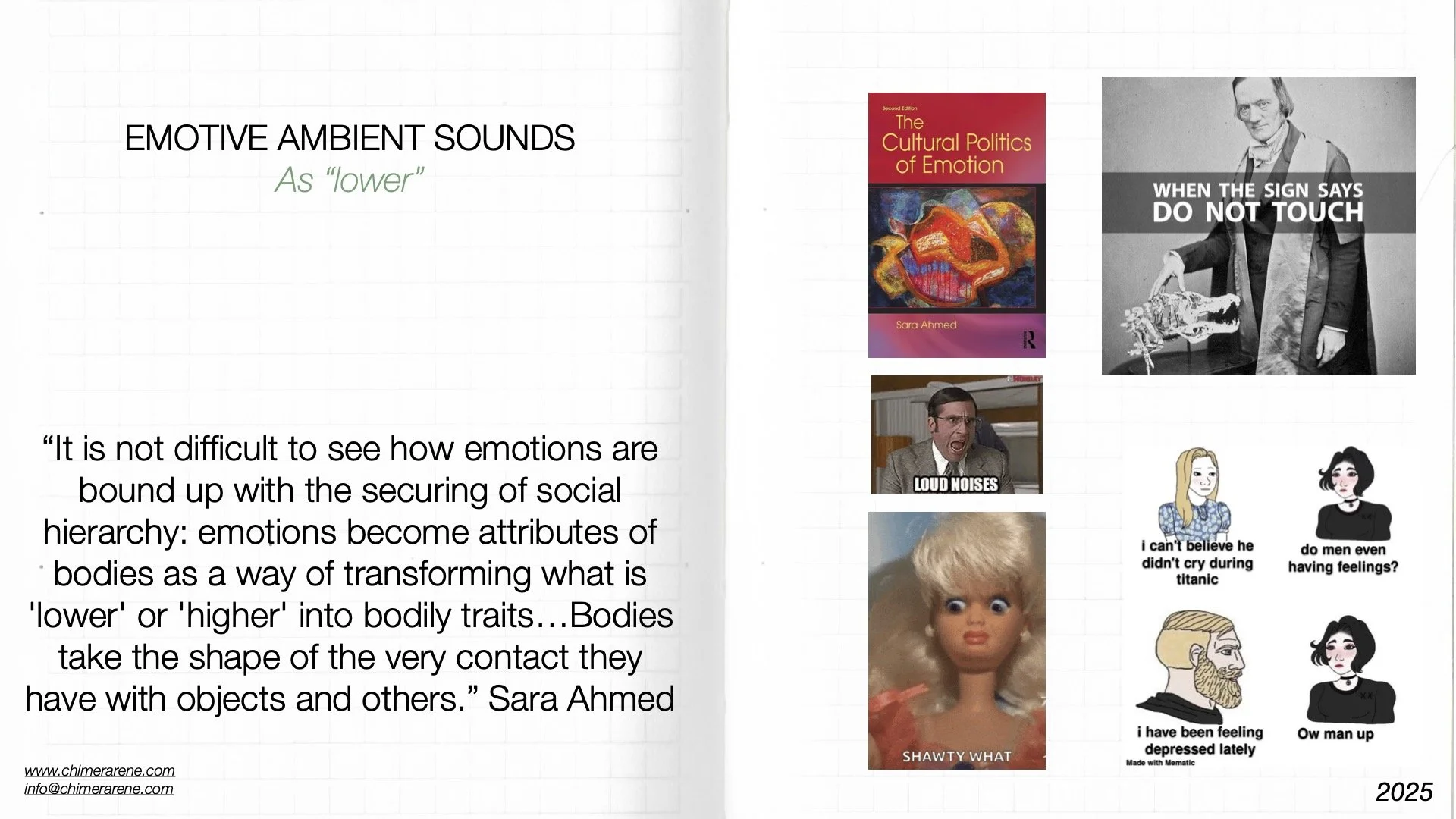
Sara Ahmed writes in The Cultural Politics of Emotions: "Emotions shape the very surfaces of bodies, which take shape through the repetition of actions over time, as well as through orientations towards and away from others."
My embodied response to Turbulent was an emotional one. The difference between a physiological and an emotional response is inextricable. The surface of my body was affected—pathē seized me. This is not only the flushed red as I cried or the scrunching of my face, but also the directional push to turn the surfaces of my body away. To turn. To stifle. Emotions are policed via social expectation.
Ahmed continues: "It is not difficult to see how emotions are bound up with the securing of social hierarchy: emotions become attributes of bodies as a way of transforming what is 'lower' or 'higher' into bodily traits... Bodies take the shape of the very contact they have with objects and others."
And we are terrified of the power this has—to unite, to divide, to motivate, to inspire. What if we emote anger, frustration, fear, grief, hysteria?
Emotive Ambient Sounds as "Lower"
The neutrality of so many curatorial spaces is, of course, not actually neutral. Sounds are often the most prominent signifiers of race, class, and gender in these rooms.
Emotions themselves are not neutral, just as the decibel from a Black American is interpreted as louder than that of a white American and a white american as louder than that of a White Frenchperson. It is not, of course, louder in any measured way. But it is perceived and symbolized as louder. So too are emotional expressions. Expressions of response to art—unless disdain, knowledge, prissiness, disgust, or stoicism—are generally, unless contained or private, considered lower than others. Unacceptable. Undesirable.
The Reverence of Sight
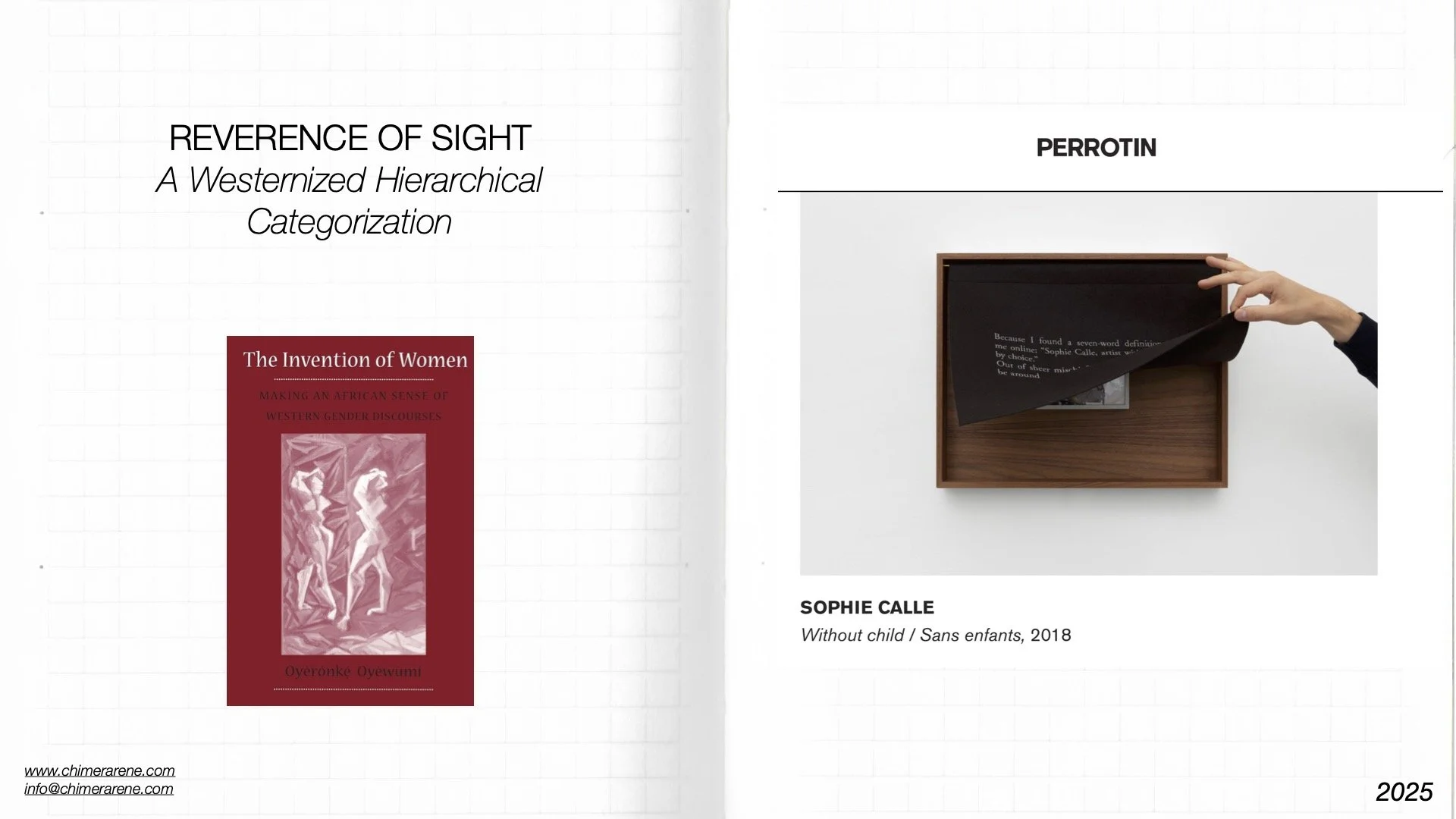
An epistemological foundation to our contemporary Western cultural knowing is categorization and therefore prioritization of sight. This Westernized epistemology has permeated academics worldwide. Oyèrónkẹ́ Oyěwùmí discusses this in her book The Invention of Women, in which she demonstrates that the category of "women" does not foundationally exist in Yoruba understanding. Even academic understanding of "third gender" is an imposition of categorical differentiation founded in our own social structuring rather than indigenous ones.
She writes: "The reason that the body has so much presence in the West is that the world is primarily perceived by sight. The differentiation of human bodies in terms of sex, skin color, and cranium size is a testament to the powers attributed to 'seeing.' The gaze is an invitation to differentiate. Different approaches to comprehending reality, then, suggest epistemological differences between societies."
This gaze extends to curation within exhibition spaces. Rather than engaging a multitude of senses, colloquially we go to museums to SEE. We "saw" the Mona Lisa, we saw Philip Guston at Hauser and Wirth. We do not smell, hear, taste, experience them.
And we certainly do not touch—perhaps the most heavily policed sense of all. Sophie Calle's Behind the Curtain offers a rare counter-example: viewers are invited to touch fabric to reveal what lies beneath. The work acknowledges that touch is part of knowing, part of being affected. Yet such invitations remain exceptional rather than foundational to how we design encounters with art.The 'Do Not Touch' sign is ubiquitous, understandable given preservation concerns, yet it further entrenches the primacy of the visual gaze. We are permitted only to look, as if sight alone could capture the full weight of art's capacity to affect us.
By limiting the other senses with false neutralities—for "no smell" is not neutral, “no vocalizations” are not neutral—a perspective, even in absences, is always on display. Our gaze becomes priority, eliminating the senses that may distract from it.
Alternate forms of exhibiting might not prioritize sight but a fuller bodymind experience, which might present very differently. There may be sound, conversation encouraged, gravelly footsteps, extensive seating—sporadic or gathered. Currently, we don't provide much seating, as we hope to allow for quicker flow, not wanting too much lingering, fearing that the space may crowd the art or each other. This is not merely aesthetic preference—it's economic logic. Museums operate under pressure to maximize throughput, to move bodies efficiently through space, to protect objects for insurance purposes, to satisfy donor expectations of order and decorum. The institutional forces that keep these spaces silent and restrictive are material, not just ideological.
It's important to distinguish between the sounds OF museums and the sounds IN museums. Sounds IN museums are curated, permitted, often literally piped in as part of artworks or audio guides. Sounds OF museums—the scrape of shoes, the whispered conversations, the bodies moving through space—are treated as noise to be minimized. This distinction reveals the power structure: institutions, and those generally White Bodies who fund them, control which sounds matter, which sounds mean, and which sounds must be suppressed. The visitor's body becomes an unwelcome sound source.
Unruly Sound: The Sonic Color Line
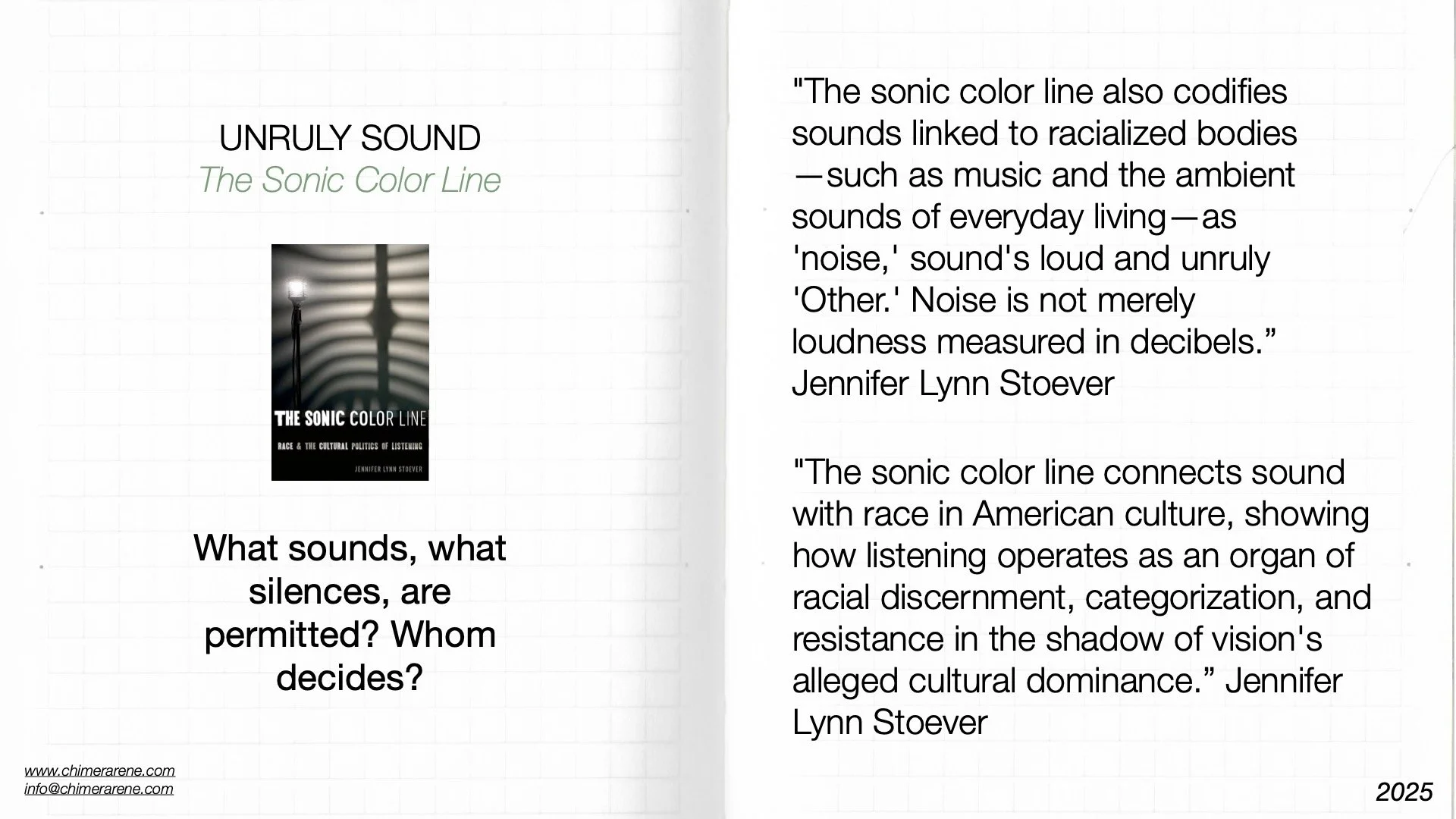
Noise is the "Other." We categorize "noise" as sound that is socially and culturally undesired. Jennifer Lynn Stoever describes in detail in The Sonic Color Line: "The sonic color line [also] codifies sounds linked to racialized bodies—such as music and the ambient sounds of everyday living—as 'noise,' sound is a loud and unruly 'Other.' Noise is not merely loudness measured in decibels."
Like weeds in a suburban American lawn, a beautiful yellow dandelion is undesired only because we have said so. It is just as beautiful as a rose, ecologically more nurturing of the soil, and edible. Laughter in a museum is only uncomfortable because we have made it so. We expect a visual reverence.
Sound, ambient noise in exhibition spaces—even laughter, tears, and conversation—are supposedly a distraction to our visual exploration and engagement. Sound draws our attention away from seeing and toward listening. Sound in museums becomes noise. And noise is not heard equally. A Black voice is unjustly heard as louder than a white one.
Stoever points out that "certain bodies are expected to produce, desire, and live amongst particular sounds." White bodies in particular expect silence, living in quieter neighborhoods, with soundproof walls, and a higher sense of the individual over the collective.
In a Westernized society in which visual categorizations remain hegemonically dominant, sound in particular becomes an unruly other, piercing the facade of civilization that rests so precariously on stacks of white canons and visual categorizations.
Noise becomes rap. It becomes laughter. It becomes whispers.
As amber jamilla musser writes: "Beyond its circulation in the sonic, noise is conceptually related to excess, abundance, and the unruly. Notably, these are terms that correlate closely with racist attempts to demean and police behavior (and, more often than not, mere existence) of people of color."
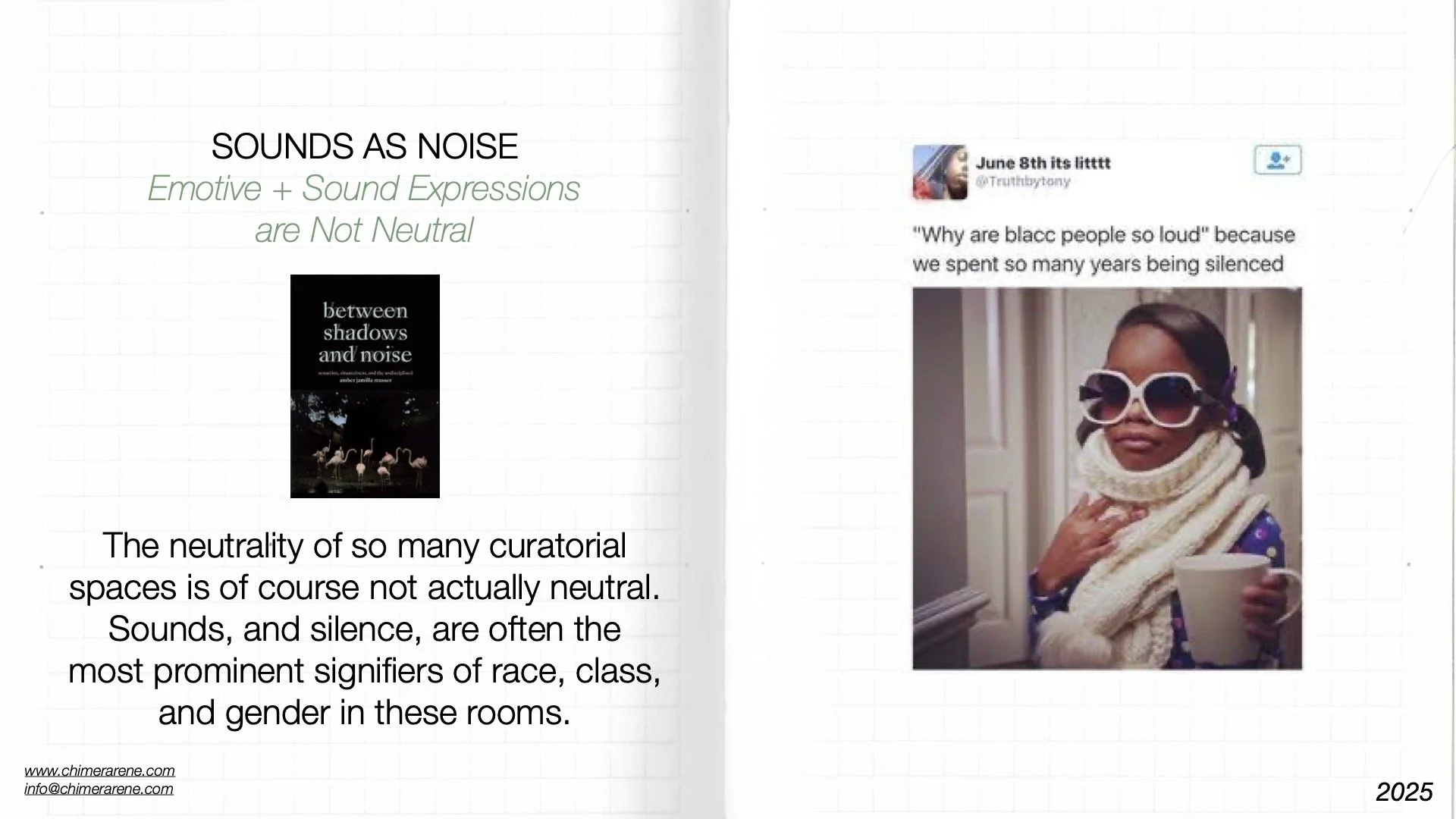
Art Moves—Movement Makes Sound
The sounds in the museum—those considered unruly or disruptive—are not only a cultural problem, but an institutional and curatorial issue. Expectations are not distributed equally. Noise becomes the monster that wakes us from the reveries of false normalcies and false neutralities.
The formation and purpose of exhibiting art has ebbed and flowed, and today through the practice of curation, art arranges artworks and their conditions of encounter. An exhibition space becomes a site for negotiating ideas and emotion—carried forward through art and artistic practices.
The conditions are as important as the art itself. Often, the conditions ontologically create art as itself and create our experience with it. Sometimes silence IS the reaction of our bodies, struck in awe. But what is needed is true permissioning—to bodily be with art. To allow its mobilizing, its destabilizing force. To allow pathē to operate through tropē.
Artists and curators increasingly occupy overlapping roles—many artists curate, many curators create. They share the work of creating conditions for encounter. Yet institutional pressures often override both artist intention and curatorial vision, defaulting to inherited conventions of silence and stillness.
Luca, presenting at this conference, uses the sounds of museum visitors themselves as tools of displacement - making audible what is usually suppressed, and in doing so, creating conditions where people feel more permitted to react. Notably, to me, he observes that the loudest moments in museums occur around children and around provocative works - moments when institutional control over bodily response temporarily falters, when pathē break through despite the architecture of silence.
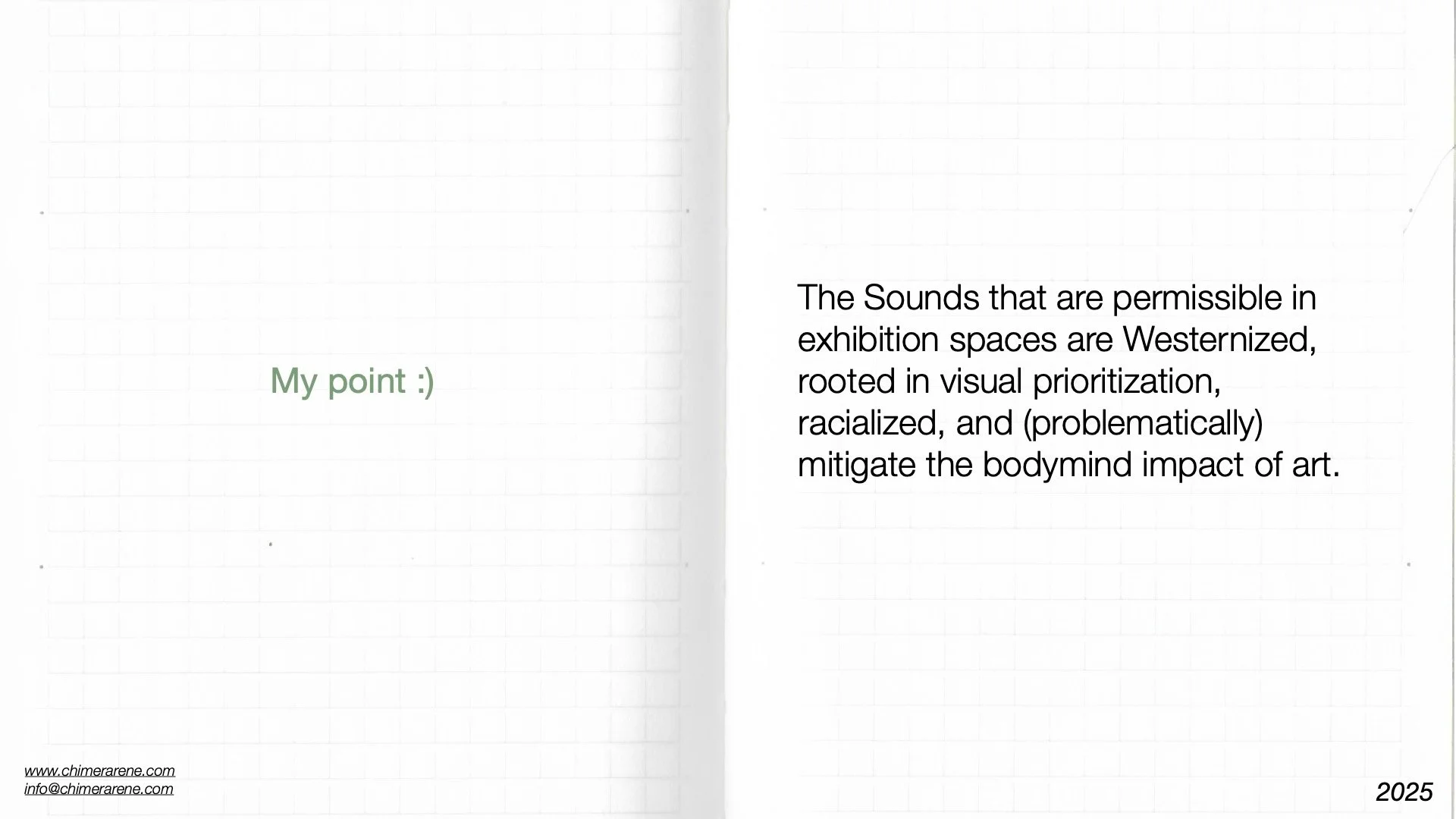
As queer theorist Paul B. Preciado claims, the body exists as a "living political archive" that contains cultural and political records, narratives, and flows of power and technology. It moves beyond the biological body to encompass the body as a site of biopolitical management, subjectification, and resistance, shaped by social, technological, and political forces.
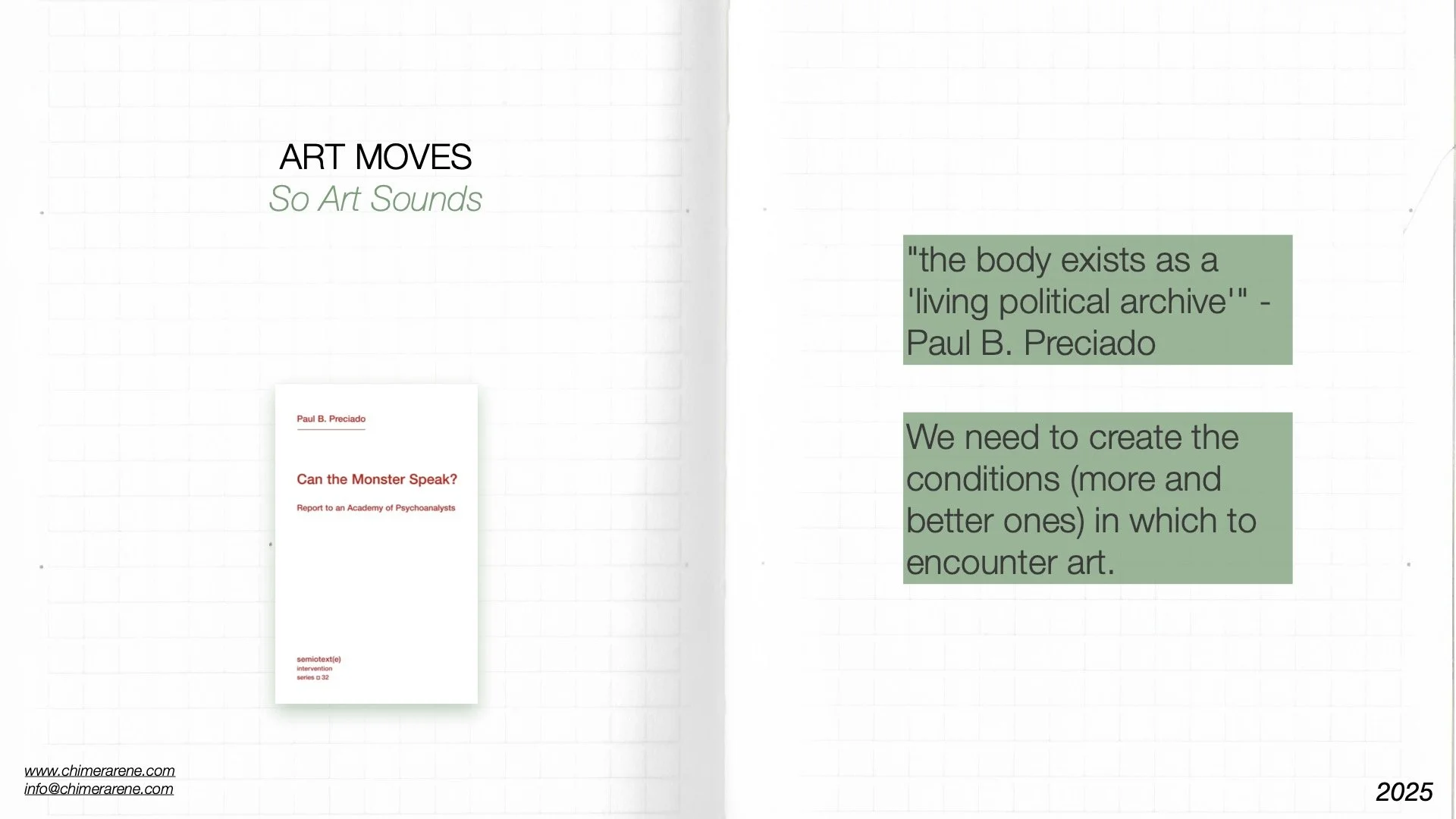
Successful Spaces
Fotografiska in NYC, before it closed, welcomed laughter and drink. Floors were carpeted blue and pink depending on the exhibit. And music played loudly for the [exhibit name], featuring a strip club in Atlanta.
I once heard a woman sharing with her child the history of the AIDS epidemic in the US during the Edges of Ailey exhibit at the Whitney Museum. This was somewhat facilitated by the loudness permitted by the curators because of his performances screened on the walls, with sound filling the entire floor.
Rirkrit Tiravanija's Untitled (Free) (1992) transformed 303 Gallery into a space where the artist cooked and served Thai curry to visitors. The work existed only in the eating, the conversation, the bodies gathered together. Sound, smell, taste, touch—all the senses suppressed in traditional exhibition—became the substance of the work itself.
Liu Chuang's Lithium Lake and Island of Polyphony II enveloped viewers for 58 minutes in layered sonic storytelling—demanding time, attention, and care. This temporal commitment runs counter to the throughput logic of most museums, but it's essential for the work to produce its pathē, its turning.
There are so many ways to do this.
Designated "responsive zones" where sound/movement are explicitly welcomed
Private zones made of fabric that create rooms and fluttering
Scent, permeating the spaces with coffee, tea, or rose oil
Varied acoustic environments within single exhibitions
Seating arrangements that encourage lingering/processing
Signage that explicitly gives permission rather than restrictionI think the disability aspect would distract.
Toward Embodied Curation
If art is poiesis that produces pathē through tropē—if art is making that moves us by turning us—then our curatorial spaces must allow for that movement, that turning, that being-affected.
The question is not whether museums should be silent or loud, sparse or abundant. The question is: can we create conditions where pathē are permitted? Where the involuntary, somatic, psychic responses that art produces in us are not policed into silence, not shamed into stillness?
This requires:
Acknowledging that "neutrality" is a fiction that serves particular bodies over others
Recognizing that sound, movement, and emotive response are not distractions from art but often the evidence that art is working—that tropē is occurring
Understanding that the sonic color line operates in our exhibition spaces, coding certain bodies and their responses as "noise"
Creating multiple modes of engagement beyond the privileged gaze
When my body crumpled before Turbulent, that was not a failure of museum etiquette. That was art doing what art does: producing pathē that reorient us, that turn us toward what we have yet to discover. The failure was in the institutional pressure that made me flee rather than stay with that turning.
We need spaces where:
A mother can whisper AIDS history to her child without shame
Laughter at the absurdity or joy in art is welcomed
Bodies can pace, stim, move in rhythm with what moves them
Silence can still exist—but as one option among many, not as a mandate
Art speaks. The question is: will we create spaces where we're permitted to speak back?
Not every space needs to be the same. But every space should ask: who does this serve? Whose bodies are made wrong here? And what might we be missing when we silence the very responses that signal art's power—its capacity to move us, to turn us, to remake us?
The work is not to make museums comfortable. The work is to make them permissive of the discomfort, the grief, the joy, the reorientation that art demands of us.
Let the tides move. Let pathē operate. Let tropē turn us.
And let our spaces—finally—make room for bodies responding to art, not just gazing at it.

The Acceleration of Digital Sags and Wrinkle Skin Pixels
irl lecture, essay
NYC Gender Symposium - 2025 - Gendered Bodies, Gendered Justice -
NYC Gender Symposium - 2025 - Gendered Bodies, Gendered Justice -
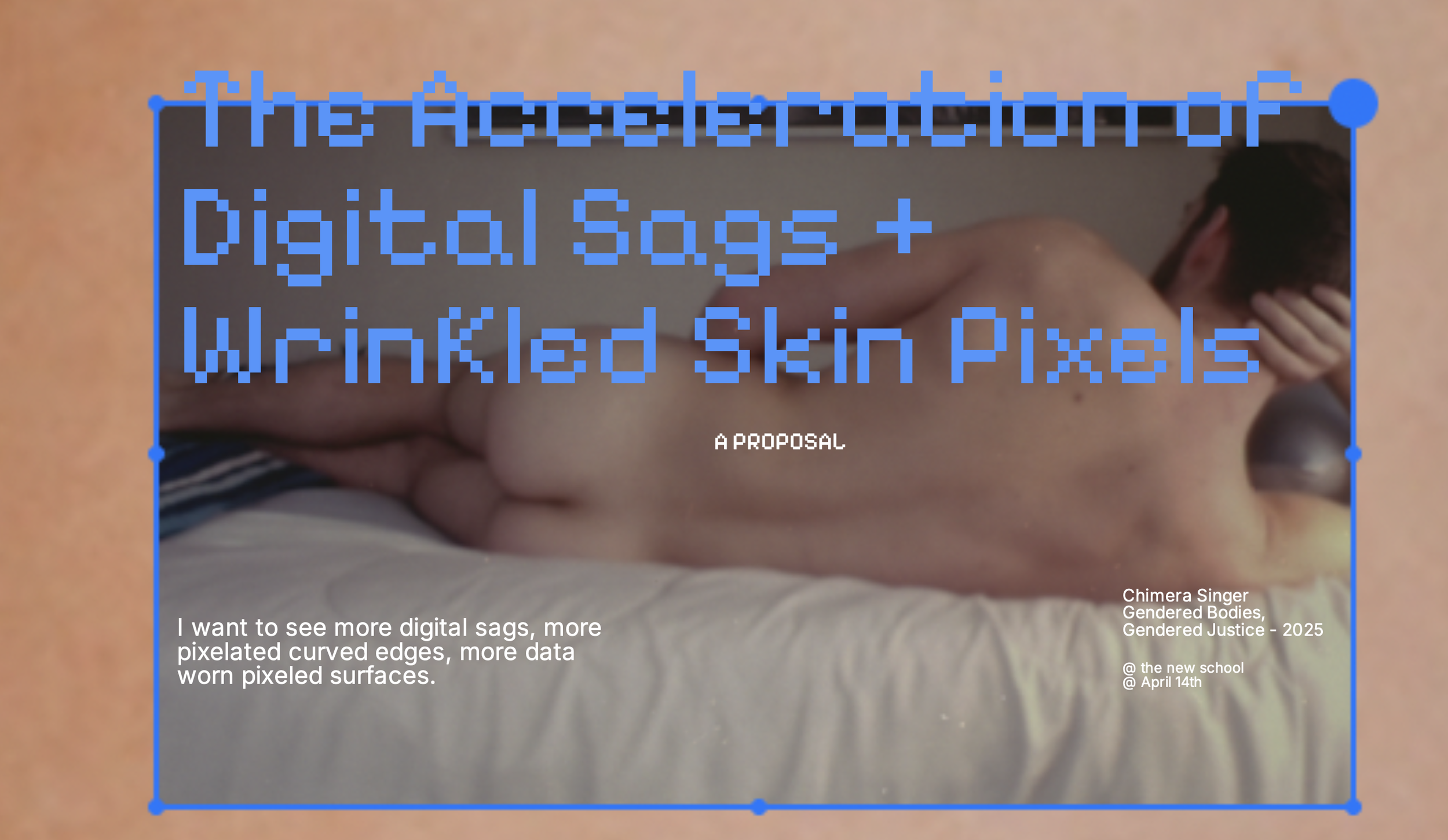
I want to see more digital sags, more pixelated curves edges, more data-worn pixel-surfaces.
I am in the business of seeing, making, and negotiating the image of bodies. I make album photos for musical artists, source material for pitch decks, outline and create websites, generate visual intimacies, scroll instagram, send TikToks, film shorts, and write about my curiosities and challenges.
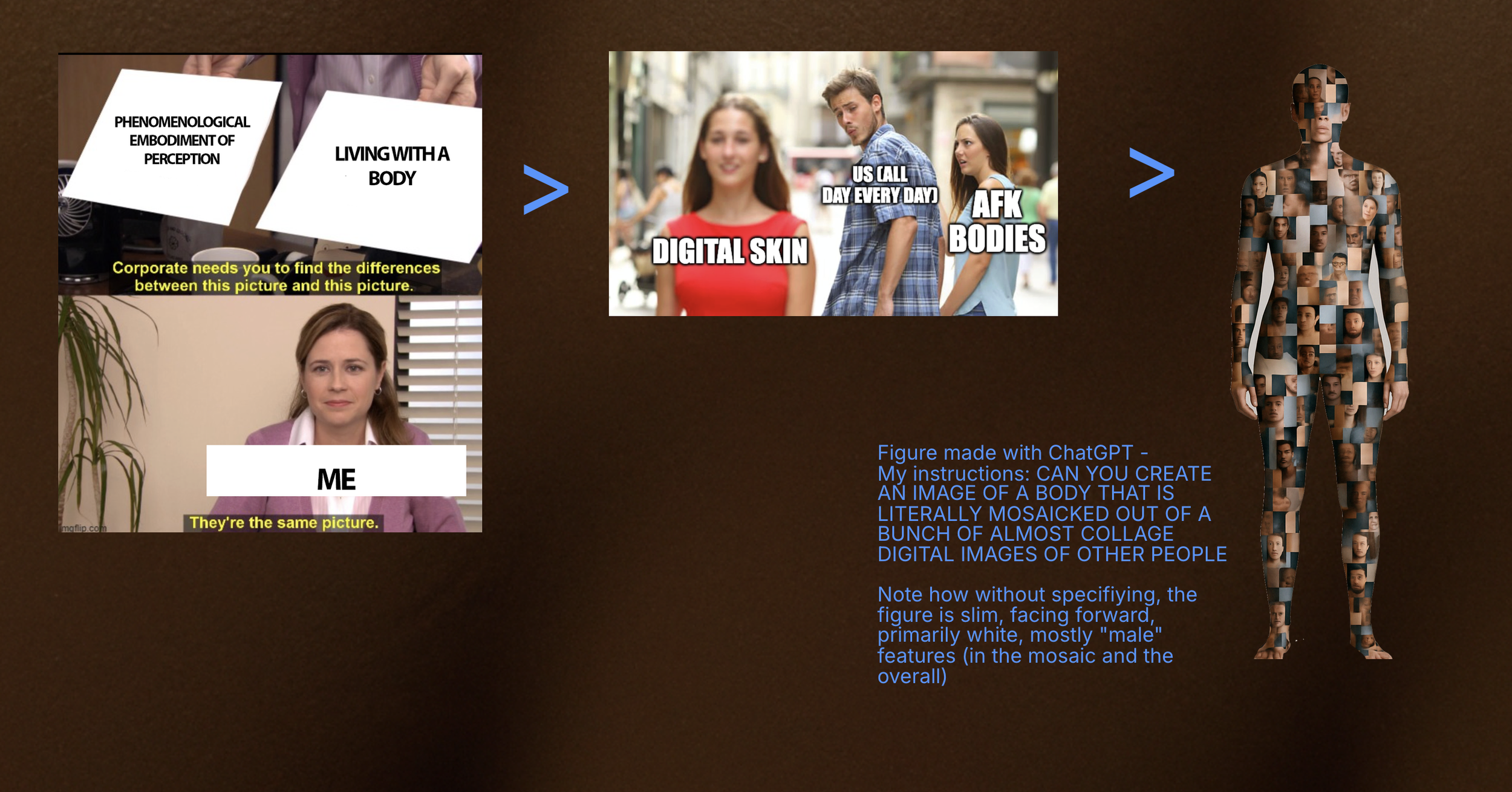
The body is the primary material, celled, meaty, subject simulated by these pixels, even if the bodies are first translated by clay, paint, or animation. The body itself, before it becomes (any layer of) simulated image, already mediates an endless array of assumption, consumption, and presumption. In Disidentification, Muñoz describes the body as a site where cultural meanings are inscribed and contested through performative acts. That is, the body houses our phenomenological perceptions, and as such, remains the primary site in which we negotiate ourselves and one another. The body contains the eyes in which we see our laptop screens, the fingers we use to type and press buttons, the chin that folds as we look to our phones – the sensory information that becomes the data activated by bodies with material and immaterial affect.
Because of this, I am in the practice of looking (and sometimes creating) that which I do not see.
I do not think that representation, especially in isolation without other considerations, is the end-all-be-all, or that it precipitates a liberatory outcome. Hypervisibility in the digital realm often creates a trap where trans, queer, and non-white bodies are more surveilled than liberated by visibility. Huxtable points to how visibility and can expose to violence, "Trans visibility isn’t enough. Hypervisibility often means hyper-vulnerability."
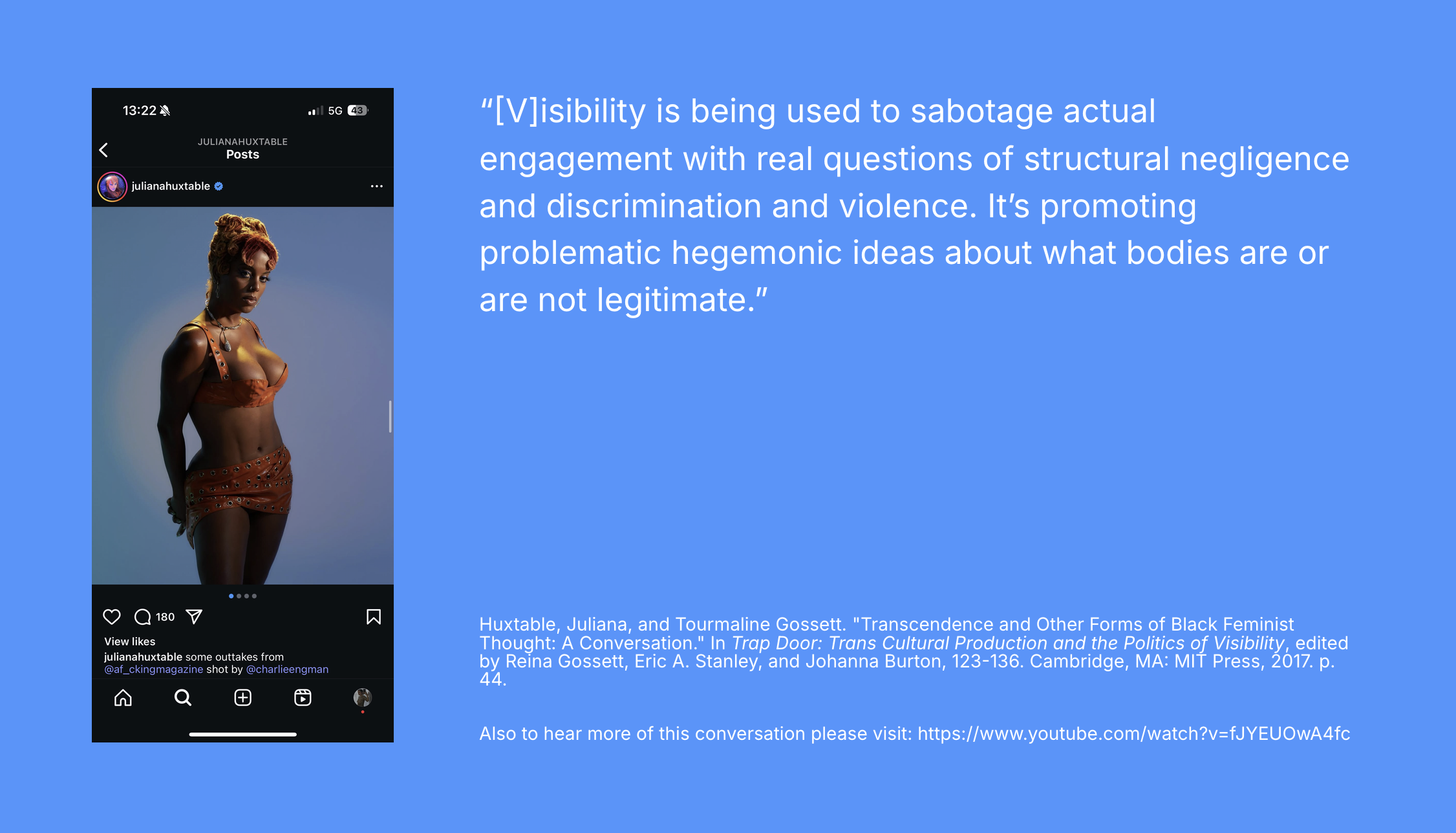
So I refer not to the need for arbitrary representation, or the mere inclusion within failing hierarchical systems of power (This would perhaps fall into using what Audre Lorde refers to as The Masters Toolkit”, and there are many liberatory feats by falling outside of inclusion - as addressed in Queer art of Failure by Jack Halberstam). Material autonomy is often co-opted and proliferated by digital representation (again, endless examples of this as addressed by Legacy Russell in Black Meme, Aria Dean in "Poor Meme, Rich Meme" & Notes on Blacceleration, Safiya Noble in Algorithms of Oppression).
In a recent conversation with Andrius Backus, he and I discussed the ways in which we personally grapple with this in our creation of multidisciplinary art - often desiring to create abstraction or narrativized bodies of flesh as we grapple with this dichotomy.
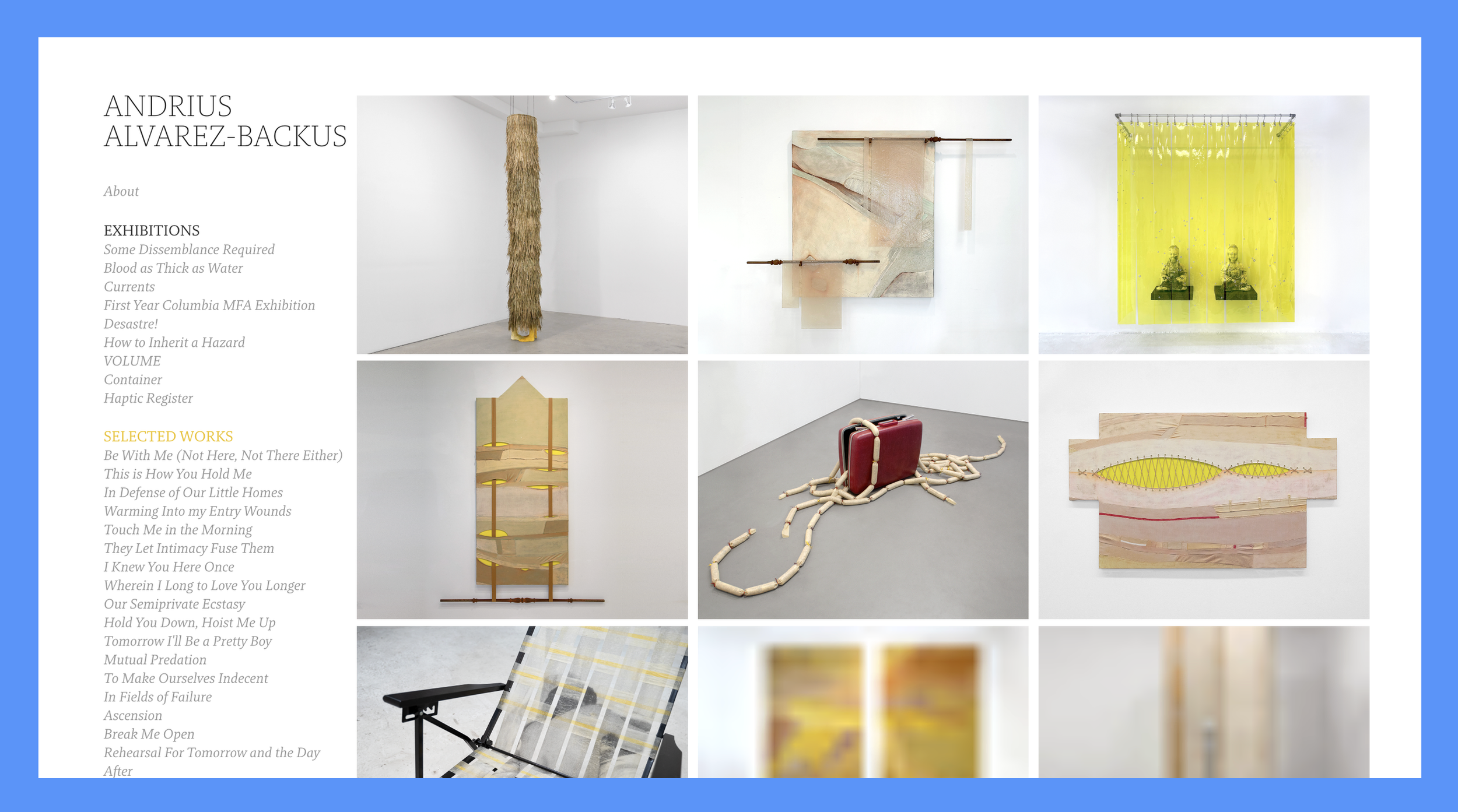
And yet. We must notice what is excluded.
And yet. I really do want to see and not just think about more wrinkles.
Perceiving in itself remains deeply important as it informs our embodied biases, erasures, assumptions, rejections, and acceptances. Asking what is missing from the barrage of daily images, or what is missing from the (perceptual - visual, sonic, textual..) descriptors more broadly, requires us to identify the areas of our own overlooking.
Overlooking (ie Individual, social and political erasure) reflects the hierarchical within the hegemonic. Much of this is obvious, but how often do we actually take the time to interrogate what we don't see, especially in comparison to the constancy of our ever constant flow of pixel-images, where galleries become digital storefronts, and google searches elicit and reflect archives of body and body-making? Many have taken on the work of identifying and challenging and navigating the countless problems that arise when bodies are represented digitally to varying degrees and with varying methodologies and in various contexts. The contexts, methods, and degree to which these bodies are circulated generate ways of being that marginalize (many of those individuals mentioned previously, alongside people like Preciado, Saidiya Hartman, Simone Browne, Hito Steyerl…)
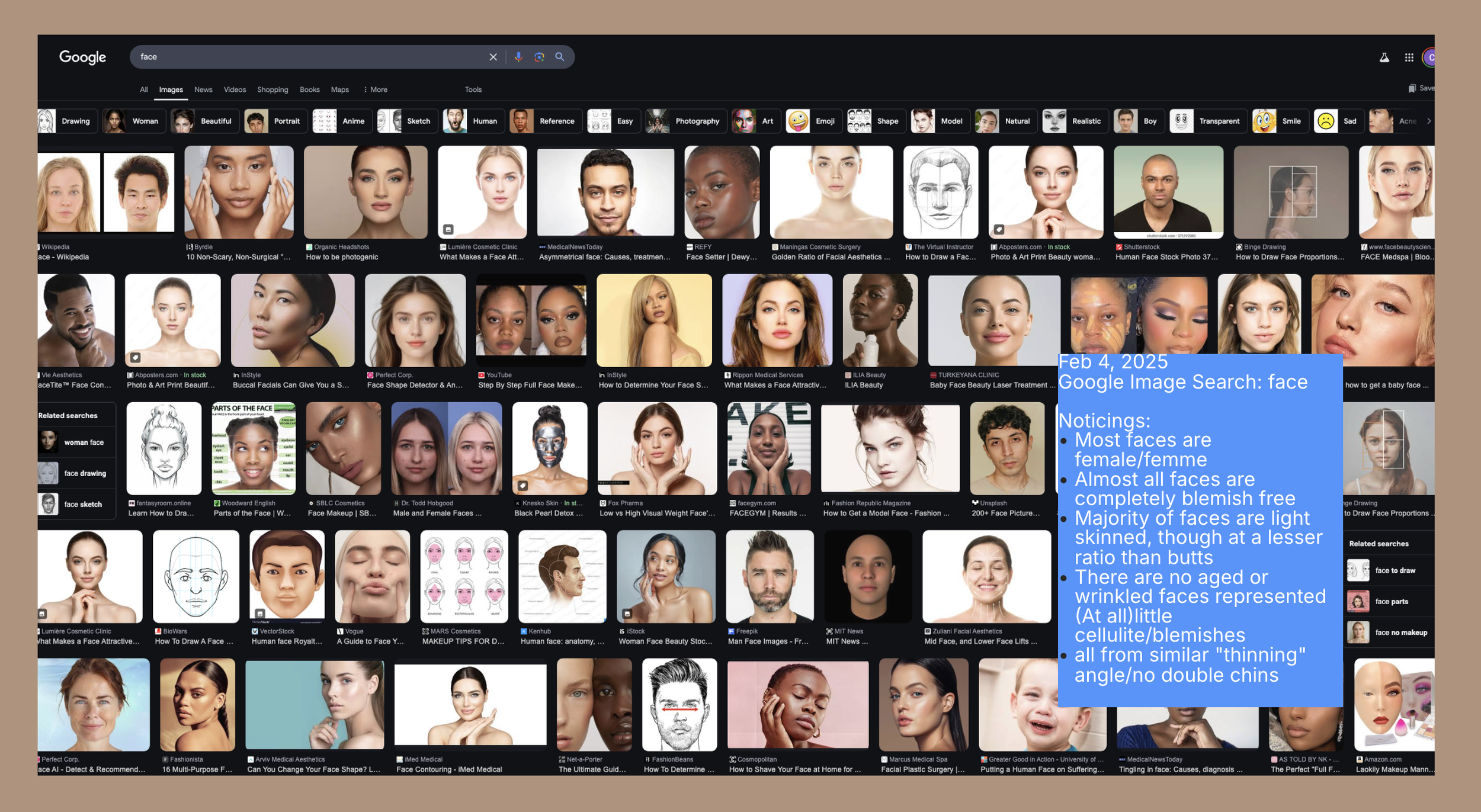
Erasures and objecthoods of personhoods proliferate – reductions and stereotyping occurs. How often algorithms could and do not work to address discrepancies that further and generate marginalizations. Potential counteractive measures instead are replaced by and become cybernetic fleshy balls that roll down hills of “x”s and “o”s at increasing speeds until someone types a metaphorical foot to stopper it, or a tiny stone is thrown to slow it down.
What astounds me, though it perhaps shouldn't because of the algorithmic balls’ escalation, are the images that I have difficulty finding even when I look for them.
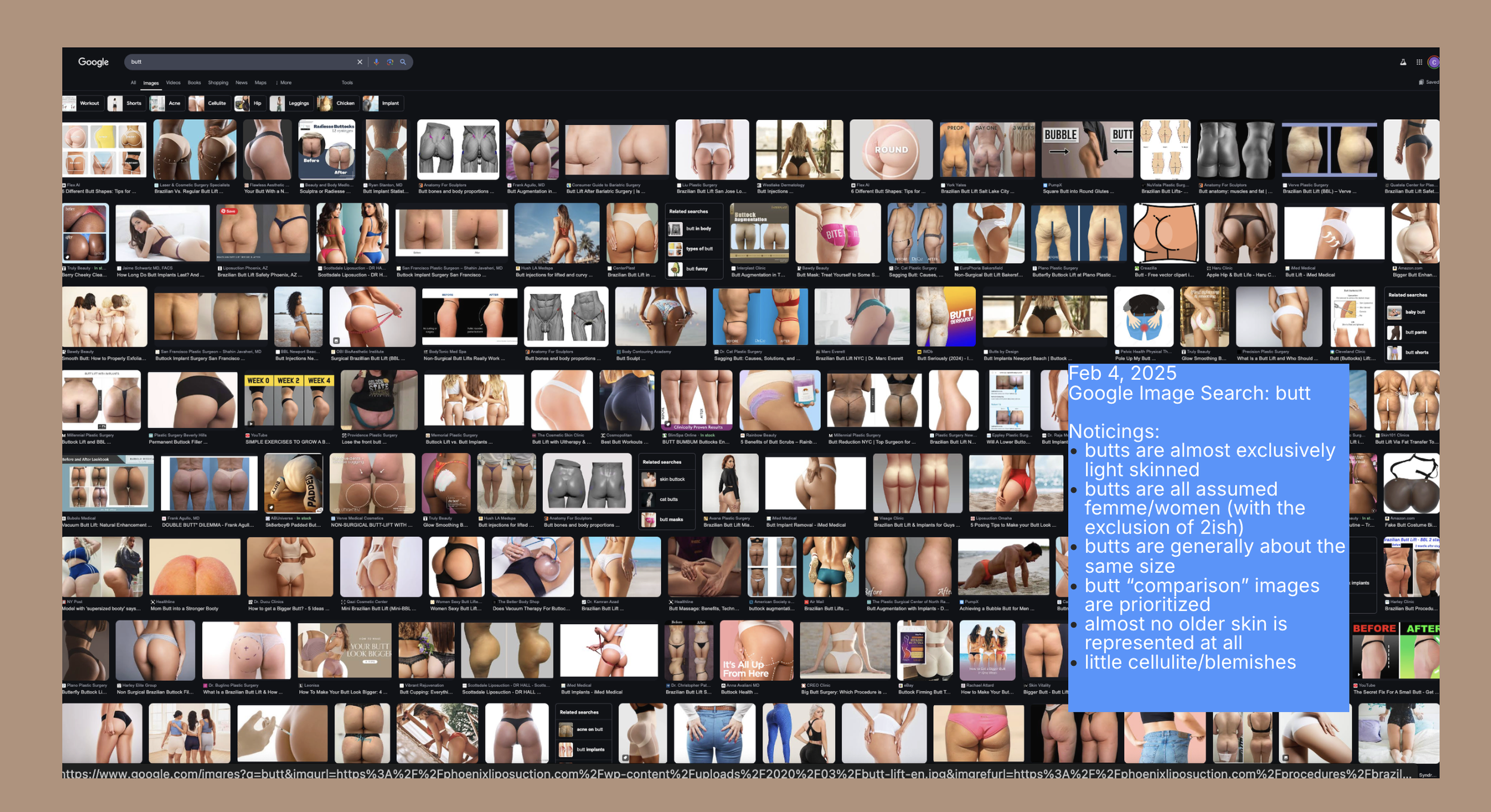
In a recent exhibit I was building a wall of mosaiced forms (check out here). I sought out aged forms, sagging forms, wrinkled forms, desiring to not relegate the body to taught, white, skin. In programs like Cosmos, Pinterest, Google image search, Wayback Machine internet archive, “butt” showed almost exclusively white thin waisted butts. Sagging skin, wrinkled breasts, flaccid penises, intersex genitals, flappy labias - missing. So many bodies, fragmented, were rarely there unless specified, and barely there even when I did. What stood out to me this time was the lack of age - something I recognize as a flaw in my work in this project as I was working mostly within my own networks, so it has been on the top of my mind.
Representations – lack of, erasures, hypervisibilities – have been written and discussed endlessly, and yet, it's something that remains so present. It remains so muc that norm that still we consistently overlook until we are in the excluded group. At this moment, I am caught up in the systemic assumption of youth, and the assumption of desired youth. How are wrinkles in the context of femininity so radical? They, of course, are not, but it would appear as such if we were to focus our gaze to look at sculptures and digitally mediated representations.
We must ask ourselves to look and look again. What is it that we don’t see? Why? In what contexts? With what frequencies? By interrogating what is missing from our visual and algorithmic landscapes, we open up new ways of seeing, resisting, and counteracting the accelerating flow of exclusionary digital images
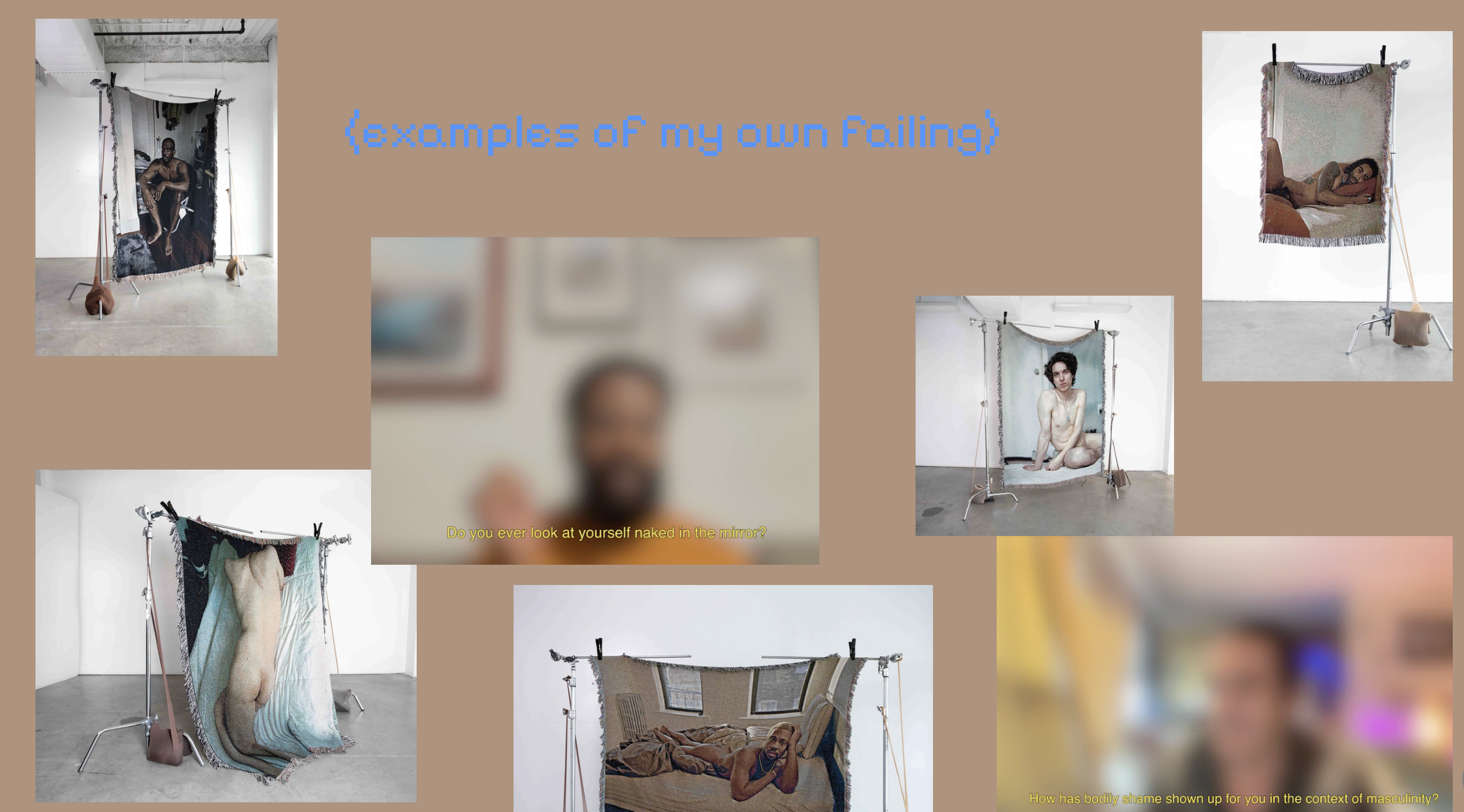
I look to people like Garrett Bradley, who sought to repopulate searches for “America” by titling their film “America,” and Legacy Russell, who points to the furtherance of digital blackface and (profit from others) of memes.
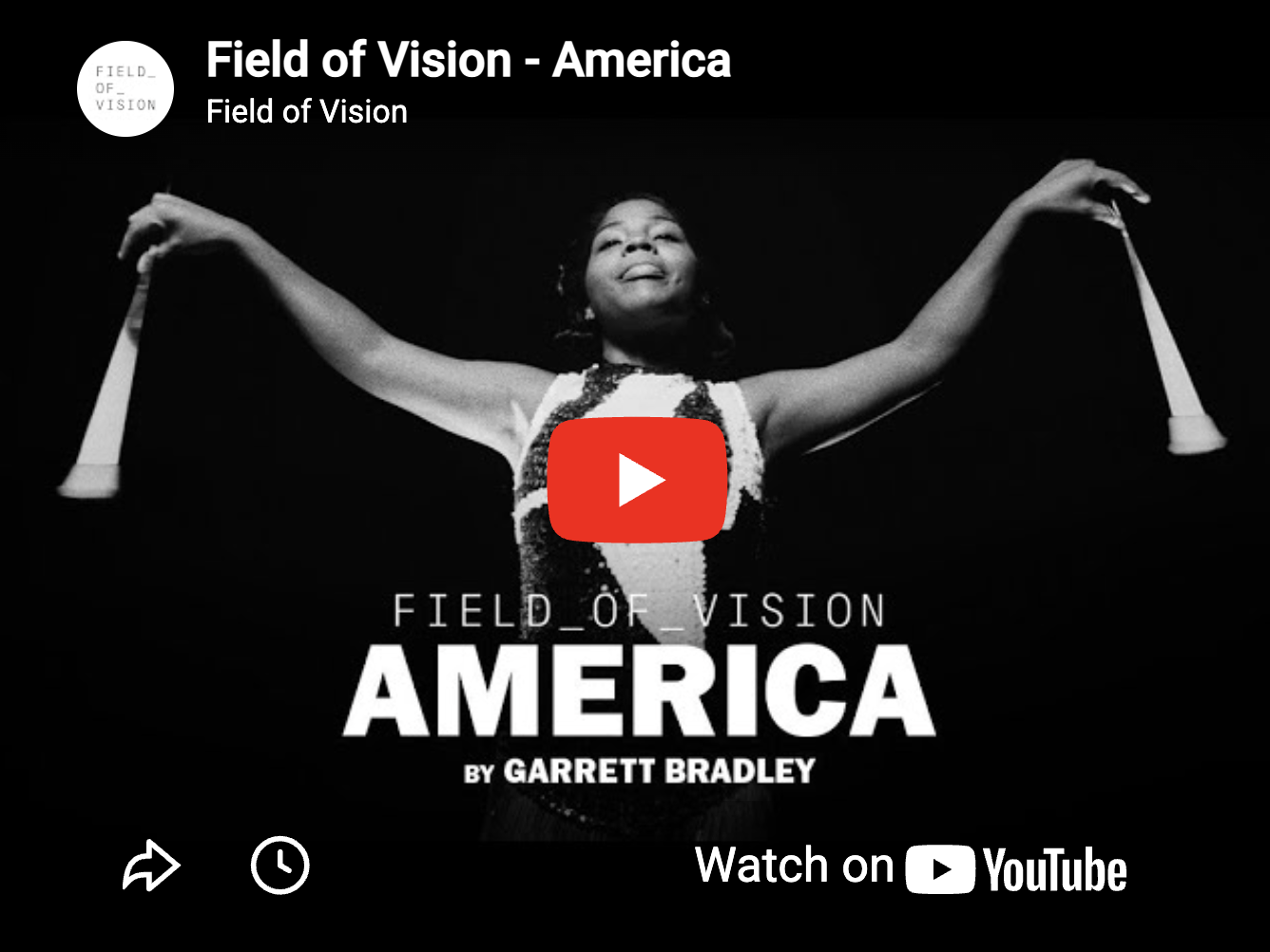
What stones can we throw to stop the ball from rolling at ever increasing speeds within digital circulation? What queer refusals can we generate? What digital feet can we build to block paths and create new pixel bodies?
Kara Walker - Event Horizon
fragment
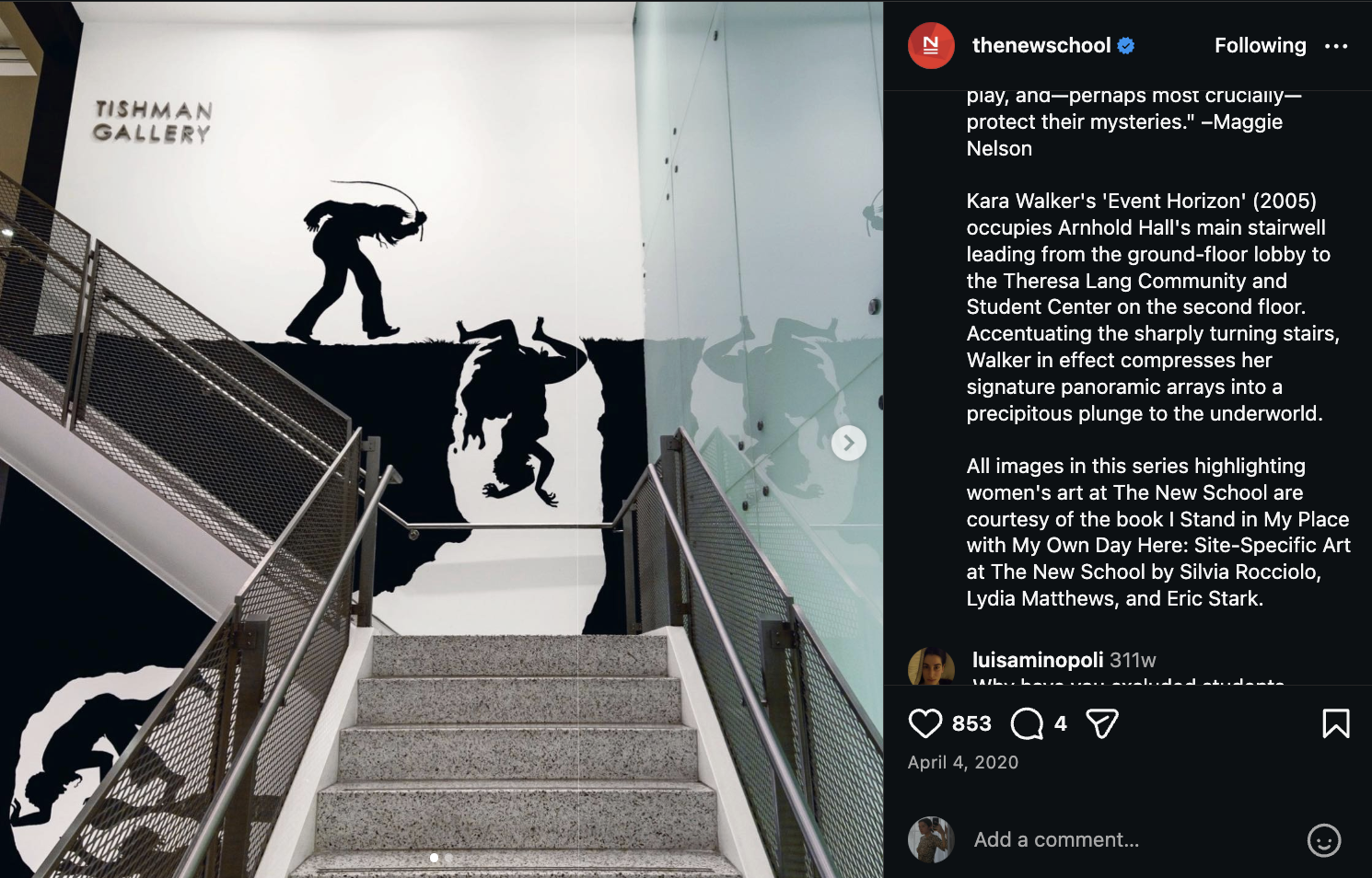
I stumbled upon Kara Walker’s Event Horizon as I walked the steps to my first day of my last semester at the New School. I recognized her violent black-on-white exaggerated silhouettes immediately, their scale and curves, but most prominently, their violent caricatures, are unmistakable. I would recognize her work anywhere. The first time I stumbled upon these depictions I was in a circular room, a room in The Broad, surrounded by mostly White people (noting audience I think is relevant) where she papered the walls with these scenes. I couldn’t stay in the room long, it felt “wrong” to look. I believe this is the point: to makes White folks sit in that discomfort and reality. I noticed how many tried to keep composure while looking at these scenes (why bother?). Event Horizon, though, is not in a museum. What makes this particular work unique is its placement: latex paint mural-ing the hallways of a college campus building.
There is a usefulness in Kara Walker’s remembering. As the name of the work suggests, there is an erasure of histories, a flattening of Blackness in the US, and a literal “black hole” in the memory of the United States chattel slavery. Event Horizon itself is in reference to this emptiness - it equates the erasure to the theory of a gravitational pull so strong around a black hole that no light or radiation can escape it. There are missing records, missing oral traditions. Kara Walker’s black (often [B]lack, but not always) figures re-create these fictionalized histories in a folkloreish narrativizing aesthetic.
However, I can’t help but wonder if the usefulness only goes so far. At what point does her work become a version of trauma porn? And in what contexts and with whom is it useful to engage this violence critically and thoughtfully? This is a question of curation, and location, I think.
A Black friend, deep in contemporary art scenes, is a skeptic: “whenever White people like a Black artists’ work so much, especially work depicting violence, I generally become skeptical, who is it actually serving?” At the time we had been talking both about Arthur Jafa and Kara Walker.
My partner, also Black, stated “whenever I see art made by my people like [that of Kara Walker’s], I can’t help but think it as an outlet for their trauma, and that it might not serve much of a purpose outside of that. It’s…pain. Pain that has the potential to be translated or wielded by Whiteness.”
I think these are important questions. Legacy Russell, in Black Meme, re-iterates the pre-internet virality of Black violence in the form of lynching postcards. These cards were collected and prized by White folks, and en masse. Do these depictions just add to the virality of Blackness as circulated by White folks for White consumption? Are White people actually uncomfortable with this violence, and do they see themselves in it? Is the violence normalized internally, and unnoticed? How are these images felt and embodied by a Black audience? The answers are hazy, especially for the latter. Is anyone even asking how Black students feel?
When a piece is controversial or a conversation starter does not necessitate it is a thoughtful choice. “Thoughtful” here I describe as asking questions like : what is the affect on those who (have to) walk by this work each day if they teach or study here? How will they be engaging with it? It’s worth noting that the viewing and engaging is done with or without consent.
It feels prudent to describe this work in more detail. Maggie Nelson, in a response essay, noted that the first scene you see is “a female figure (inflated butt, iconic head rag) appears to be fisting or stuff a man’s butt, her hand disappeared up to her forearm. The man appears legless, reaches up in agony. She is studious, patient, in the face of his suffering.”
Descriptions of the sexual violence are often missing in write-ups and reviews. Other scenes, each displayed in layers in a Dante-esque wormhole up two flights of steps (on both the East and West walls) are: a presumably White man at the top whipping a woman who is falling (in agony to her presumed death), two folks who play a handclap game (complacent or distracted), a young child with a doll (both barely holding themselves from falling…(into what, we do not know, but it is ominous), amongst others. Many of this figures are presumed Black by their notably exaggerated stereotyped features that Kara Walker so often employs.
Stefano Basilico, who commissioned this piece for the New School in 2003, is White. I am skeptical of his care in his decision. His Whiteness does not ensure his unthoughtfulness (Basilico’s predecessor as the head of the Committee for the University Art collection was Kathleen Goncharov - she acquired pieces by Adrian Piper, Dorothea Rockburne, Lorna Simpson, Nancy Spero, and Carrie Mae Weems - in a way that feels much more responsible to the students and the artists). BUT his Whiteness, and frankly his maleness, does make it more likely, and also makes him, as they both were, a gatekeeper of Black art and money for Black artists.
There are indeed many usefulnesses in discussing and “listening to images” (Tina Campt). There is not always a usefulness in looking at these images. At least, not in every context.
In an interview on NPR Radio on March 7, 2008, African-American talk show host Farai Chideya quoted Betye Saar’s criticism:
“I felt the work of Kara Walker was sort of revolting and negative and a form of betrayal to the slaves, particularly woman and children, and that it was basically for the amusement and the investment of the white art establishment.”
Walker’s response:
I think the first thing that’s striking to me is that I’m not making work about reality. I’m not. I am making work about images, you know, I am making work about fictions that have been handed down to me, and I’m interested in these fictions because I am an artist, and any sort of attempt at getting at the truth of a thing, you kind of have to wade through these levels of fictions, and that’s where the work is coming from.”
Excerpted from Kara Walker No/ Kara Walker Yes/ Kara Walker ? (New York: Midmarch Arts Press, 2009).
Event Horizon and its placement in a school creates a liminal space in which we confront a violent America. But at what cost? The comfort daily of Black students in White dominant and White run spaces? Let’s ask.
More information/sources:
https://blog.fabrics-store.com/2019/09/30/kara-walker-a-history-of-violence/
https://thenewschoolartcollection.org/works/kara-walker/history-of-the-commission/
Other notes:
there is no wall text other than the name/artist/year
the official (rather shitty imo) release text: https://www.newschool.edu/pressroom/pressreleases/2005/042605_nsu_walkerk.html
A Phallic Berlantian Mirage
essay
Written in October 2024 for Dominic Pettman’s Eros class: Making of the Modern World (Shoutout to Dominic Pettman whose humor, kindness, and brilliance made that class one of my favorite classes of all time)
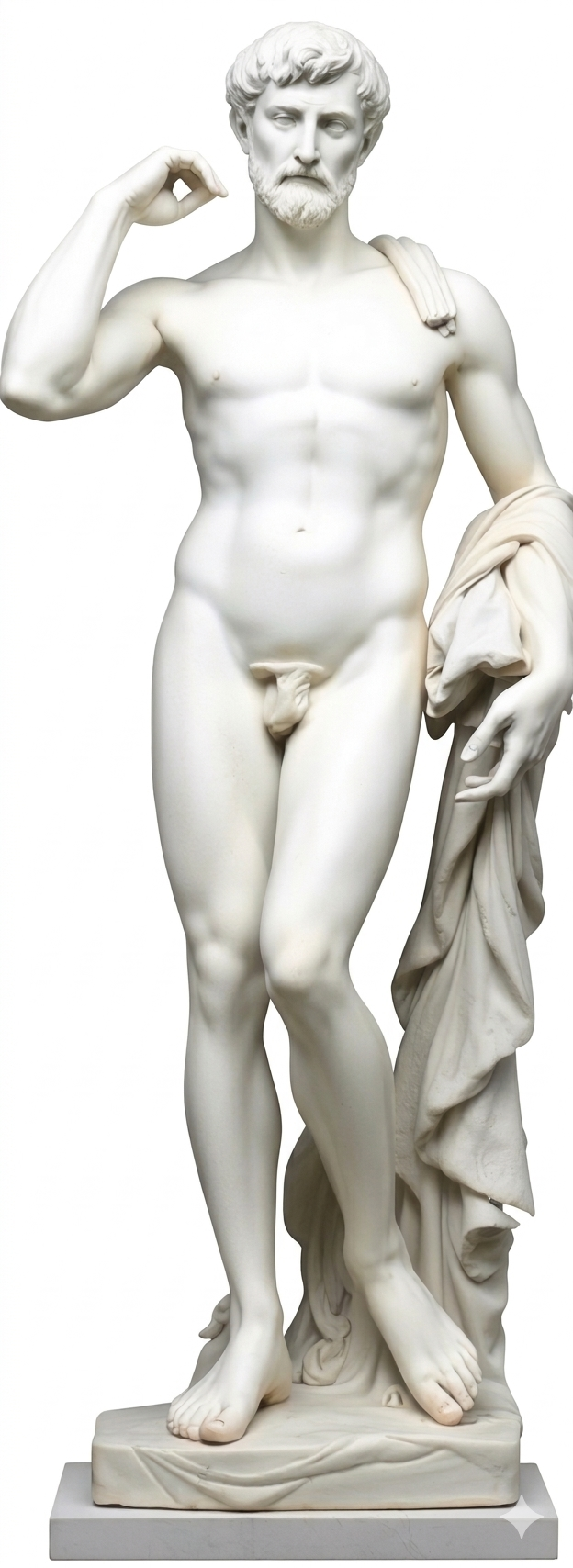
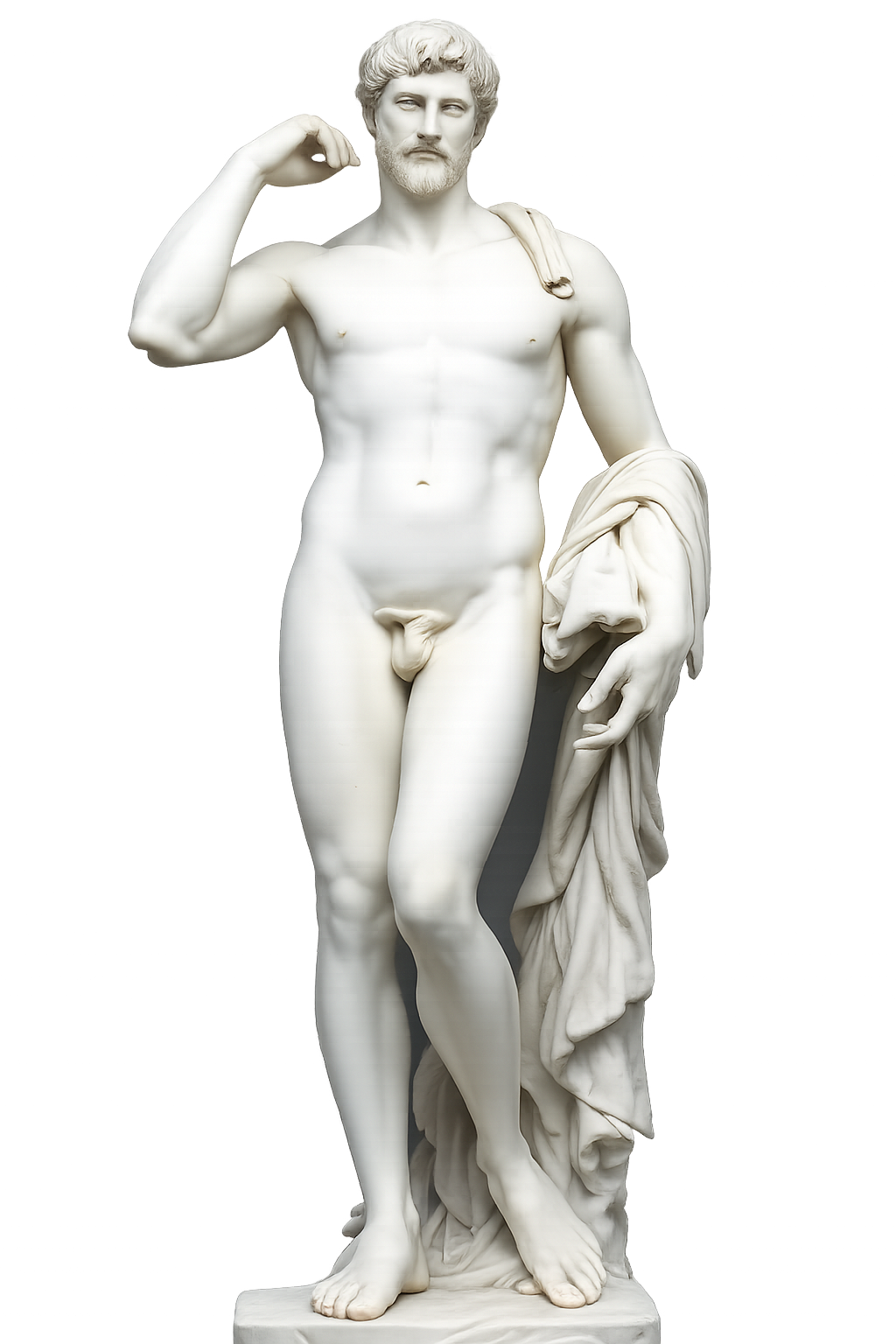
[AI generated images - both ChatGPT [RIGHT] and Gemini [LEFT] create flaccid penises when prompted to make a nude statue due to their prevalence in especially sculpted art.
The Metropolitan Museum of Art is filled with penises. Penises of all kinds. There are the penises of Medieval Jesuses, African and Oceanic wooden ancestors, the occasional Hindu Shiva linga, and Egyptian hieroglyphs and the god Osiris [1].
But today, I want to direct our gaze toward the stony ghostlike figures erected most prominently in the Leon Levy and Shelby White Court of the Metropolitan Museum of Art. Museum-goers and art-lovers everywhere are fascinated by these penises, specifically, their size [2]. A quick google of “penises of Roman and Greek art” will rapidly lead to a plethora of articles reveling at their “smallness” which is sometimes, but not always, clarified as flaccid. The first suggested Search (The “People also ask” section…do they actually?), after googling this was: “Why do Greek and Roman statues have little willies?”
The real question, I think, is: Why would one expect these “willies” to be “big”, ie, erect?
In talking about this with my mom, she exclaimed “I’m always so surprised by just how contracted real life penises can be when cold or after activity. I don’t actually understand these statued penises as anything outside of the norm, though. Most penises are ‘small’ when flaccid.”
Because they are flaccid.
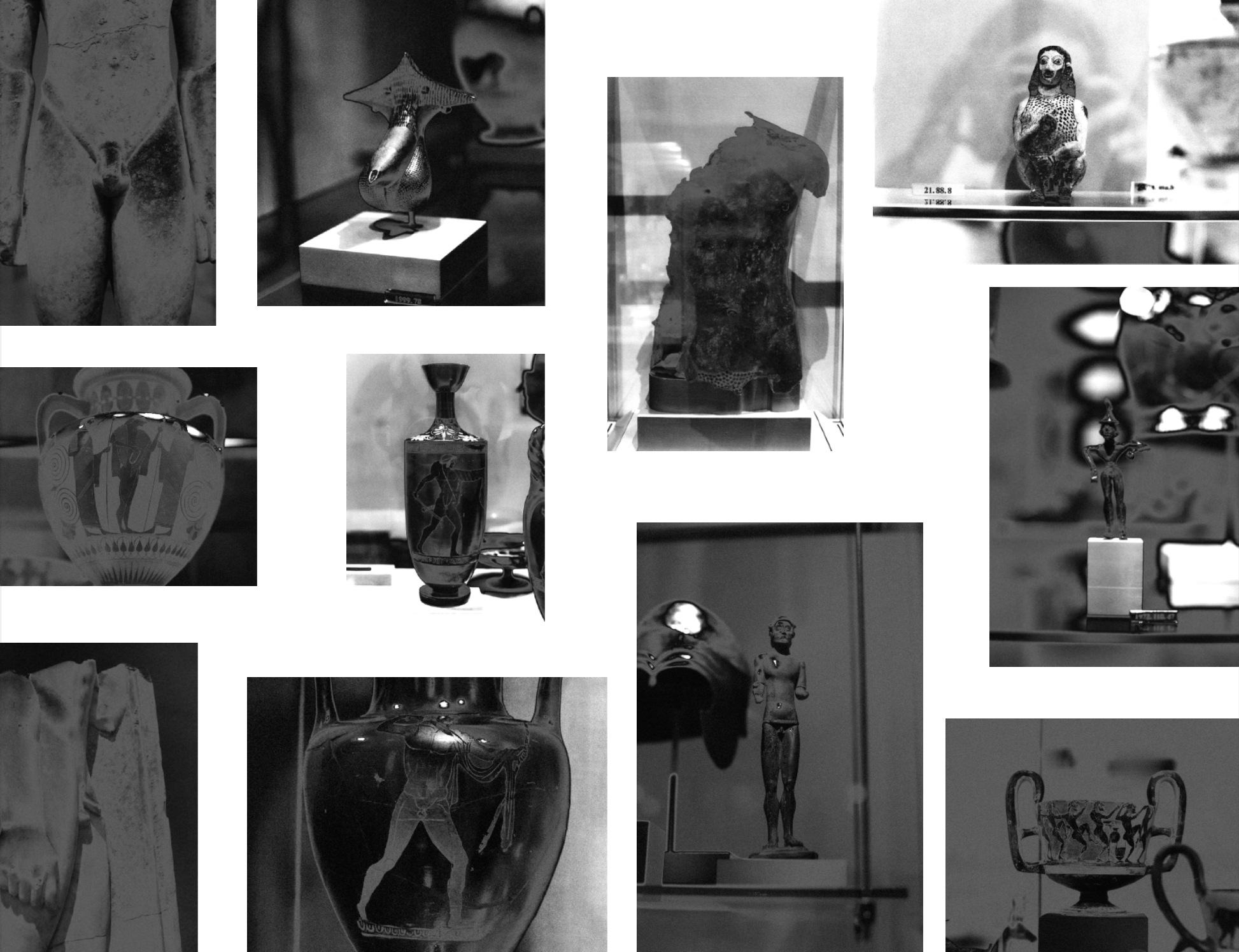
I set out, months ago now, to document each and every penis in the Met. That was the goal, though I quickly realized how outrageously ambitious this was. I barely documented even half of the penises in just two rooms that day [3]. I was inspired by Picasso’s Assholes [4] to discover what this repeated gesture, this repeated looking and witnessing, would lead to. While Picasso’s Assholes is playful, a codified comedic look at an often serious artist, my endeavor was a bit more studious. As a professional photographer and visual artist, I decided to document and record each penis with my camera. I also knew that photographing as a form of study, rather than as a way to share experience or represent a moment, would narrow and focus my gaze — a deepening of looking and remembering would occur. The images themselves I had, and still have, no real plan for.
As I stepped into the room, snacks in hand and friend in tow, I was reminded of the many conversations I’ve had with Millennial and Gen Z non-trans males as part of my gender queer research. I have learned that the first visual nude male most of these subjects remember encountering are in porn, generally digitally mediated, or, printed replications (occasionally the works themselves) of Greek and Roman statues. In reflecting on my own encounters with nudity, specifically masculine coded, I have a similar story. I remember being fascinated, driven by libidinal curiosity, and subsequent confusion, as I snuck repeated glances at the magnet my mom stuck on the fridge. It depicted Rodin’s The Kiss. Their embrace, their stony bodies, held me as tightly as they held each other. So many of our first encounters with nudity are the same.
I began my intellectually motivated documentational quest where mostly Hellenistic Greek and Roman art resides because I knew they never shied away from representing the penis (though non-representation is also interesting to me). There would be no delicately placed hands, floating fig leaves, or lightly draped fabric coyly hiding genitalia. I wanted to quickly penetrate these non-penetrative archives.
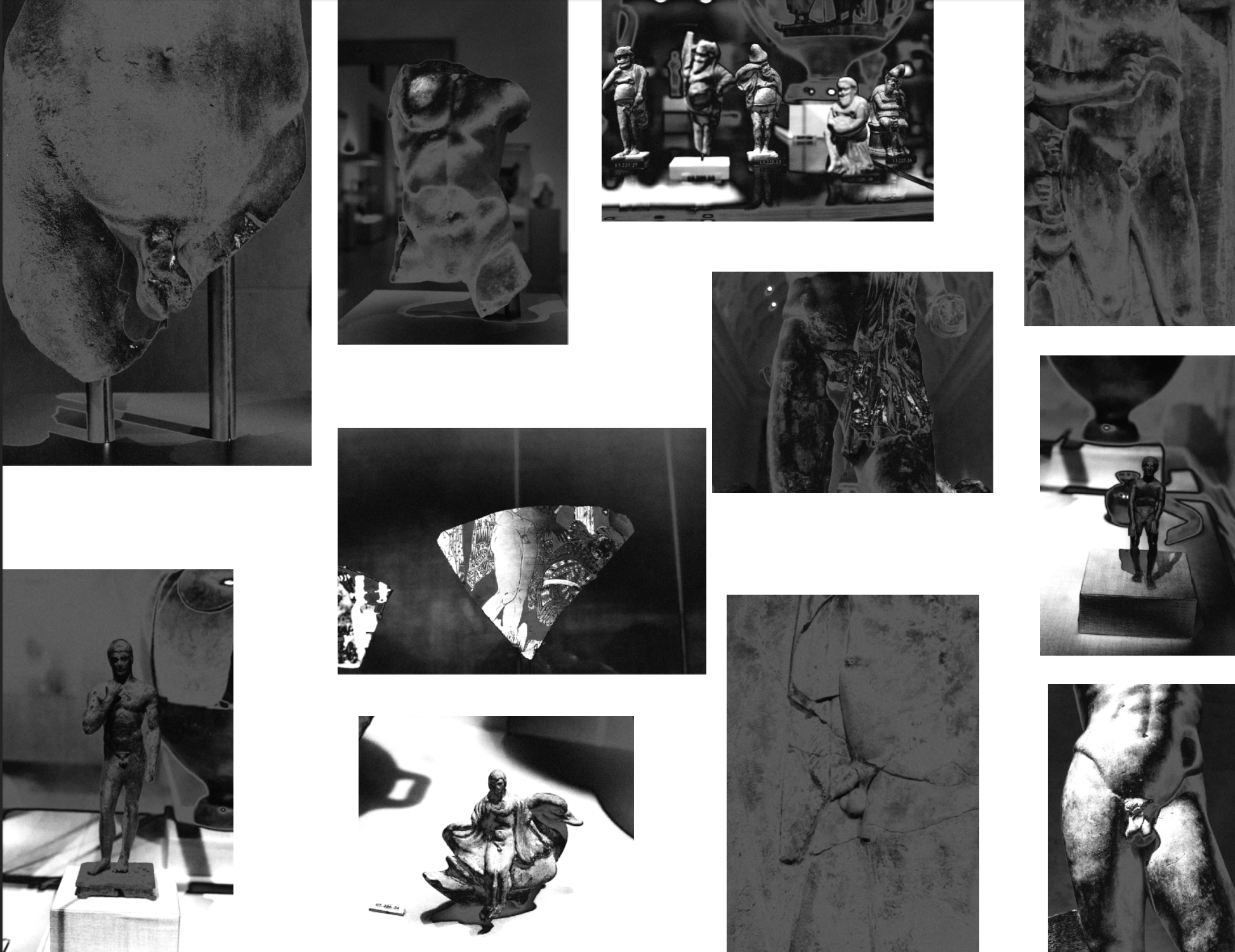
images from the day
I meticulously circled each adorned pot, trying not to miss any minuscule nubs in the groins of running men, ferocious gods, or even the rarely penised chimeras [5]. I know that I must have missed some, there were simply too many.
A woman who noticed my task slyly said “that sphinx over there has something interesting.” I was excited. Did it have a penis? Rare. Sphinx’s almost always have vaginal genitalia. But no, “just,” a vagina. This, though, displays part of my curiosity in taking on this task. How would museum goers engage with my clear genitalia focus and intent? Would I feel embarrassed? Would they? Would my gaze change the pattern of their looking, would they look away and avert their eyes, or would they look closer? Inasmuch as I was asking questions about the attendee experience, I also asked questions like: How are penises depicted across time and geography? What are the contemporary interpretations, descriptions, and perspectives of these historical portrayals, symptomatic of socially and culturally?
There is a distinct contemporary preoccupation with size, particularly in how smaller, flaccid penises in Roman and Greek statues have been broadly interpreted as symbols of restraint, rationality, and the idealized masculine form in contrast to modern views on virility. Because we relate physical attributes as fragmented symbolisms of dominance, desirability, and difference, we misunderstand ancient aesthetics to reflect Phallic correlation to ideal masculinities.
Today, I will make a few rather bold claims in regard to the proliferated speculations of these ancient statued penises:
These statues, with “small willies,” do not reflect a historical reverence of the flaccid penis. They do not reflect a de-sexualized or sexualized portrayal via the penis. And neither, the flaccid or erect penis, are reflective of revered historical masculinity. Our assumption of these are rather reflective of our contemporary gaze, our narrative assumptions, from our own embodied gendered hegemonies. Not theirs.
Lauren Berlant offers some insight. “Men are also subordinated to phallic masculinity. At the same time that there seems to be conventional referential continuity between the symbolic and the fleshly sign, masculinity is constantly threatened by the fragility of their linkage….This suggests a painful contradiction within masculinity, for the very logic that authorizes the penis to be misrecognized as the Phallus or Law sentences men to experience anxieties of adequacy and dramas of failure. The price of privilege is the instability at its foundation” (pp. 56-57) [6].
Berlant expands upon Lacan’s descriptions of subconscious gendered embodiments. She points to the failure of the symbolic Phallus, often confused for the fleshly penis, to consistently or adequately reflect and be upheld by the fleshly material bodies that it represents. The link between symbol and flesh is brittle, shifting. The Symbol of the Phallus changes as gender drifts [footnote], as cultural expectations shift. She notes, as Lacan does, that this produces an immense anxiety of adequacy within the non-trans male to uphold Phallic, often masculinist, masculinities as correct “performance” is impossible to maintain.
It is this Lacanian anxiety, what we might also call patriarchal insecurity, which has led to the contemporary colloquial and academic consensus of the Greek and Roman statues’ “small penises,” and their theorized meanings.
In “When Shame and Masculinity Collude and Collide: Introduction” by Ernst van Alphen. Ernst states “But what characterizes the Greek and Roman traditions of the male nude is the penis is slightly reduced in size. This is of course a difficult issue, because of the underlying norm: what is the standard size of a penis? Unstable as penises are, opinions about what the standard size is can differ. But in art history the established idea is that classical penises are reduced in size. In general, that is correct, because in the tradition of Greek male nude impressively big penises do not exist in idealized depictions of men” (p. 37) [7]. I do not accept this. There is the occasional outlier that recognizes some of what I am about to say [8], but these are by far the outliers.
Is it really a difficult issue as van Alphen claims, except in the context of the anxious male [9] who unconsciously (or consciously) upholds masculinist, specifically Phallic, expectations? He even continues by recognizing “the penis is represented in the same casual way as knees, elbows, or noses.” He offers no support for his evidentiary claim for this size-related consensus except that it is an “established idea” and therefore is adopted. This consensus should not be given arbitrary merit, especially without further evidence and excavation. He (gender is notable here), as many, give in too easily to this canonical classical assumption especially when there is significant theoretical and statistical evidence that would point to differing conclusions.
Some of the reason(s) we are given for the “small, and smaller than average, flaccid penises” are: that the Romans and Greeks valued intellect and so excluded explicit sexual/sexualized references in revered, godlike or athletic, subjects, believing these to be in conflict [10]. These figures had transcended the banal libidinal desirous ways of being. Large penises are read to be considered “primitive” - this assumption is often rooted in a problematic racialization and reduction of hypersexualized Black bodies [11]. The statues, according to art historians, represent the ideal masculine form.
These conclusions assume a few “narrative norms.” The stony penises are “misrepresented” and misread “as the Phallus” as represented by the flaccid Phallus within an ideal form. I refer to the narrative norms mentioned by Lauren Berlant when expanding upon Lacan’s description of unconscious embodiments that “the censored material is written down in monuments like symptoms that represent on the body, in archives of memory and seemingly impersonal traces that take on uncanny value, like childhood memories, in the presumption of language, and in narrative norms. Masculinity in particular involves creating a kind of mirage…” (p 58).
Berlant speaks of the ways in which our celled, material, fleshly bodies absorb cultural and environmental data, and how this data is carried through our bodies onto the objects we interact with. So assumed are these informations and ways-of-being that we cannot see them. They become hegemonically assumed and thought. We see, hear, smell, taste all through the filter of the framed genders within the culture we inhabit.
Berlant refers to the AFK [12], or celled material body as carrying the data of our political/cultural/social/medial environments. In other words, the phenomenologies of perception (our interpretation of it, anyway) become embodied, living through our movements and thoughts. These smooth stony fleshly bodies were shaped by material fleshly bodies, and reshaped (often in cast-making), or re-cast by fleshly bodies. Kimberly Juanita Brown, in describing the Black Atlantic subject, though it’s beautiful phrasing extends to this as well, insightfully says “History is carved into the flesh of rock and concrete, forming a cast out of which the figure emerges repeatedly” [13]. To historical excavators, much of this is obvious. What can be less obvious is recognizing the hegemonic filters we use in viewing these objects as witnesses, examiners, and spectators.
Why are we so surprised to see a flaccid penis within our contemporary psyche?
Every day, as we walk to the train station, enter the platform, board the train, and walk to whatever coffee shop we work out of that day, we are surrounded by flaccidity. We cannot see this flaccidity, but it is there. These flaccid penises rub against boxers, pant legs, stick against testicles. They protrude from fleshly bodies, sometimes silhouetted through soft cotton pants, often hidden by thick pleated jeans. We go home and step into the bathroom to give our partner, who's just returned from an intensive bike ride, to give him a quick kiss in the shower. We see his penis, and it is (most often) flaccid.
It’s most common state is limp and resting. When I say “common” I refer to the state in which it inhabits the material world in a proportionate length of time. What is not common, is seeing this reflected in our visual psyche, unless one has a penis. A penised individual likely sees their own flaccid penis multiple times a day, sometimes seeing without seeing. Some may see them on their child as they change a diaper, in locker rooms as men change, or in bathrooms as folks stand to pee [14]. However, this is rarely visually represented outside of the AFK experience. I distinctly remember the scene in Perfect Days as the main character washes his body, surrounded by wrinkled and flaccid nude men. And many remember the “striking” moment when Jason Segal comedically whips his penis back and forth in Forgetting Sarah Marshall [15]. The most commonly viewed penis is, of course, erect and in porn.
Within the symbolism of the contemporary Phallus, and its erect visual circulation and proliferation, we forget the penis’ common flaccidity, we see the visual flaccid penis, and to many it says “I am small,” “I am not aroused,” “I am not sexy,” “I am not man enough,” and “I am not a man.” An erect penis, and specifically “large” ones, can say “I am confident,” “I am sexy,” “I am horny,” “I am powerful,” “I assert dominance,” and “I am MAN.” A “small” erect penis and a “small” flaccid penis, are seen as the lesser form of hegemonic heteronormative masculinity. Those reflecting on these Greek and Roman statues cannot unsee them as lesser, and so a large penis in these depictions is assumed a necessity for these sexy figures. To them, to portray smaller penises must be a censoring of eroticism. To them, a flaccid penis in these depictions therefore must represent a focus on intellect rather than lust and power. To them, it cannot say nothing. Culturally we cannot even see a flaccid penis without assuming there is something wrong or uncommon with it despite its rampant commonality.
However, these larger-than-life (well, human life anyway) statues are sexy and present a sexualized ideal, not an asexual one [16]. I was reminded of the sensuality mimicked by these statues on a bus ride between airport terminals. I gestured to my partner with an arm above my head, he laughed knowing this wordless gesture referred to his arms stretched above his head holding the rail. I referred to the endless magazine covers with men like Jacob Elordi [17] and Idris Elba holding their arms above their heads and on door frames in provocative, inviting manners. He knew I was silently calling him sexy.
These statue-makers reflect these sexual sentiments. These medusa-like monochromatic statues lounge casually, erotically on pedestals of stone, they hold arms above their heads, pulling stiff fabric around their heads, revealing muscular toned arms and torsos. Their oft unknown sculptors echo their own presumably libidinal desires with sanded silky skin and rippling marbled muscles. Some lean heavily on their hip, emphasizing the “V” of their pelvic bones. Hairless chests gleam under the museum’s skylights. Their torsos elongate and their gazes look straight ahead, ignoring me and passersby. They confidently disregard me [18]. Sometimes limbs are missing where time has aged these cast and re-cast bodies. But these statues, without a doubt, are sexy. With or without an erect penis.
Scholars, in fact, agree that these statues are sexy. But that it is a “non-explicit” or understated sexiness because of their flaccidity. The assumption that these statues are somehow "censoring" the penis, presenting it as flaccid to emphasize intellectualism or idealized masculinity, and anti-eroticism (some hypocrisy here), reveals more about our own contemporary anxieties and hyperfocus than it does about the cultures that created them. These ghostly stones are imprints and remnants of humans that once were. They grow like humanoid stalagmites from the ground, elevated so as to draw our eyes up. In many ways, these figures are like “archives of memory” represented on the body of stone. These statuesque simulations of the body mark the archives of and created by the makers, creating their own memorializations. These materially fleshly bodies (the artists and the cast-makers and all those in these processes) imbue/impose their expectations, their cultural assumptions, into its creation. It is for this reason that we so often look at objects to study a people, a time, a society. However, we presume that the symbolic Phallus was traced and rubbed upon the chiseled bodies of these statued beings by their fleshly makers and casters. We assume their creators deliberately made a statement about gender and power through the representation of the penis. We assume that the Berlantian “symptom” of the small penis reflects their gender culture. We presume that a small, flaccid penis must be a symbolic statement about intellect or virtue. This is a Berlantian mirage of the now, manufactured by our own contemporary Phalluses.
What is a “small” penis? What does “small” mean in the context of flaccidity?
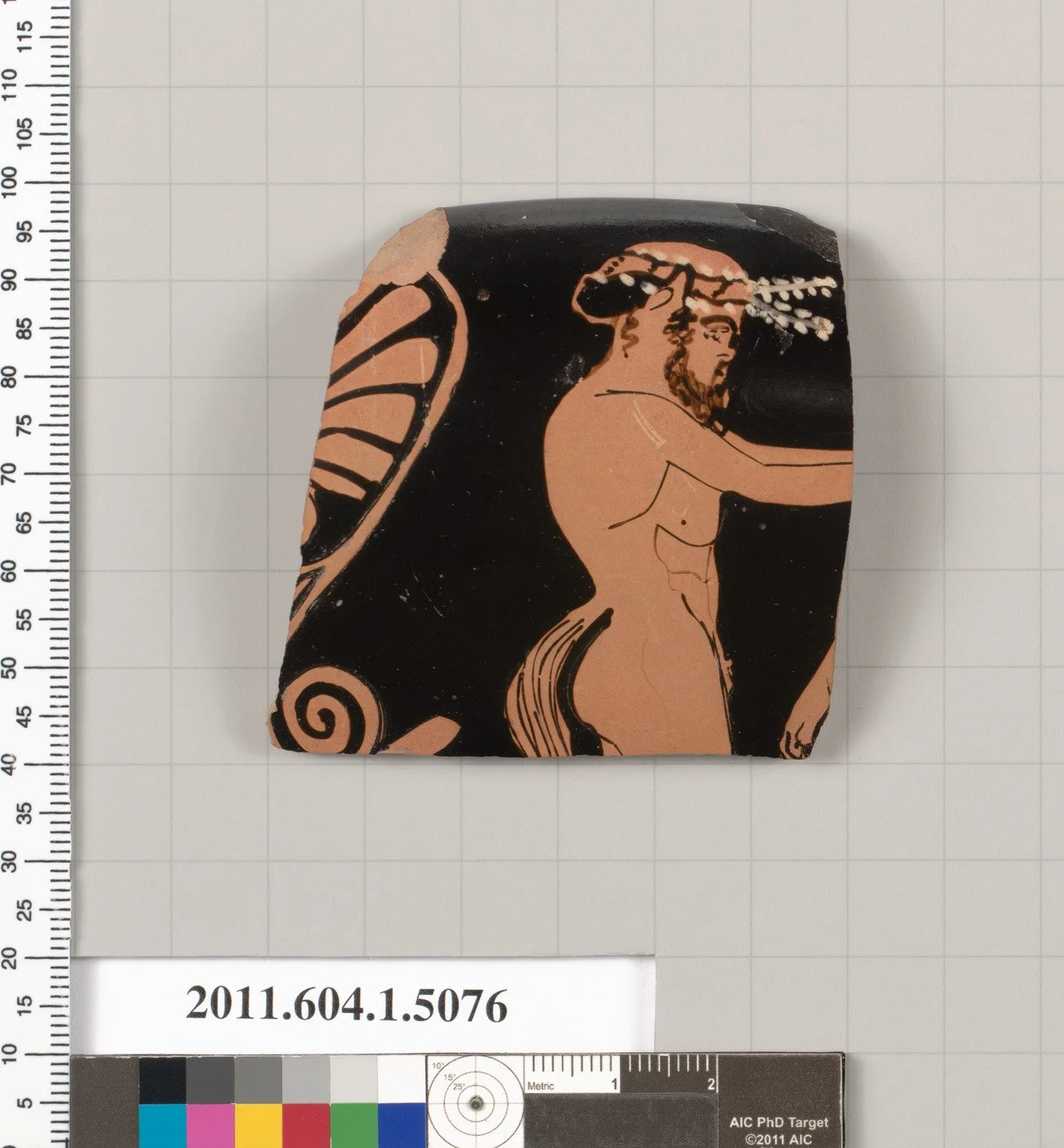
Terracotta rim fragment of a kylix (drinking cup), Greek, Attic, mid-5th century BCE, On view at The Met Fifth Avenue in Gallery 157
This question forces us to step back and reconsider: what is a small penis, really? Is its "smallness" merely a physical characteristic, or is it a metaphor constructed through layers of historical interpretation, influenced by how we view the body, sexuality, and power today? By asking this, we open up a broader dialogue about how cultural narratives shape our understanding of the body across different eras.
We need to revisit Ernst van Alphen. To claim these penises as noticeably flaccid, small, and potentially smaller than average “is of course a difficult issue, because of the underlying norm: what is the standard size of a penis?” [19] Let’s pick this topic back up and re-examine the lens of contemporary biases.
Here’s what we do know about penis size:
Average penis size, flaccid and erect (which are not much correlated to each other in terms of size comparison), are incredibly variable and dependent on social, geographical, and environmental factors
Athletic activity and temperature and stress are some of many factors that render size even momentarily widely variable in the daily individuals life
When asked, most penised individuals report to believe their penis to be smaller than average
Most also notoriously self report their penis to be larger than the known average
Globally, no one has a materially accurate linguistic or literal understanding of penis size in any of its states
So not only is there the question of why we continue to fixate on the size of these statues' penises at all, more than their unusually non materially representative noses or hands [20], but also, why do we feel so intent on declaring its smallness and “smaller than average”ness when the average is unknown, and the proportions so close that we cannot be near certain.
What about the erect penis?
I don’t think we can talk about the flaccid penis during the Greek and Roman era without also looking at how, and in what contexts, the erect penis was visually exhibited. We see the erect penis in three contexts: depictions of actively occurring sex, ithyphallic representations of comedic nymphs etc, and, notably, on doorways, necklaces, and wind chimes as talismans and amulets of prosperity and good luck.
In the first context, the erect penis is simply recognized as an often active part of sex. Most often these depictions are painted on the sides of pots. The second depiction is something that is often noted as supportive of the erect penis as vulgar, anti-intellectual, foolish, violent, comedic [21]. However, there is a point that must be clarified. These penises, which are narratively stigmatized via the characters they inhabit, like those on Satyrs, are so large that they become grotesque or ridiculous. There is the exception of Priapus, a god of fertility. Unlike the flaccidity of the statues and runners on pots, there is no debate as to whether these penises could represent fleshly material erect penises of the time. The penises often exceed the size of the entirety of the body to which it is connected. Given the impossibility of these realities, it is not in debate, and one can reasonably conclude its moralized negative or humorous Phallic symbolism. The last example is something that is rarely looked at alongside these statues. These erect penises coexisted with these athletic monuments. The penises are contextualized in writing as talisman and omens of good fortune and prosperity, perhaps in reference to Priapus [22]. The “normal” versus enlarged erect penis was not a sign of overt sexuality or intercourse or eros, but of prosperity. These depictions further contextualize the flaccid penis as neither sexual or asexual, simply as non-Phallic, in any regard (versus simply a “different type” of Phallicness that is prescribed to it).
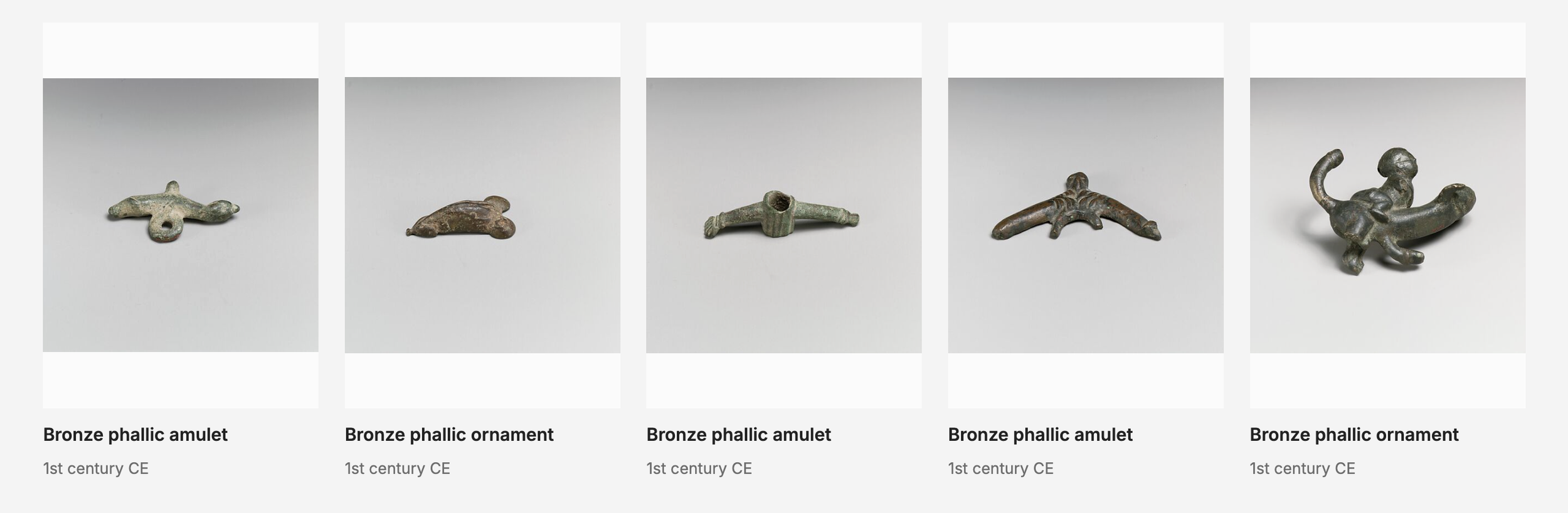
Roman amulets from the MET
Conclusion
In photographing the penises at the Met, I noticed this slippage in the continuity between the symbolic and the fleshly bodies of the penis, a dissonance that disrupts our understanding of what these statues represent. The fragility of our contemporary Phallus—rooted in masculinist anxieties about the physical size and state of the penis—blurs our ability to see the statues, rendering art historians and casual viewers alike blind to their own projections. This disconnection remains largely unacknowledged, and most continue to impose our present-day preoccupations onto these ghostly forms, presenting the flaccidity of the statues’ penises as intentional symbols of virtue. This act of projection exposes the insecurities of modern masculinity, where the symbolic Phallus holds disproportionate power over how we interpret the body. In doing this, we assume a specific kind of Phallicism—that is, we believe that the symbolic meaning we attach to the penis as Phallus in our culture must have existed in some way in theirs as well. This is a critical error.
Lauren Berlant's notes on Lacanian symbolisms sheds light on this phenomenon, highlighting the complex and discontinuous ways gender, especially masculinity, is inhabited, both historically and in contemporary culture. She articulates how these variable norms—constantly shifting and unstable—complicate any straightforward reading of gendered bodies. These statues, then, become ghostly archives not only of the cultures that produced them, but our reading of them archives our own. We look at these stony bodies and project our own troubled gendered navigation onto theirs.
What else will this photographic study of the penises at the Metropolitan Museum of Art reveal?
FOOTNOTES
[1] there are notably very few North American penile artworks or historical artifacts in and outside of the Met
[2] a few examples of countless such articles can be found:
https://www.artsy.net/article/artsy-editorial-ancient-greek-sculptures-small-penises
https://www.dw.com/en/why-do-ancient-statues-have-such-small-penises/a-65151780
https://www.mentalfloss.com/article/79897/why-arent-classical-statues-very-well-endowed
More prominently:
Beard, Mary, and John Henderson. Classical Art: From Greece to Rome. Oxford: Oxford University Press, 2001.
Chrystal, Paul. In Bed with the Ancient Greeks. Stroud: Amberley Publishing, 2016.
[3] I have not given up on this venture - but it will be after many more days to come
[4] Kyle, Jonas, Jake Shore, and Reilly Davidson. Picasso’s Assholes. Spoonbill Books, 2022.
[5] while chimeras in their earliest depictions are female/have vaginal genitalia, chimerical variations are sometimes penised
[6] Berlant, Lauren. Desire/Love. New York: Punctum Books, 2012.
[7] van Alphen, Ernst. "When Shame and Masculinity Collude and Collide: Introduction." In Shame! and Masculinity, edited by Ernst van Alphen, 1–14. Amsterdam: Valiz, 2020.
[8] Rempelakos, L & Tsiamis, Costas & Poulakou-Rebelakou, Effie. Penile representations in ancient Greek art. Archivos espanoles de urologia. 66. 911-916, 2013. https://www.researchgate.net/publication/259468154_Penile_representations_in_ancient_Greek_art
[9] here I use male to mean both trans and non-trans as these expectations carry into queer masculinities as well
[10] much of this is articulated in the audio guides and plaques themselves
[11] Fanon, Frantz. Black Skin, White Masks. Translated by Charles Lam Markmann. New York: Grove Press, 1967.
Collins, Patricia Hill. Black Sexual Politics: African Americans, Gender, and the New Racism. New York: Routledge, 2004.
Holland, Sharon P. The Erotic Life of Racism. Durham: Duke University Press, 2012.
Willis, Deborah, and Carla Williams. The Black Male Body: A Photographic History. Philadelphia: Temple University Press, 2002.
[12] “AFK” refers to a term meaning “Away from keyboard.” It provides an alternate way of describing the material body that is not digital. It was created by Legacy Russell in response to the idea that digital bodies and lives are not “real.”
Russell, Legacy. Glitch Feminism: A Manifesto. London: Verso, 2020.
[13] Brown, Kimberly Juanita. The Repeating Body: Slavery's Visual Resonance in the Contemporary. Durham: Duke University Press, 2015.
[14] though it is rude to be seen seeing
[15] after writing this, my TikTok fed me this: https://www.tiktok.com/t/ZTFV1oPpY/
Barrow, Rosemary, and Michael Silk. Gender, Identity and the Body in Greek and Roman Sculpture. Cambridge: Cambridge University Press, 2018.
[16] van Alphen, Ernst. "When Shame and Masculinity Collude and Collide: Introduction." In Shame! and Masculinity, edited by Ernst van Alphen, 1–14. Amsterdam: Valiz, 2020.
[17] just for fun: https://www.coupdemainmagazine.com/jacob-elordi/17517
[18] sexy
[19] van Alphen, Ernst. "When Shame and Masculinity Collude and Collide: Introduction." In Shame! and Masculinity, edited by Ernst van Alphen, 1–14. Amsterdam: Valiz, 2020.
[20] it is worth noting that there is also immense variation in nose and hand sizes, that are questionably materially reflective, ie, very little is exactly proportional whilst not being highly exaggerated
[21] Shaw, Carl. Satyric Play: The Evolution of Greek Comedy and Satyr Drama. New York: Oxford University Press, 2014.
[22] Rempelakos, L & Tsiamis, Costas & Poulakou-Rebelakou, Effie. Penile representations in ancient Greek art. Archivos espanoles de urologia. 66. 911-916, 2013.
Clarice Lispector + Susan Stryker
fragments
Talking Monsters.
No. 02
A conversation with Clarice Lispector via Agua Viva and Susan Stryker…with a touch of Mckenzie Wark.
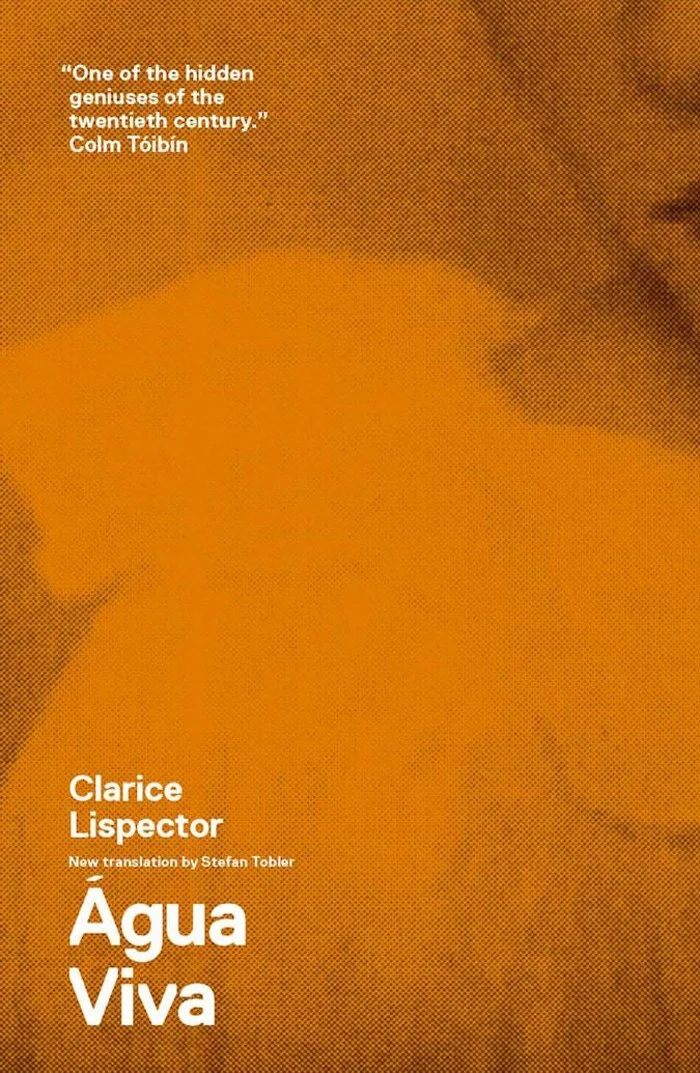
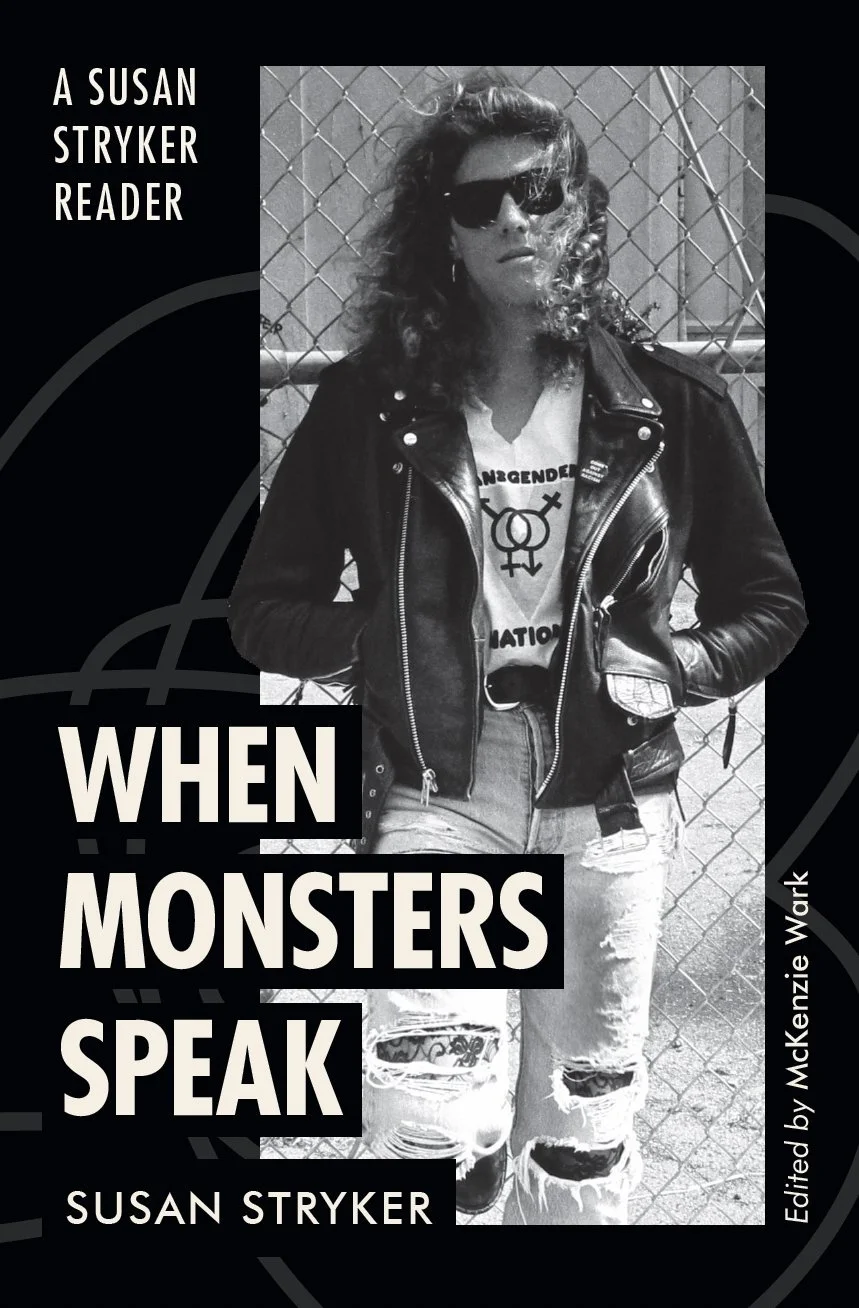
I don’t like gender. It doesn’t feel exploratory. To be “read as ___” is boring, and falsely assumptive to me. It negates the work of learning and knowing another, it negates the necessity of curiosity. It assumes too much and does too much work that then inevitably is undone. Or if it is not it flattens and mimics. Maybe my mind will change. Most thoughts do. Or they mutate to be premised in meaninglessness. But i also need you to not need or expect me to change my mind. This is important.
Reading Stryker I wondered out loud whether monster was useful for us to identify with the Other as liberatory practice. Wark said of course. For some reason this made me angry. Stryker said it is like reclaiming whore or slut or gay. No it’s not. It’s not. Maybe it’s still useful to Be Monster, but it’s not the same. To be gay whore slut is only bad or wrong if the thing it describes is assumed bad or wrong. The terms themselves are not indicative of a description of “badness” itself. Monster - is. Monster reflects the subjective speaker. It does the work of communicating that which is harmful, ugly, and feared. It does not generate or prescribe specific actions or traits as whore slut gay do. Monster does the work of being flexible, to be specifically and exclusively defined by those who use it. Monster is the judgement itself, not the identity or practice that is judged.
I did not say any of this to her. Why would I when I wouldnt be heard. And Wark did not explain or change my mind. I was disappointed by this. I learned nothing. I changed my mind later. I changed my mind when I embraced the monster for myself because i didnt want the human described as human by those who use Monster. Which is almost exactly what Stryker said. id rather be the creature they feared. i would rather be the thing feared than the boundaried saltless human they want. To them, I am a monster and she is a monster. But, to me, so are you. And so the speaker of Monster is Monster. They just don’t know it yet. Which really means we are all human again too. It all is the same metaphor for the same creature. Mary tried to tell us.
Monster isn’t a slur to be reclaimed, it is diagnostic of the speaker, diagnostic of their prescription of “human.” But as with gender and race and most things, human and monster equally drift, shift, blur, glitch, slide, drip.
Boundarilessness is wordlessness.
Sometimes it’s hard to speak words when words mean everything and never nothing.
How can I speak when not all can hear and how can I gesture when not all can see and how can I touch when not all can feel and how can I whisper when you are so far and how can I shout when the wind snatches thought and how can i write when youre not there. And how can i share when i cannot feel. What is left to be said, communciated, shared when it is all and all everything and you already know anyway?
Like photoshop attempting to distinguish one pixel from the next to form an edge, a selection. How often it gets those pixels wrong. A corner of a nose blends with the skin of another’s stomach. Even when we tell it which pixels to look for a shirt rubs off on the moon. How can I gender when it’s boundariless and how can i race when it fictious except for how we live it in body against body atom against atom and so we speak in poems and riddles and metaphors and analogies and monsters and words. And so words become genders become races become types become categories become All of us monsters, but not all of us Narccissus. That is the secret. We are all monsters. But speaking to no one. But us.
Etel Adnan
poetry
NO. 01
Poems from thoughts with her each morning for a month.

train
“one foot in the grave and the other in the coffin”
doors. are. closing.
doors. are. opening.
doors. are closing.
bird bite the breadcrumbs of tortoise shell silences
bread swells the nests
tortoise shell vases
lounge with weighted sighs
hoping for a branch
that is not olive
the olive tree swells with righteous indignation
it licks the skies their
branches stripped
ceramic bulged protrude
like dicks in pants
swelling at the prospect filling their molds
lick the edges of the fan with eyes
wished it were fingertips
lounging at the edge of tortoise shell laughter
tomorrow’s day swells as tortoise shell molding
shields my eyes from the whispers of another day tired
breadcrumbs of thoughts catch the fans gaze
they glatten against yesterday’s
unexfoliated skin
he turned the POS face toward me
filling the coffee to the brim
brimming with the false cheer not so false
in my coffee-throwing days
ceramics chirped loudly
the bar burring
piercing the throbbing hum
of pairs
pairs of shoes
pairs of grinders
pairs of eyes
pairs of ears
pairs pockets
pocket-dialing
3:03 is it too late in the day to drink coffee?
Etel Ednan said
[the] sea is a body
               is a world

                  is a house

                     is a hood
all i could think is a house in the hood
David Hammon’s lone hood
Black on the White wall. hung.
the Gugs didn’t pay Ashley enough
the candle smells like sage
i can’t find anywhere online
the cards told me to write a love poem to
i have not met you yet
i have smelled your fragments
edging the sea
dryness crusts its head outside by chest and flakes
to not be a stranger in a strange land
to touch the bones each year of the dead
someone else picks up the pencils on the way to the studio
the clothes piled yesterday tomorrow
today they half concealed the wet wipes
new underwear unopened
silent before the 66 the AC hummed
fingertips reak of the lemon ginger wings
made by hands carried by hands
plucked by hands
sheets carry the burden of the cat that always wanted more
“clay had memory” youtube echoed and she echoed as she
handed me her phone share her IG
ghosts everywhere
tomorrow again the day smelled like
todays cool summer AC
white t shirts scratched at the door of yesterday
the hardest thing to do is live just once
ghosts of our present pull us out
out of the body encounters
opie twitches nervously next to me
for once demanding nothing
he’s decided he only likes the porch
when i am there
even the birds don’t save his terror. i do though.
maybe fear recognizes fear
fear keeps us safe
his whiskers whisper warnings
car horns
cob webs
yellow lines
sans serif fonts
do too
the size of this morning only as long as the block
and the trash bags only as high as piled
i cannot remember his name but he looks up at me on the porch
my jadeite mug
he just rolled out, actually
today he wears a different blue than the bags
i don’t see that blue on this block
i see it in the tides when they slide away though
Ednan’s thoughts drip
like a faucet
i wear mine
on my sleeve.
drip.
i make J’s image most mornings
i take it Mark Sealy
i do take it. later, when i ask, i make it.
i make it out into the living from and to my nest
where i take J’s image
with paint this time
rosemary’s branches crack
i dont water you enough
tides flow in
but mostly out
its branches arch like the pines spilling the coast
where i was raised
where i raised
myself
i followed the gaze of the branches
turning heads toward salty air
the air whispered back
and bless me with memory
memory - the scents and sense of time
i ask her to pick up the cards for me
i gave mine to my mom
i lean too heavy on a house of cards sometimes
but i needed those cards
this time (where does that phrase come from?)
the river
the manta ray
the gazelle
the river was upside down
i trusted her hands to tug out the individual cosmos
the cosmos - winding paths, gathering pools, meets of cleanses and quenches
tide in
tide out
drip
all day tomorrow
i slept
dreams of today
regrets of yesterday
we regret to inform you
i regret to be informed
but
here we are
out for delivery
an oyster shell cradles the half burnt
half lit
candle matches
it used to smother weed butts in my studio
10 million years ago it shrouded an oyster
i didn’t realize it was a fossil until just now
chatgpt told me
the color of the fossil matches that of the mans shirt on the block
hands crack with
yesterday’s clay
stomach aches with a lifetime
of tomorrow
the impossibility of fireflies fossilize their
magical liturgies
some call it a dance
but that’s not quite right
they buzz without buzzing
alien ships like bouncing marfa lights up
and down
but, with more
tenderness
sliding in and out of darkness
their vernacular hums without humming
measured subtleties
the accent marks i forget the keyboard shortcut to
constellations, of course
but that’s too easy
haikus-ish
negative space
to dip hands into
the dips of the air around
my hips is to plunge
uneven wood under the same boxed wood on top of
our wet stained apple
box
its the stain and the uneven placement
all slightly off
perfect
pick up the table
on the sidewalk
it’s free!
on mars
“it’s always clear skies over there”
over here the table
heavy with words fallen clumsy mouths
wooden tongues lick the dust off
the legs
clay bowls bow because
the dust hold their memories
like cookies and cache
recycling is a myth.
brown paper and plastic boxes
tied up with string
wait to be crushed
cardboard air cardboard lines
with white lies and white lines
richly smothered
im too shy to breath cardboard air to ask the
uhaul hussle man how much
to wash
my car
need a van?
need a wash?
need a backbone?