The Acceleration of Digital Sags and Wrinkle Skin Pixels
NYC Gender Symposium - 2025 - Gendered Bodies, Gendered Justice -
NYC Gender Symposium - 2025 - Gendered Bodies, Gendered Justice -
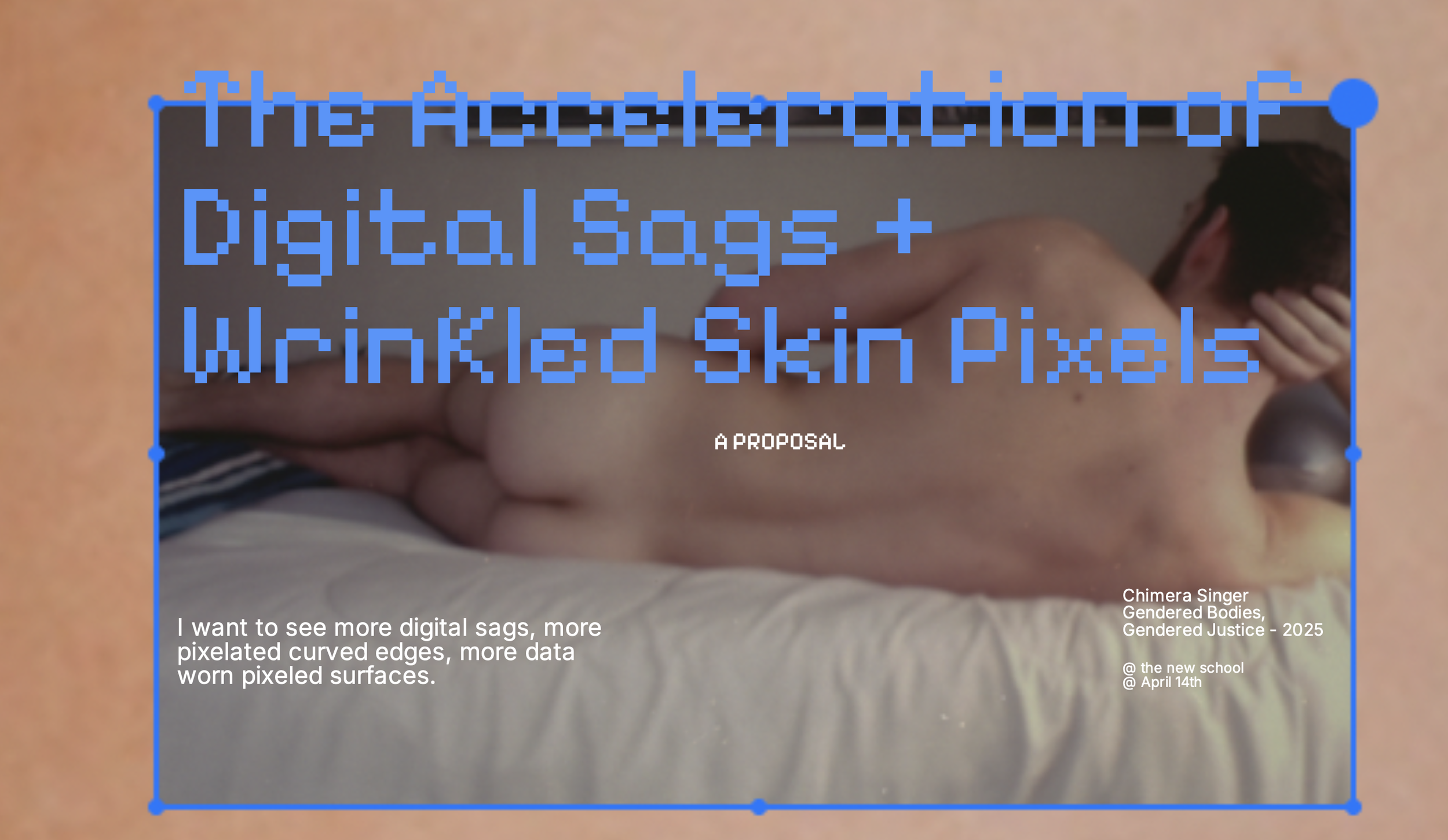
I want to see more digital sags, more pixelated curves edges, more data-worn pixel-surfaces.
I am in the business of seeing, making, and negotiating the image of bodies. I make album photos for musical artists, source material for pitch decks, outline and create websites, generate visual intimacies, scroll instagram, send TikToks, film shorts, and write about my curiosities and challenges.
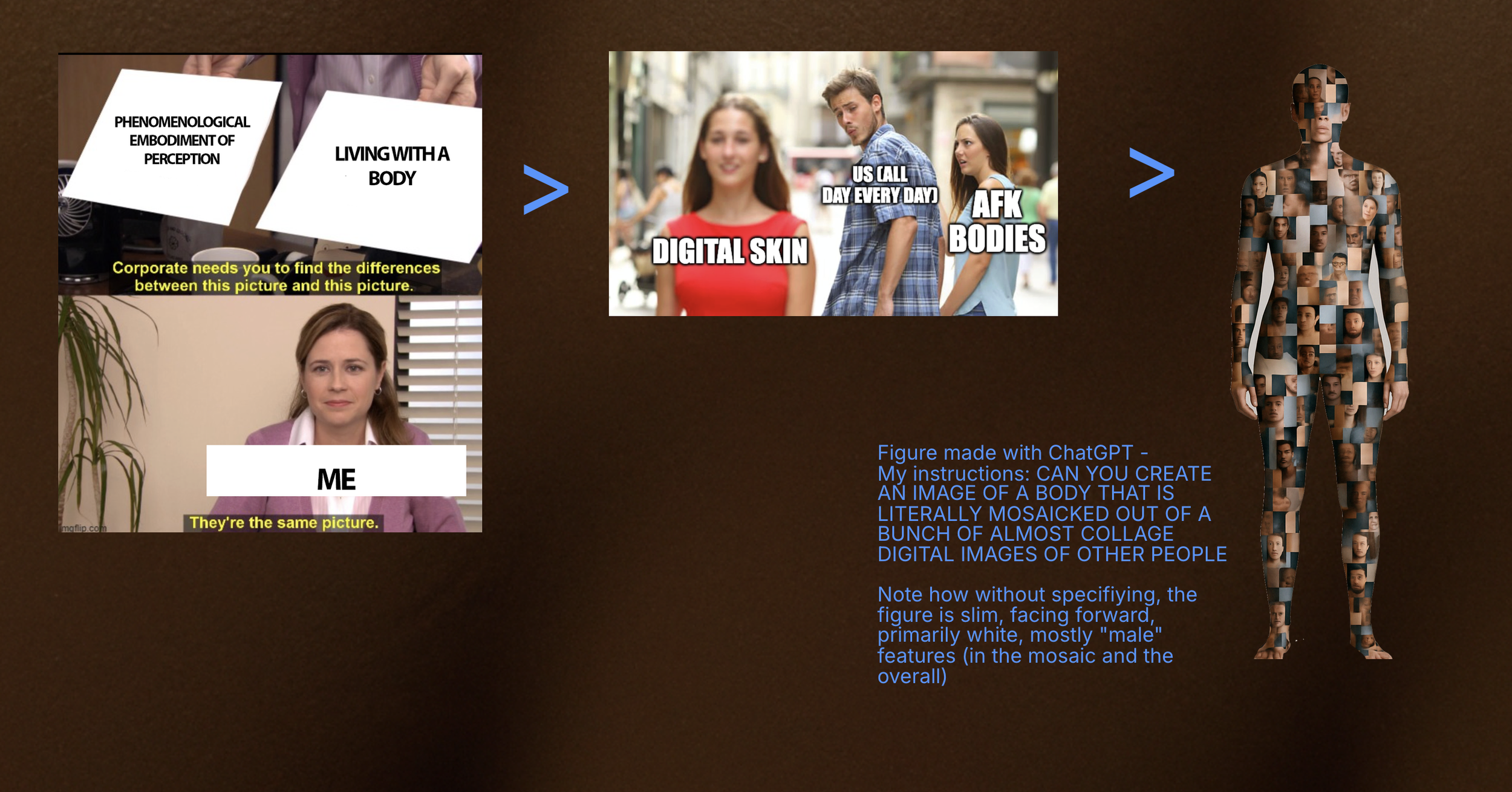
The body is the primary material, celled, meaty, subject simulated by these pixels, even if the bodies are first translated by clay, paint, or animation. The body itself, before it becomes (any layer of) simulated image, already mediates an endless array of assumption, consumption, and presumption. In Disidentification, Muñoz describes the body as a site where cultural meanings are inscribed and contested through performative acts. That is, the body houses our phenomenological perceptions, and as such, remains the primary site in which we negotiate ourselves and one another. The body contains the eyes in which we see our laptop screens, the fingers we use to type and press buttons, the chin that folds as we look to our phones – the sensory information that becomes the data activated by bodies with material and immaterial affect.
Because of this, I am in the practice of looking (and sometimes creating) that which I do not see.
I do not think that representation, especially in isolation without other considerations, is the end-all-be-all, or that it precipitates a liberatory outcome. Hypervisibility in the digital realm often creates a trap where trans, queer, and non-white bodies are more surveilled than liberated by visibility. Huxtable points to how visibility and can expose to violence, "Trans visibility isn’t enough. Hypervisibility often means hyper-vulnerability."
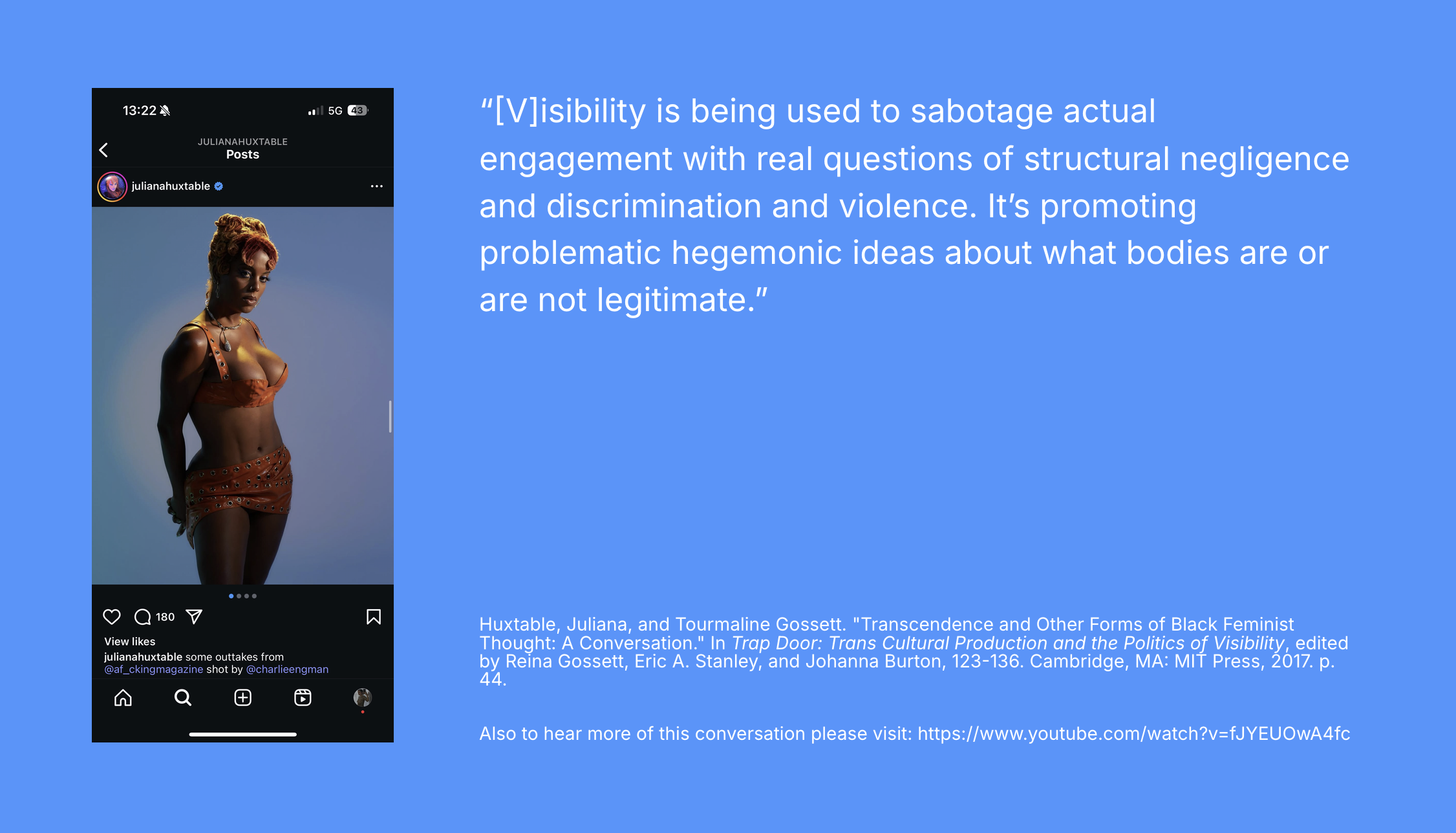
So I refer not to the need for arbitrary representation, or the mere inclusion within failing hierarchical systems of power (This would perhaps fall into using what Audre Lorde refers to as The Masters Toolkit”, and there are many liberatory feats by falling outside of inclusion - as addressed in Queer art of Failure by Jack Halberstam). Material autonomy is often co-opted and proliferated by digital representation (again, endless examples of this as addressed by Legacy Russell in Black Meme, Aria Dean in "Poor Meme, Rich Meme" & Notes on Blacceleration, Safiya Noble in Algorithms of Oppression).
In a recent conversation with Andrius Backus, he and I discussed the ways in which we personally grapple with this in our creation of multidisciplinary art - often desiring to create abstraction or narrativized bodies of flesh as we grapple with this dichotomy.

And yet. We must notice what is excluded.
And yet. I really do want to see and not just think about more wrinkles.
Perceiving in itself remains deeply important as it informs our embodied biases, erasures, assumptions, rejections, and acceptances. Asking what is missing from the barrage of daily images, or what is missing from the (perceptual - visual, sonic, textual..) descriptors more broadly, requires us to identify the areas of our own overlooking.
Overlooking (ie Individual, social and political erasure) reflects the hierarchical within the hegemonic. Much of this is obvious, but how often do we actually take the time to interrogate what we don't see, especially in comparison to the constancy of our ever constant flow of pixel-images, where galleries become digital storefronts, and google searches elicit and reflect archives of body and body-making? Many have taken on the work of identifying and challenging and navigating the countless problems that arise when bodies are represented digitally to varying degrees and with varying methodologies and in various contexts. The contexts, methods, and degree to which these bodies are circulated generate ways of being that marginalize (many of those individuals mentioned previously, alongside people like Preciado, Saidiya Hartman, Simone Browne, Hito Steyerl…)
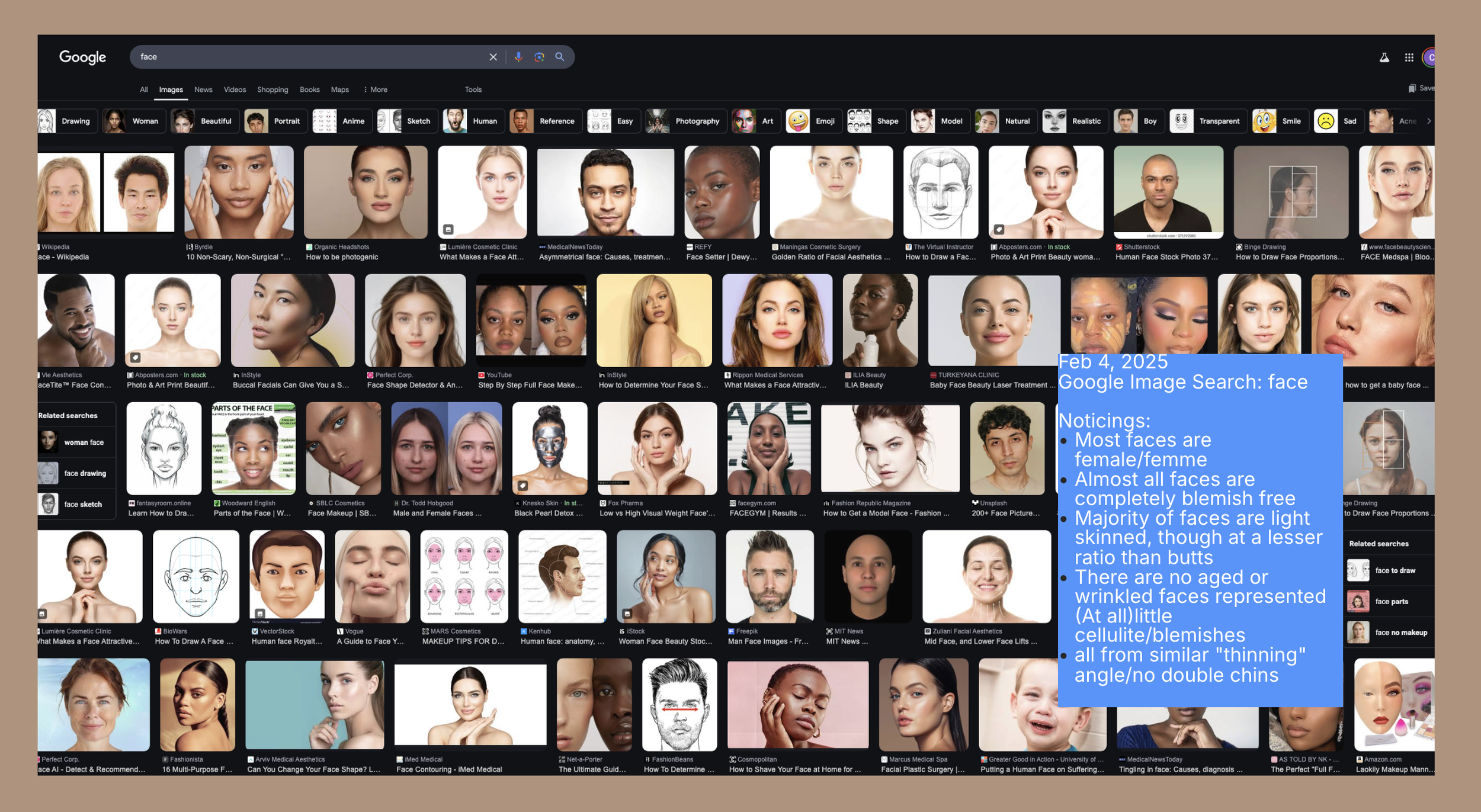
Erasures and objecthoods of personhoods proliferate – reductions and stereotyping occurs. How often algorithms could and do not work to address discrepancies that further and generate marginalizations. Potential counteractive measures instead are replaced by and become cybernetic fleshy balls that roll down hills of “x”s and “o”s at increasing speeds until someone types a metaphorical foot to stopper it, or a tiny stone is thrown to slow it down.
What astounds me, though it perhaps shouldn't because of the algorithmic balls’ escalation, are the images that I have difficulty finding even when I look for them.
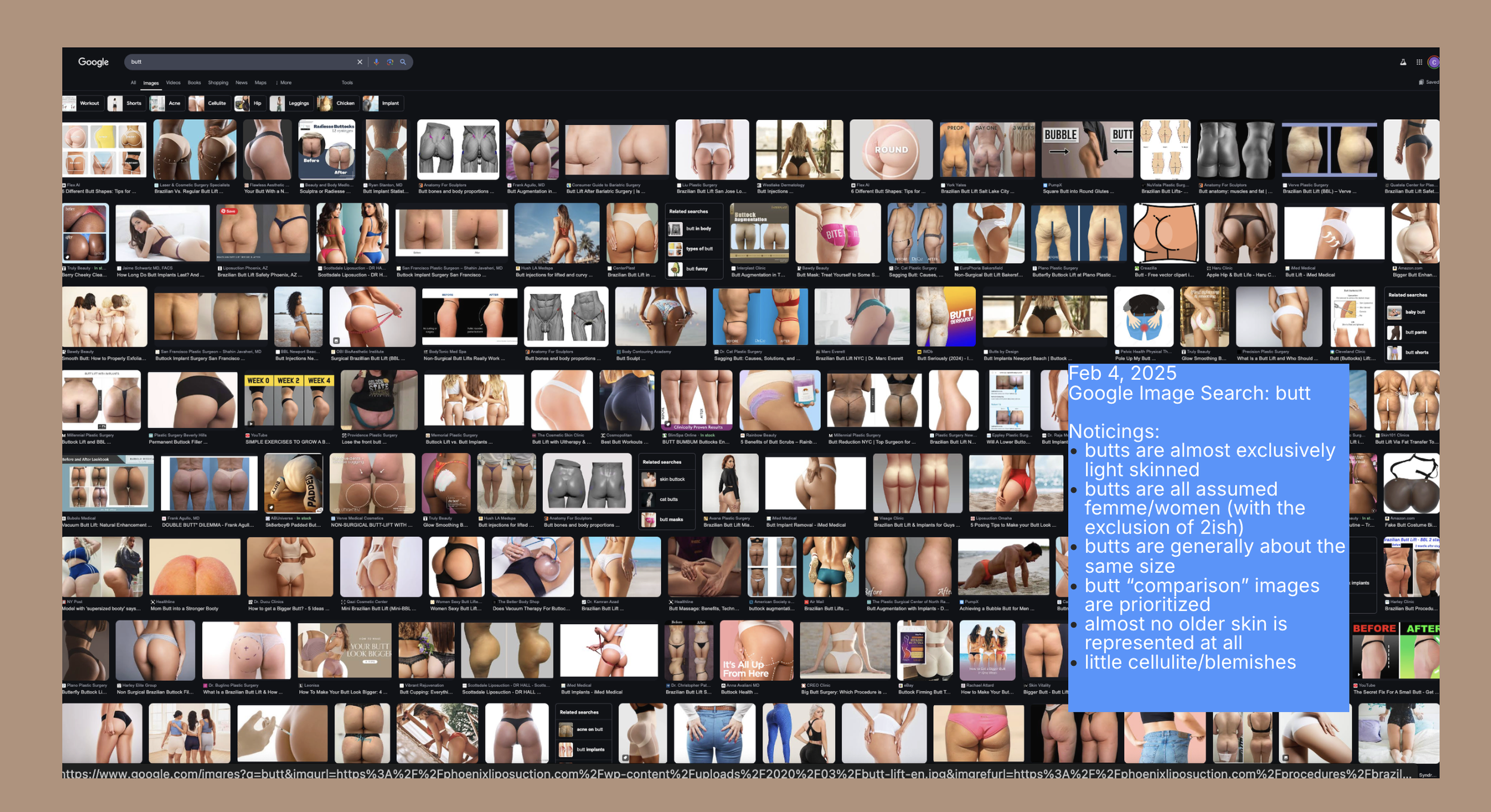
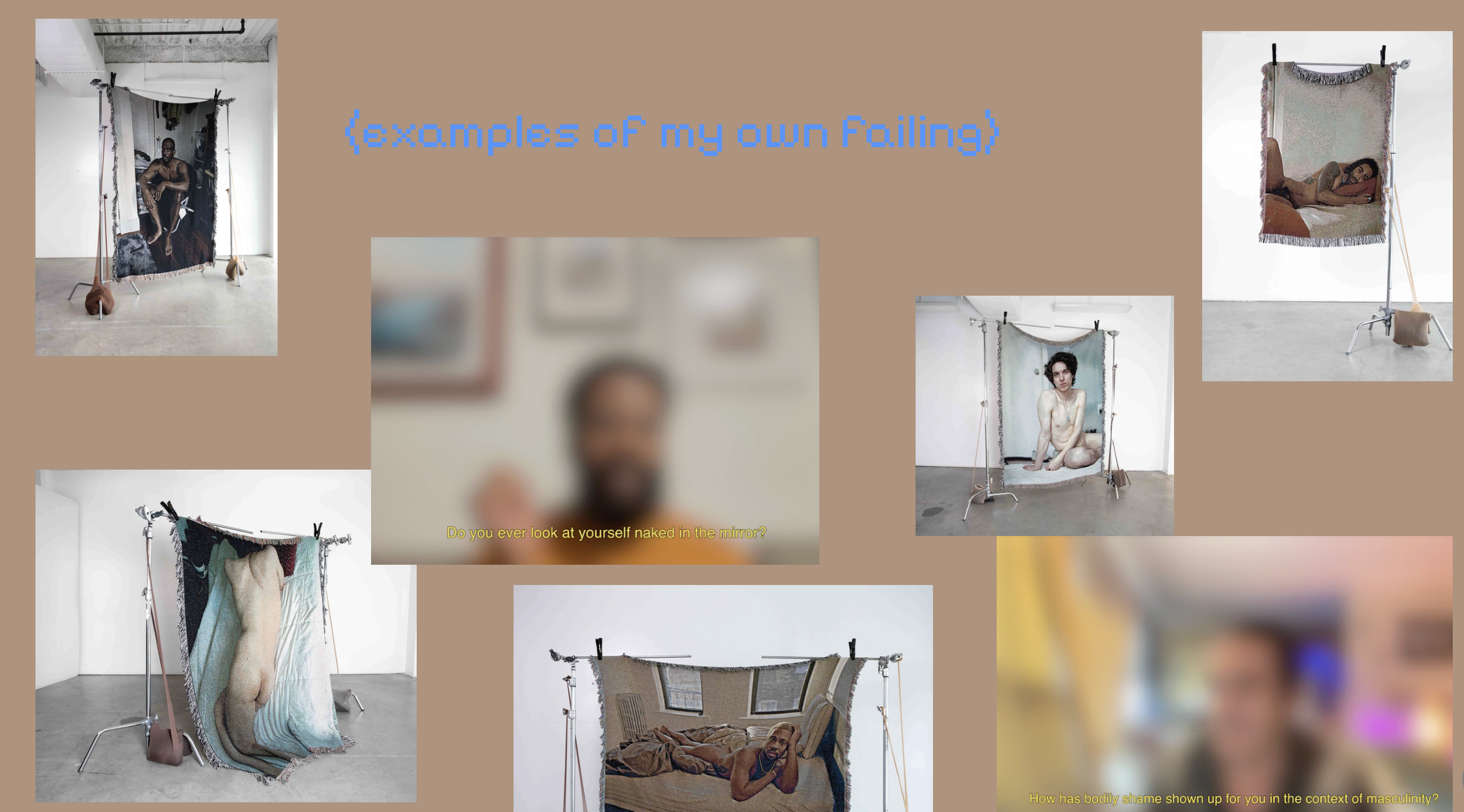
In a recent exhibit I was building a wall of mosaiced forms (check out here). I sought out aged forms, sagging forms, wrinkled forms, desiring to not relegate the body to taught, white, skin. In programs like Cosmos, Pinterest, Google image search, Wayback Machine internet archive, “butt” showed almost exclusively white thin waisted butts. Sagging skin, wrinkled breasts, flaccid penises, intersex genitals, flappy labias - missing. So many bodies, fragmented, were rarely there unless specified, and barely there even when I did. What stood out to me this time was the lack of age - something I recognize as a flaw in my work in this project as I was working mostly within my own networks, so it has been on the top of my mind.
Representations – lack of, erasures, hypervisibilities – have been written and discussed endlessly, and yet, it's something that remains so present. It remains so muc that norm that still we consistently overlook until we are in the excluded group. At this moment, I am caught up in the systemic assumption of youth, and the assumption of desired youth. How are wrinkles in the context of femininity so radical? They, of course, are not, but it would appear as such if we were to focus our gaze to look at sculptures and digitally mediated representations.
We must ask ourselves to look and look again. What is it that we don’t see? Why? In what contexts? With what frequencies? By interrogating what is missing from our visual and algorithmic landscapes, we open up new ways of seeing, resisting, and counteracting the accelerating flow of exclusionary digital images
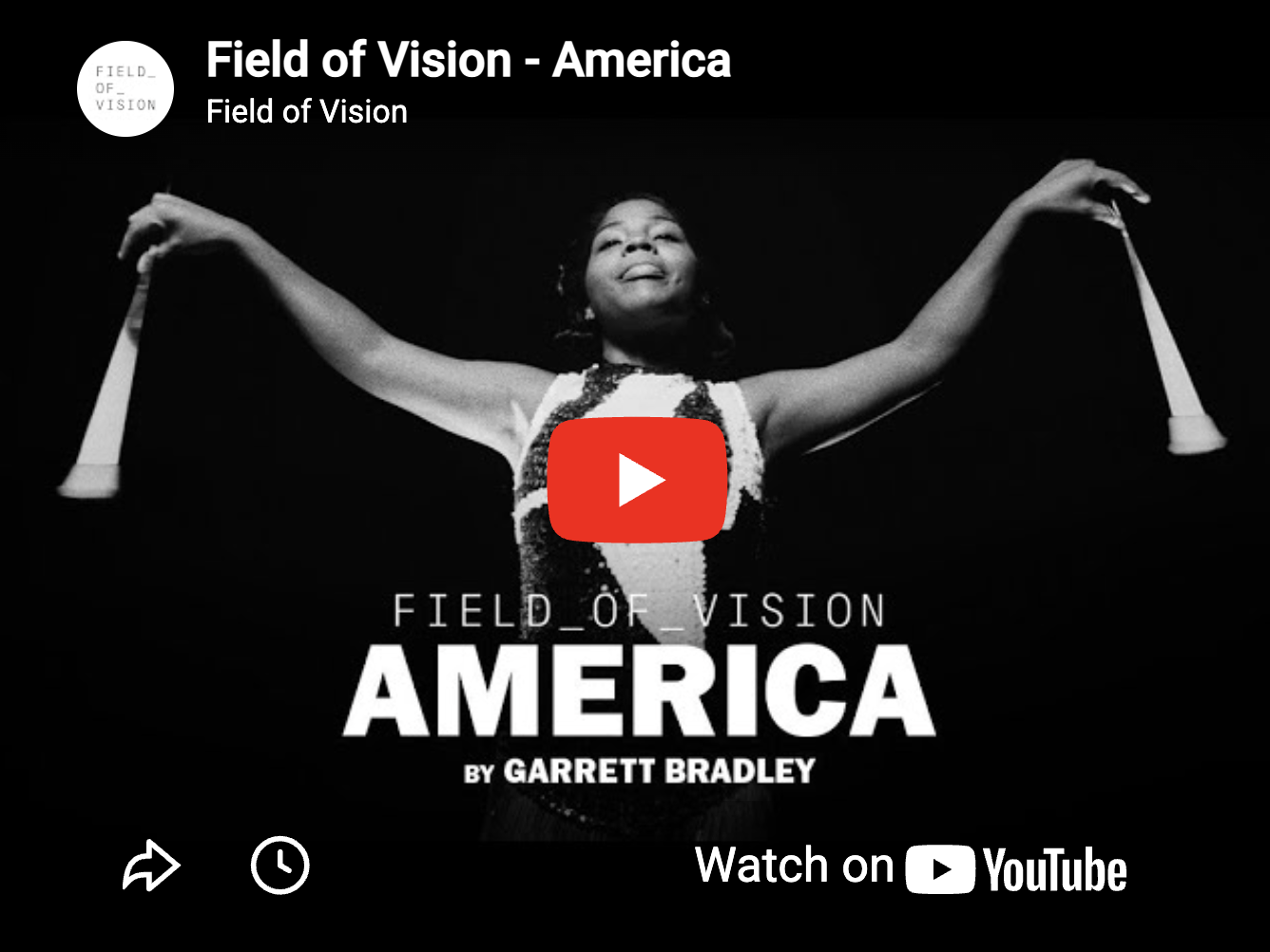
I look to people like Garrett Bradley, who sought to repopulate searches for “America” by titling their film “America,” and Legacy Russell, who points to the furtherance of digital blackface and (profit from others) of memes.