
Conversations with Ghosts
This is where I collect write after encounters with ghosts. Every book, artwork, gallery floor, landscape, every sentence typed…carries the imprint of another being, their thoughts, their memory, their words, their paint, their fleshy fingers. Often I find I cannot write because the topic of yesterday’s reading slips away, I’ve latched on to a more recent thought or idea. SO, alongside collecting word-works, this is also a space where I write new scraps with: the thing I'm reading now. The work I saw today. The phrase someone said that won't stop circling. Each pixelpage is a trace of that meeting, between the living and their hauntings. In Fragments, typos will be had. Errors made. Revisions necessary.
Fragment by fragment, ghost by ghost. I encounter them and something moves between us, a conversation that started before I arrived.
Selections (keep scrolling for the full list)
Conference Lecture

Zine, Drawings + Essay
Essay, sample of MA Thesis
Soft Images: toward a less certain penis
irl lecture
Fleshly bodies are in a constant state of slippage and glitch. They refuse to be simple or easy to label, define, represent, or symbolize. As soon as we give them shape, color, or language, nuance and complexity are erased—assumptions are assigned.
This is accelerated by the rapid transmission and algorithmic reward for images that are easily legible and quickly interpreted.
These systems don’t just circulate meaning—they construct it.
But like bodies, and everything really, this generates feedback loops. Assumptions and flattened understandings slip and leak back into our fleshly, corporeal bodies. We are moved and oriented—how we speak, write, make images, and engage with others is shaped by these mediated constructions.

Today, and many days frankly, I’m looking at how this process constructs one body part in particular: the penis.
My work professionally and academically is in excavating and unearthing assumptions of the body that I—and we—adopt culturally, especially in the US.
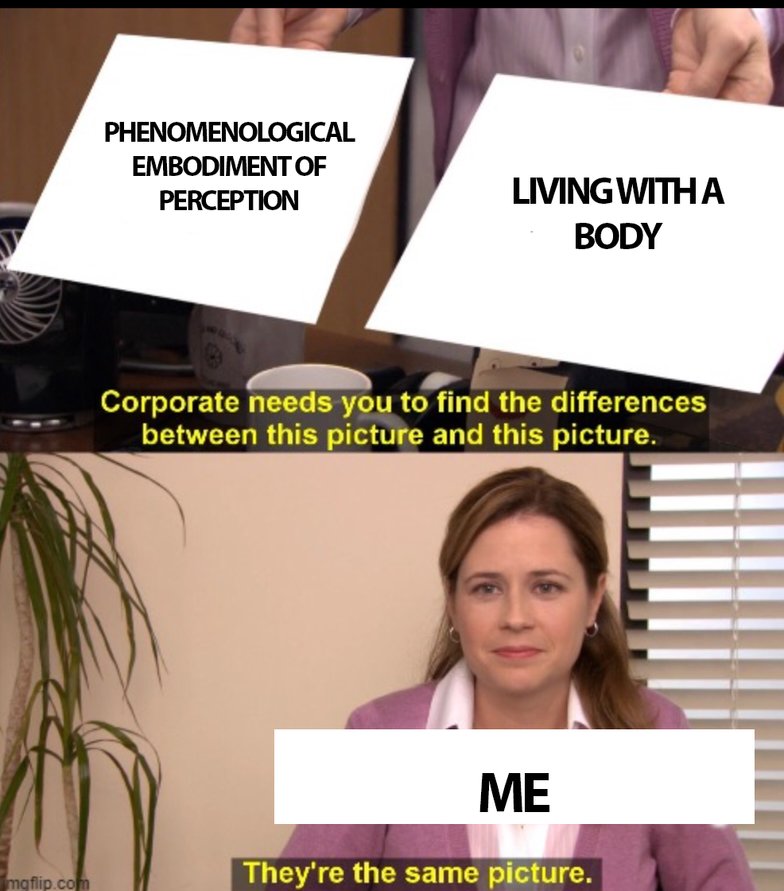
By default, this has meant working through media studies, because our phenomenologies of perception are so deeply entangled with the near-constant perceptual visual and sound mediations we engage with.
These interpretations become lived in our bodies and spill outward—into texts between friends, Instagram comments, drawings in margins, textbooks, and, often unfortunately, our medical practices and policies.
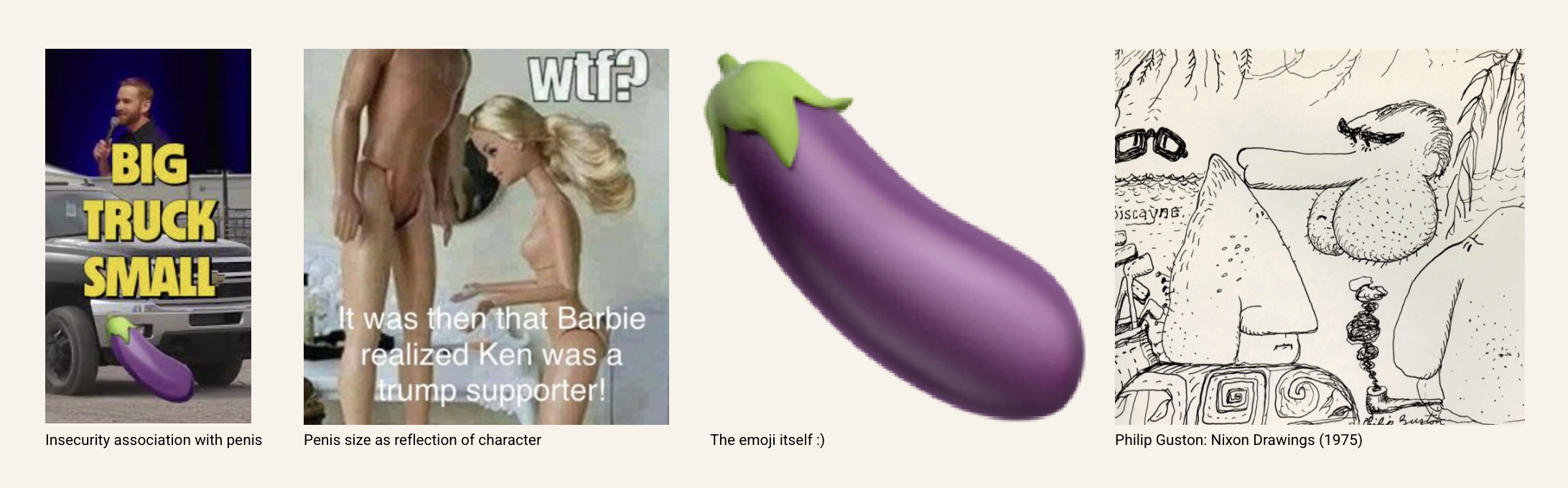
I’ve become particularly interested in the penis—not as a Freudian Phallus, but as a body part that has been fragmented from the body, that it has a life of its own.
We often encounter the penis as a symbol before—or instead of—its fleshly origin.
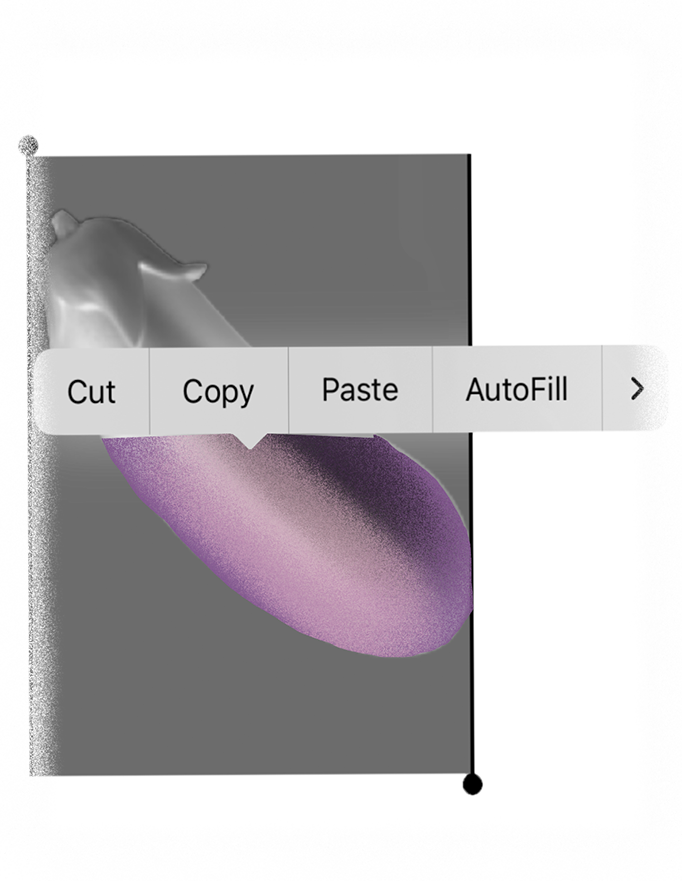
Instead of flesh made of blood and skin, it becomes an eggplant emoji, communicating thirst or jokes.
It becomes shorthand for misogyny on subway walls, or in art. (This one by Pussyfoot)
An unsolicited Dick Pic on our phones, a tool of power play.
It becomes a tool of ridicule in political cartoons and in our everyday colloquialisms.
Its representations are employed as tools that communicate broader ideas rather than communicating the actual body part.
Perhaps the most entrenched symbolic construction is the penis as a primary tool and communicator of violence, domination, and rape.
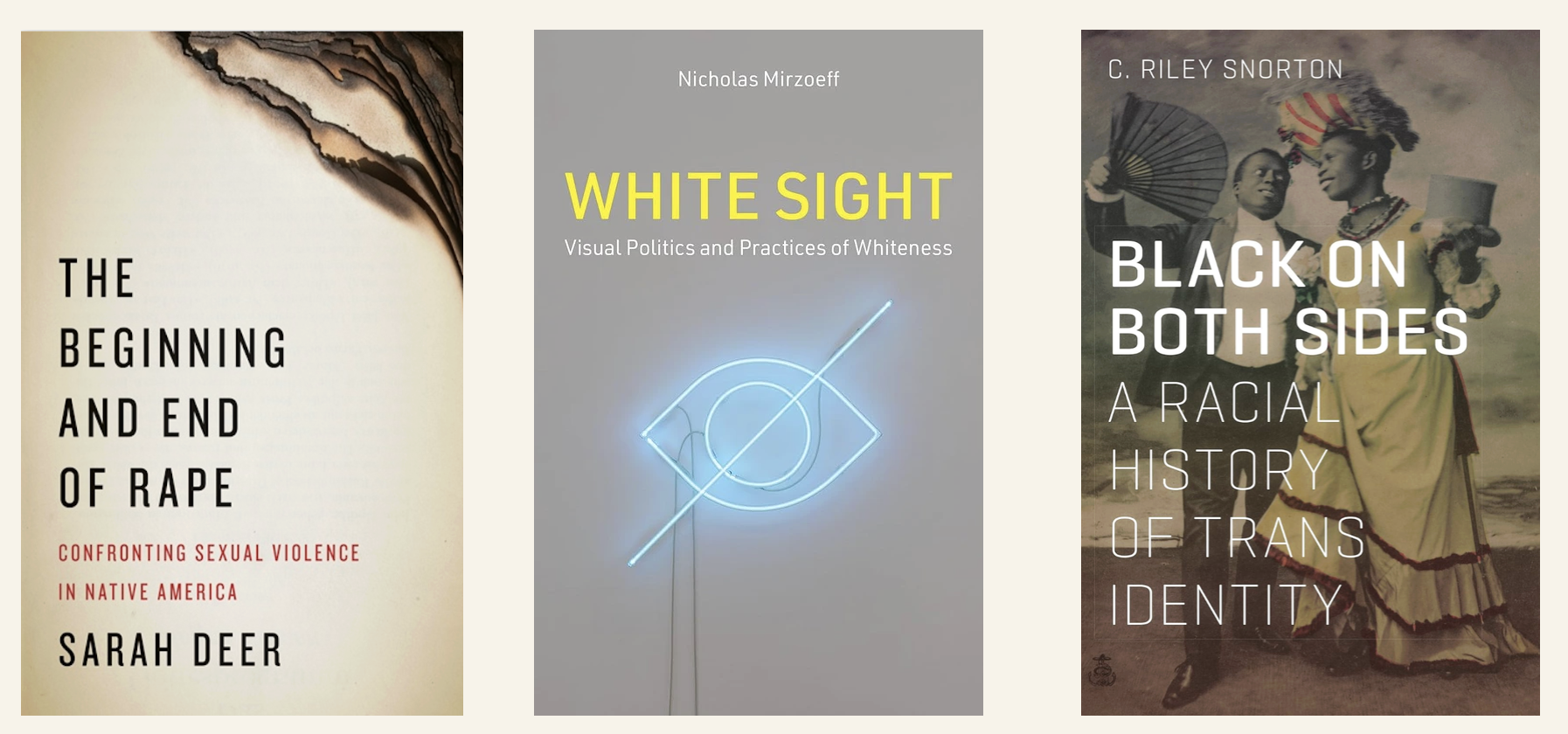
Nicholas Mirzoeff, drawing on Sarah Deer, writes that rape can function as a metaphor for colonialism—but is also an everyday practice of racial capitalism.
In this context, the Phallus is not just anatomy—it is the penis within a structure of violence.
But this symbolic weight expands outward into how we interpret sex and nudity more broadly.
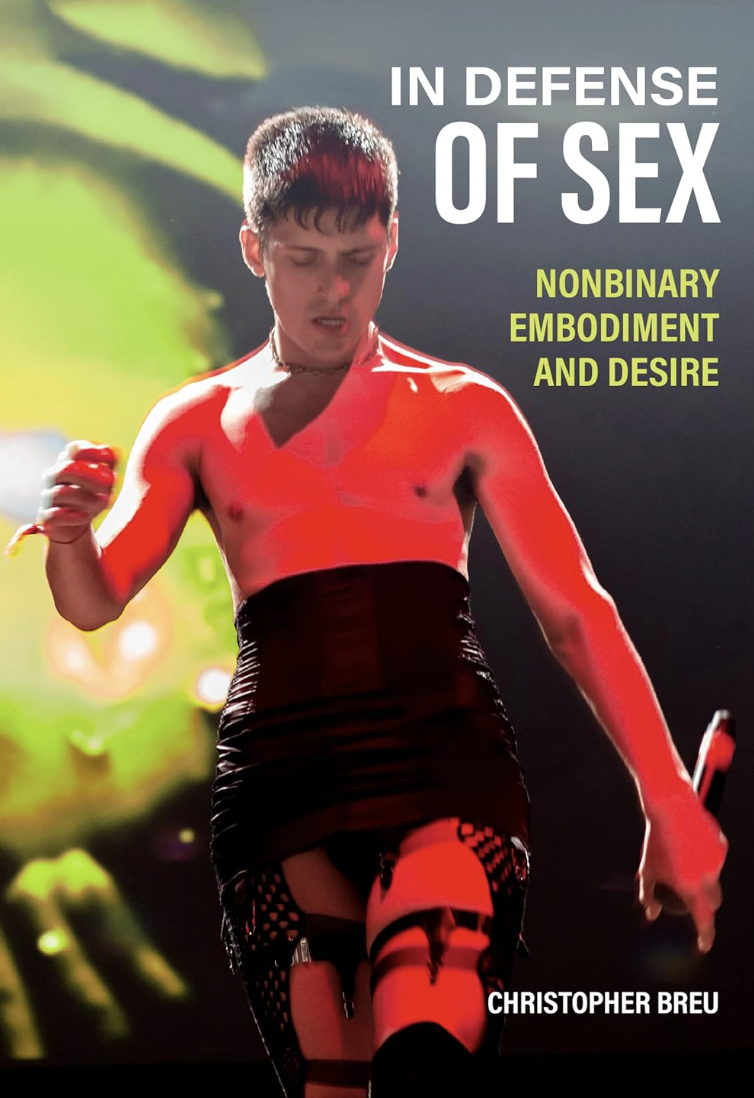
In In Defense of Sex, Christopher Breu describes a cultural condition in which even nudity itself becomes potentially traumatizing—where the presence of the body is already read through the possibility of harm.
Christopher states that not only is sex now associative with trauma, but “Nudity itself has now become potentially traumatizing. I am not talking about the obviously aggressive and intentionally traumatizing actions that fall under the category of indecent exposure. We live in a culture where sexual violence and the straight, cis, male control of public space, through acts of symbolic and physical violence, are still much too prevalent. However, I am talking about the way in which even animal nudity is regularly blurred out on Facebook posts or moments in which the panopoly of meanings attaching to the artistic display of nudity or scanty dress gets read as de facto traumatizing...”
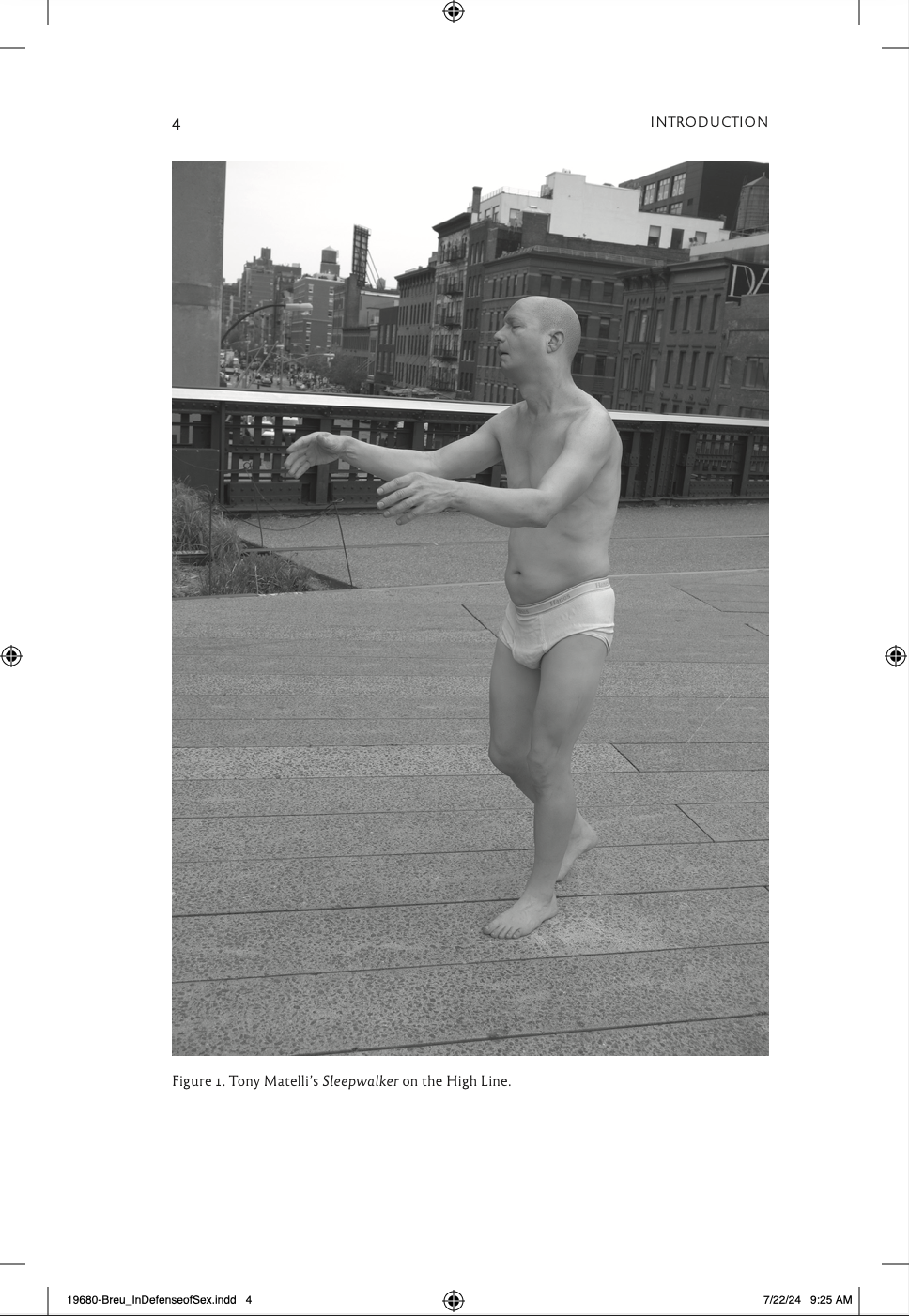
The example that Christopher gives is of Tony Matelli’s sculpture “Sleepwalker,” a figure of a presumed man clad only in underwear, one they describe as “vulnerable and older.” The lifelike sculpture was placed on a college campus and was taken down due to folks interpreting it as trauma-inducing.
Institutional organizers likely would not, and do not, receive accounts of the countless nude sculptures and images of female coded (ie breasted and with vaginal genitalia) as traumatizing. We see it everywhere. This distinction is missed, or at least not explicitly stated, in Christopher's assessment. It is the penis, even a sculpted penis, hidden behind sculpted underwear, in a vulnerable position, that is considered Phallic. In this, It is not just a covered penis, but a slyly hidden symbol of innate sexual White non-trans male violence.
Even when it is not acting, not visible, or even concealed, the thought penis is still read through this symbolic frame.
Even the penis in representations of vulnerability are read as threat.
We need to return to the body as a neutral site.
No body part is inherently moral.
No body part is inherently violent.
It is flesh—benign, variable, contingent, and attached to very real and variety of humans.
One of the most harmful effects of this symbolic construction is the essentialization of the penis that is innate in these framings.
In shaming it, fearing it, and equating it with rape and violence, we:
erase or shame intersex bodies
erase trans women who keep their penis, by choice or circumstance
shame trans masculine people who pack or want to pack [INSERT PIC}
reinforce racialized stereotypes, like those of Black men
and also often mistakenly attribute power where there less (ie - a gay black man with a penis, is often going to be more oppressed than a white woman without a penis)
These symbolic constructions of the penis assume a stable, non-trans body—and often racialize that body in contradictory and harmful ways.
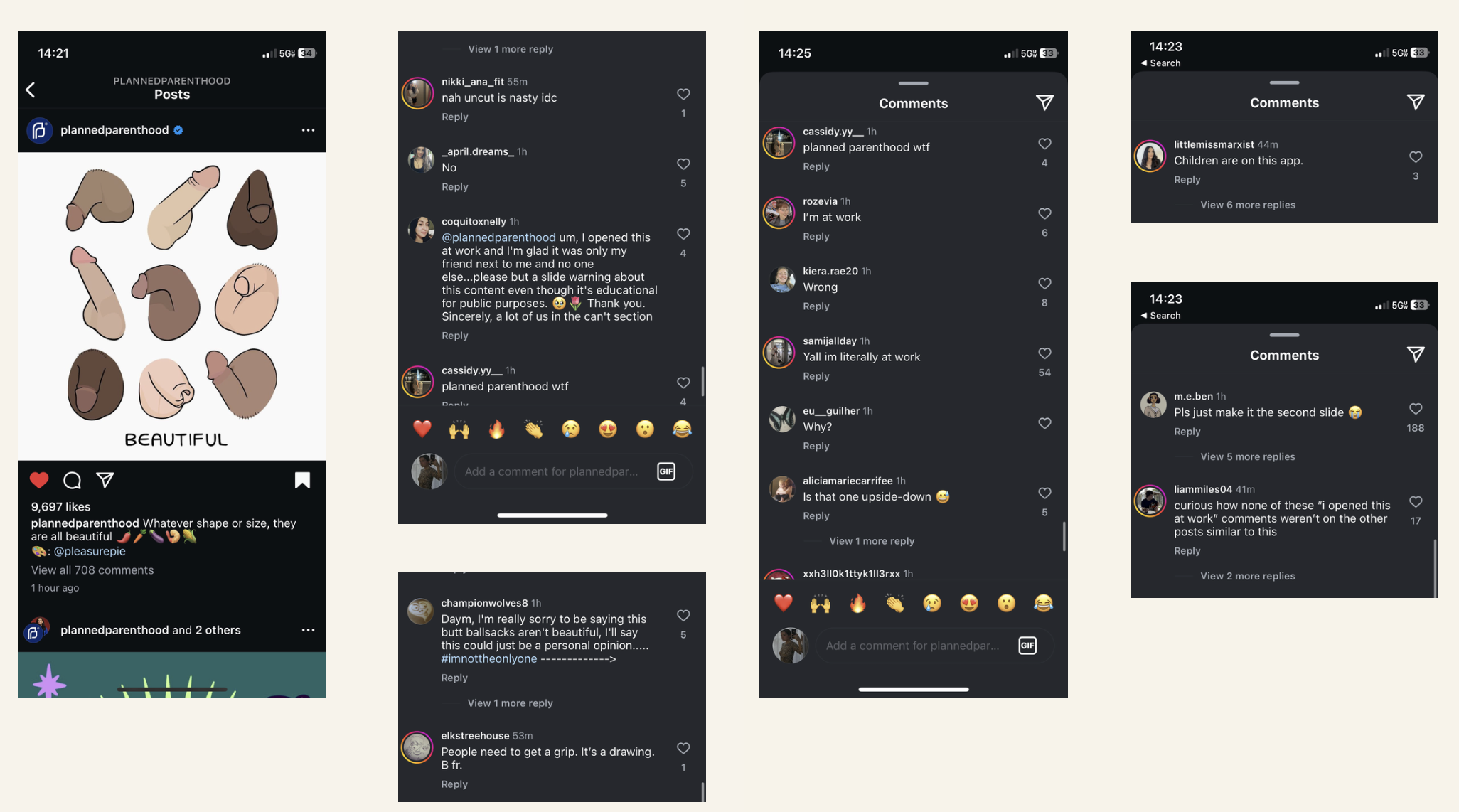
These instagram comments, taking offense at cartoon penises, often calling them gross, are talking about real people. Disgust of others bodies should never be accepted. Especially under the guise of feminism, fighting racial patriarchal capitalism too important.
A friend recently asked me how one makes the penis non-phallic.

And the answer is actually quite simple:
The penis is not phallic most of the time.
It is made phallic.
It most often exists as soft, flaccid, non-performative.
An erect penis is not the norm—but generally brief moments, as millions in research for things like viagra can attest.
To see the penis as non-phallic, we have to stop attributing fixed meaning to it.
We are assuming:
that the penis belongs to a non-trans person
that the penis perpetrates harm, rather than sometimes being a vehicle and subject within systems of harm
that it carries stable racial meaning in the context of cisness
that it is erect, or capable of staying erect
that body shaming constitutes critique
This part becomes a little dense. But I’m going to provide a bibliography for those who are interested.
These assumptions rely on a broader framework of how we understand bodies, gender, and power.
And Marquis Bey reminds us that cisness is not neutral—it is historically structured through whiteness. What we expect in cisness is most often a White cisness. (Define his framework)
Black bodies, through the violence of the transatlantic slave trade and its afterlives, have been both hypersexualized and quite literally ungendered and denied gender/sex—positioned differently within these relational frameworks of power. (Reference whatsherface black on both sides)
Building on this, Perry Zurn proposes the term “non-trans” instead of “cisgender,” as “cisgender” itself reinforces a binary that erases intersex and other non-normative experiences. (Explain this)
I want to mention Emma Heaney’s concept of penetration as a way to think through this differently. I know the phrasing sounds a little aggressive, but conceptually it works. (Explain this/ define the phrase)
Heaney uses the term penetration not as a literal act, but as a conceptual process for understanding hierarchy and relationality.
Within this framework, bodies are not fixed as identities cis and non cis or male and female, but are positioned in relation— a network of
as penetrated and penetrator. If you’re interested in learning - she has a book called Feminisms against cisness which is free online.
It unsettles the assumed coherence of assumption of cisness, which relies on fixed, binary, and stable bodies.
So when we talk about the penis as symbol, and more importantly, when we use it as such and embrace it, we are not just talking about a body part—
we are also embracing a set of assumptions we ourselves are making, built on unstable, racialized, and historically constructed categories of gender and power.
Reclamation of the penis does not mean ignoring harm or rape.
It means speaking about harm without collapsing it into a body part.
It means understanding that violence does not live in the penis itself, but in the systems, structures, and contexts in which it operates esp with non trans white men in patriarchies.
A reclamation might look like assuming a penis:
that is non-cis, non-gendered, racially expansive, and often flaccid.
This is not a minimizing of harm—it is a more precise account of where harm actually lives, and an embodied acceptance for a variety of ways of living with a body, including a penised one.
We must collectively reckon with how often we essentialize and flatten bodies—including bodies with penises.
What this looks like in practice:
physically drawing or looking what makes us uncomfortable (not shying away from it in museums, public spaces, looking at ones own or partners body)
wearing brands like Carne Bollente that embrace penises
shifting language away from “big dick energy” or “small dick energy”
engaging representations that complicate rather than reinforce
In my work, I’ve done this a few ways…
Figuring Flesh workshops
Workshops where drawing becomes a method for slowing down perception and collectively unpacking the assumptions we place onto bodies.
The Nude (but male-ish)
An ongoing project of nude portraits, anonymous interviews, and multidisciplinary works that reframe the penis outside of fixed identities and symbolic expectations.
@theproblempen_s (Instagram)
An archive of penis imagery encountered in everyday life that tracks how the penis circulates as symbol across casual, digital, and social spaces.
Photographing every penis in the Met (ongoing)
An ongoing study of how the penis has historically been represented in art, approached as a form of social and visual relearning.
If the penis has been constructed as a symbols for misogyny and violence, then it can be constructed otherwise.
And that work begins by returning it to flesh, a flesh that belongs to bodies that glitch.
Bibliography + Recs
Ahmed, Sara. Queer Phenomenology: Orientations, Objects, Others. Durham: Duke University Press, 2006.
Berlant, Lauren. Desire/Love. Brooklyn: Dead Letter Office / Punctum Books, 2012.
Beu, Marquis. Cistem Failure: Essays on Blackness and Cisgender. Durham: Duke University Press, 2022.
Breu, Christopher. In Defense of Sex: Nonbinary Embodiment and Desire. New York: Fordham University Press, 2024.
Cotten, Trystan T., ed. Hung Jury: Testimonies of Genital Surgery by Transsexual Men. Oakland: Transgress Press, 2012.
Deer, Sarah. The Beginning and End of Rape: Confronting Sexual Violence in Native America. Minneapolis: University of Minnesota Press, 2015.
Freud, Sigmund. "The Infantile Genital Organization (An Interpolation into the Theory of Sexuality)." 1923. In The Standard Edition of the Complete Psychological Works of Sigmund Freud, vol. 19, translated and edited by James Strachey, 141–148. London: Hogarth Press, 1961.
Gleeson, Juliana. Hermaphrodite Logic: A History of Intersex Liberation. London: Verso Books, 2025.
Grosz, Elizabeth. Volatile Bodies: Toward a Corporeal Feminism. Bloomington: Indiana University Press, 1994.
Heaney, Emma, ed. Feminism Against Cisness. Durham: Duke University Press, 2024.
Merleau-Ponty, Maurice. Phenomenology of Perception. 1945. Translated by Donald A. Landes. London: Routledge, 2012.
Mirzoeff, Nicholas. White Sight: Visual Politics and Practices of Whiteness. Cambridge: MIT Press, 2023.
Russell, Legacy. Glitch Feminism: A Manifesto. London: Verso Books, 2020.
Snorton, C. Riley. Black on Both Sides: A Racial History of Trans Identity. Minneapolis: University of Minnesota Press, 2017.
Spillers, Hortense J. "Mama's Baby, Papa's Maybe: An American Grammar Book." Diacritics 17, no. 2 (1987): 65–81.
Steyerl, Hito. "In Defense of the Poor Image." e-flux 10 (November 2009). https://www.e-flux.com/journal/10/61362/in-defense-of-the-poor-image/. Also collected in The Wretched of the Screen. Berlin: Sternberg Press, 2012.
Zurn, Perry. Cisgender: Disorienting a Category. Durham: Duke University Press, forthcoming 2026.
Muted Spaces, Resonant Bodies
irl lecture, essay
Sound In Museums Conference - 2025 - Mafra, Portugal -
Sound In Museums Conference - 2025 - Mafra, Portugal -
Curated Bodily Wrongness
There was a time not long ago, before my mom and I knew we were autistic. A time before we knew how trauma, Complex PTSD, and autism directed our bodies a little differently than those around us.
I now understand how we stand is a little too close to the art on the walls. How when we speak it's a little too soft. And that I shut the door a little too heavily. How our desire to touch can precede the asked-for preservation of materials. How we laugh a little too loud, or whisper at just the wrong time.
We could feel the wrongness of our bodies in space and time, a wrongness that extends and is felt by so many in their own bodies in various ways. This wrongness is especially pronounced in art exhibition spaces: an issue of curation and institutional expectation. The particular strength of expectations of "rightness" in exhibition spaces makes this wrongness exist in the many, not just my mom and I.
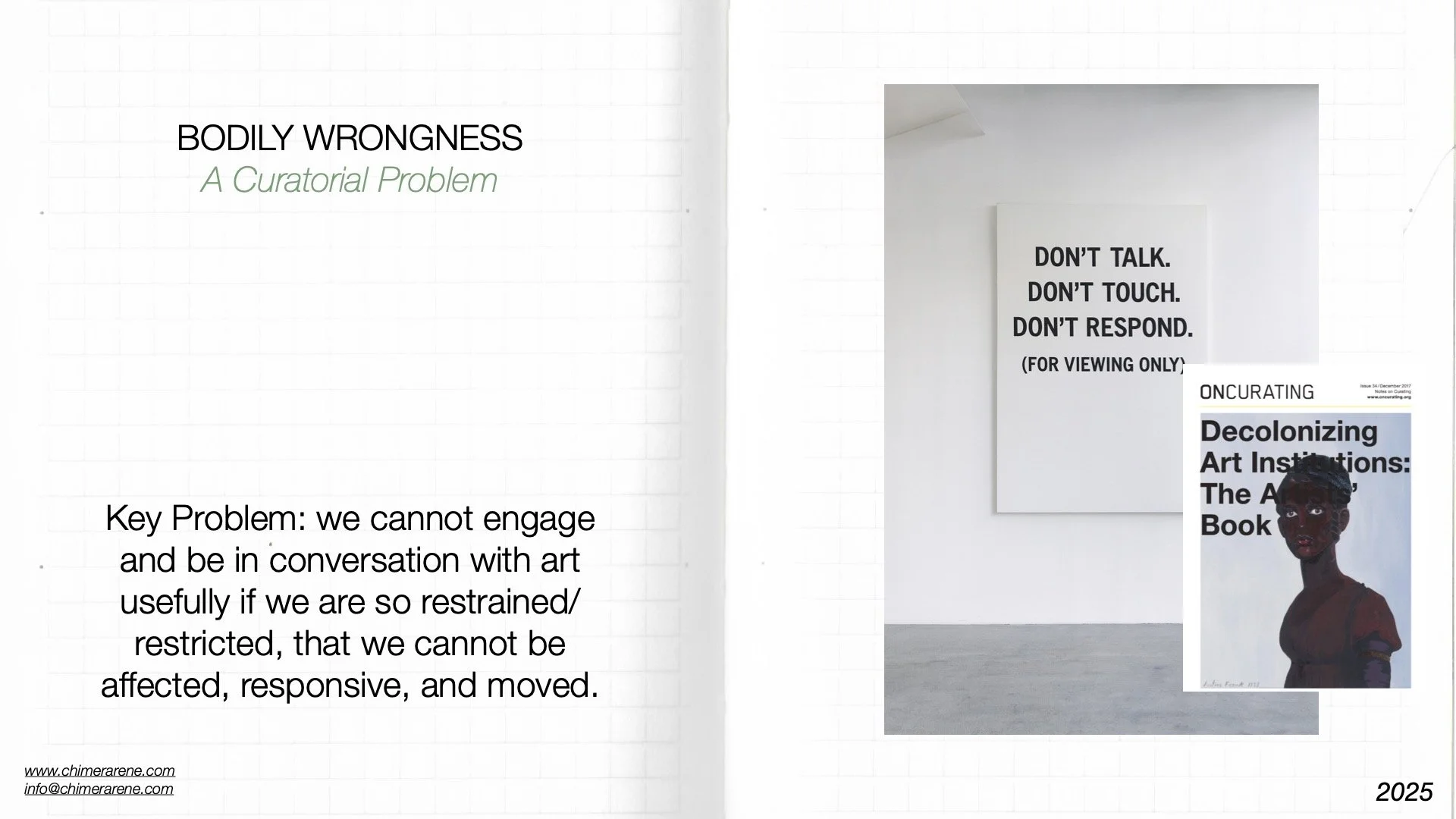
This discomfort is so widely experienced that it becomes a primary focus in "Decolonizing Art Institutions: the Artists Book" (issue 34 of On Curating). In describing her experience at Lina Bo Bardi's Museo de Arte de São Paulo, Maria Thereza Alves explains how her mother was terrified to enter—certain the guards would shout at them to leave, dragging her feet even after they'd bought tickets, whispering that they wouldn't be allowed inside. The fear of public embarrassment, of not belonging, held her back even at the threshold.
It's a feeling so many of us are familiar with in art curatorial spaces. Of feeling like we don't belong. It is readily apparent that this is because of classist, elitist expectations. What I think is less noted is the specific tangibilities in which this becomes apparent, and that's what I will be addressing today.
Giovanna Bragaglia asks: "Museums have, or at least should have, very different aims; however, how can they continue using the same structure as before? There is a need to rethink its nature as a social space, as a space of representation, observation, display, and regulation. How to build a place that people are not afraid of? How to engage people to be part of it? In order to make contemporary art more open to the world, perhaps the solution is to try to transform it into a home, where visitors and artists are not received as numbers or even guests, but in a place that they can feel at home."
While I share many of the same questions, I don't particularly desire to make it home. It assumes too much about home and comfort, and assumes too little of non-private and public spaces as inherently uncomfortable. It is for this reason I point to bodily wrongness versus discomfort. Many growings and learnings are deeply uncomfortable. So instead, I ask: how can we create these spaces to be ones in which we can engage art? And we cannot engage art if we are so restrained, so restricted, that we cannot be affected, responsive, and moved.
Art as Movement - An Emotive Force
I used to dread entering these spaces. Not because of their starkness, but because of how watched I felt, how restricted. Body physically tightening.
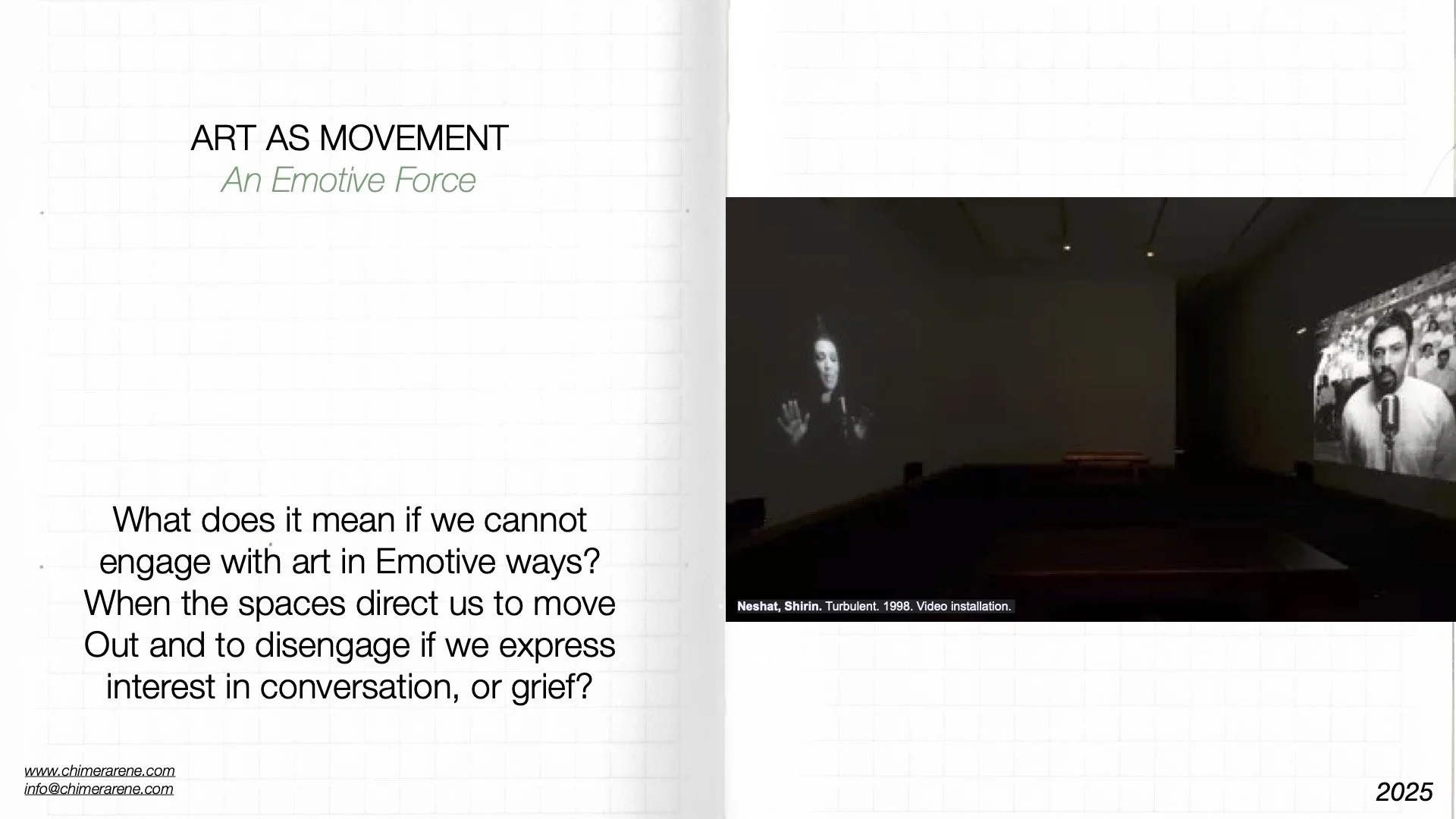
A particularly memorable moment: many years ago, my body crumpled in uncontrollable, body-vibrating sobs, echoing the cries of the song sung in Shirin Neshat's Turbulent. The screens and screams cocooned me in a dark museum room, eliciting immense grief. I later learned this was a PTSD response that the work had triggered.
I am deeply grateful to this terrifying experience. Grateful because it shifted grief that had stoppered inside for so long that I now will spend the rest of my life uncovering it. I was physiologically impacted by this emotional and emotive experience.
But I was not only moved to uncover grief—I was also moved, externally re-oriented, by the pressures of the institutional space. At The Broad, though it is not specific to just this institution, I turned away from the artwork and fled.
What is art but an empty aesthetic object if when it speaks to us, we cannot respond? If we are embarrassed? An emotive body can be silent, struck with awe. But it can also make sound. Sobs.
Art is like the tides in that it moves us, lifts us, and takes us with it. An outside force often outside of our control. The stifling hums of our vagus nerve, the squeaking pacing steps—the way we have constricted our museum spaces is in resistance to our own metronomic tides.
We need to create embodied curations that allow the tides to move us. In order to do this, we need to prioritize other forms of engaging art beyond the silent gaze. While there is use for silence at times, the decibel level in many museums—particularly in NYC—is that of a scream held in.
The tides move us in waves, rocking us to and fro in the rhythms we use to soothe babies, the paths our feet walk when we pace. My mom does this already. Her feet tap in rhythms. It does not stop when she sleeps, which as a nervous child would drive me crazy.
But First: What Is Art?
Art is defined by its relationship between (sorry greek terms, they dont exist in english) poiesis (POY-ES-ISS), pathos, and tropē. Art historically has been so hard to define because it is defined by a moving relational network. Art is poiesis (poy-es-iss) that produces pathē (PAH-thay) through tropē (TROH-pay).
In poiesis, something is brought into being—whether shared publicly or experienced privately, the essential act is one of making, of creation. Often this is done via "thinking through things," where language or thought alone fall short and something must be made. Artistic poiesis differs from mere craft in its orientation: it aims toward pathos, toward affecting the experiencer.
Pathē are not emotions we choose but states that seize us—bodily, visceral, involuntary responses to what stands before us. We are acted upon, moved, impressed. Yet the pathē (PAH-thay) of art aren't arbitrary sensations. They operate through tropē: art turns us, redirects our consciousness, reorients our understanding.
Where a utilitarian object—like my coffee mug I sit and drink from as I wrote this—confirms existing patterns (the mug delivers coffee as expected), art disrupts and redirects, though not always in constance. It is, like the tides, moving us. It uncovers what was hidden while simultaneously guiding us toward new territories of experience. Art, then, is making that which moves us by turning us—poiesis producing pathē through tropē.
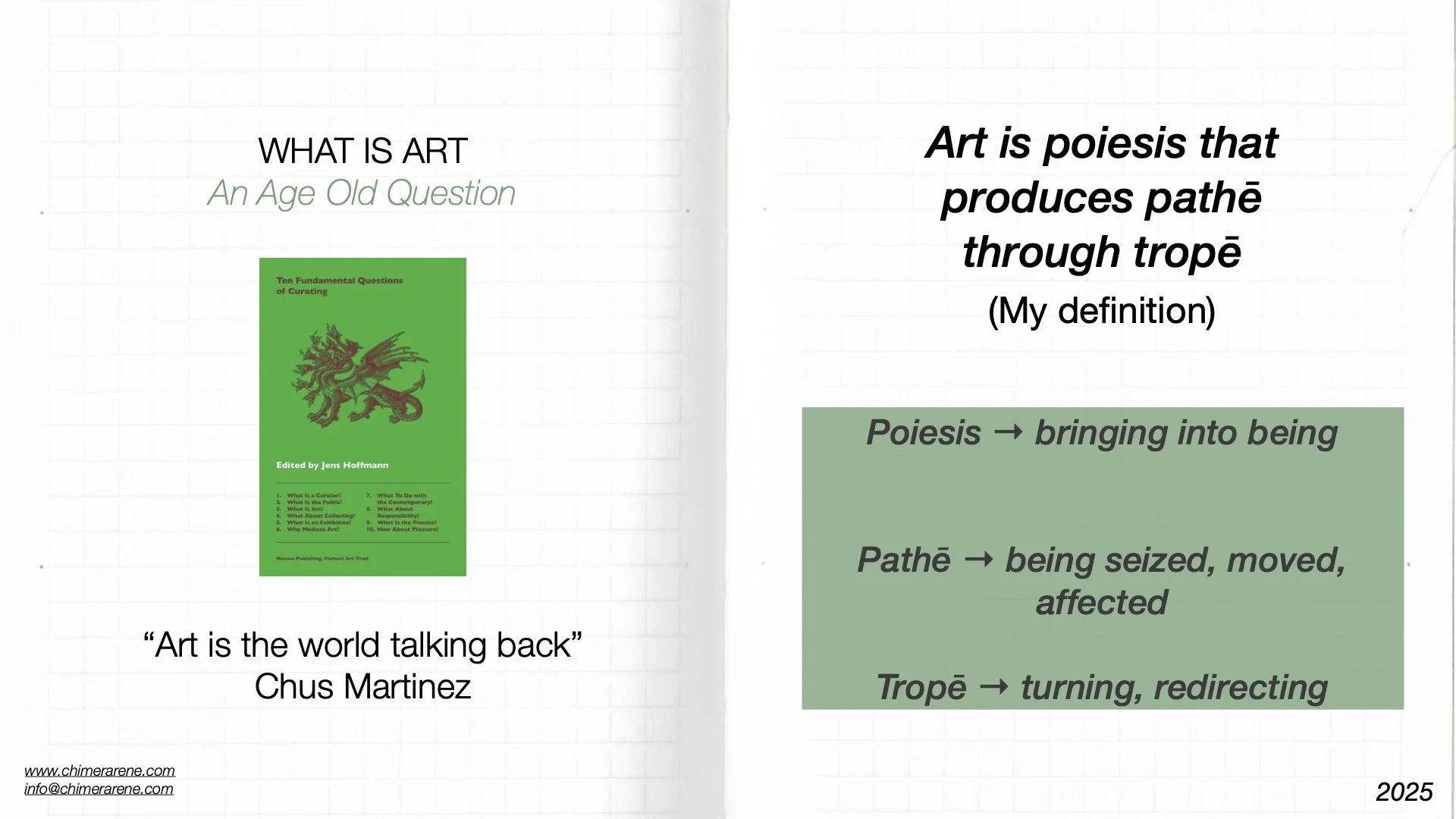
A very clear example is Duchamp's urinal. Duchamp brings something into being—not by traditional making (sculpting, painting), but by selecting and recontextualizing. The act of signing "R. Mutt," the sculptor (as so many urinals are or were made), titling it Fountain, and submitting it to an exhibition is the creative gesture. The poiesis here is conceptual displacement.
Viewers undergo something visceral: the collision between "sacred or elite art space" and "hidden bathroom fixture" creates a bodily, intellectual jolt.
This is where Fountain becomes genuinely artistic rather than mere provocation. It turns your understanding—it reorients what counts as art, what counts as creation, where aesthetic value resides. You can't look at art the same way after encountering it. It redirects consciousness from "art = skilled handcraft producing beauty" toward "art = framing, context, concept, questioning." The urinal doesn't just shock—it pivots the entire discourse, makes you face a different direction.
"Art is the world talking back." (Chus Martinez in “What is Art” in Ten Fundamentals of Curating.
Emotive Ambient Sounds
The silences in most art exhibit spaces, curatorial spaces, museums, emphasize the sounds that are present. Stones caught in sneakers scrape across cement and wood floors. An old man's phone rings. His zipper unzipping as he scrambles—a little too slowly, albeit frantically—to silence it. Voices are hushed. Parents shush their children. People talk in whispers, always whispers. Ambient sounds outside of the art are stifled.
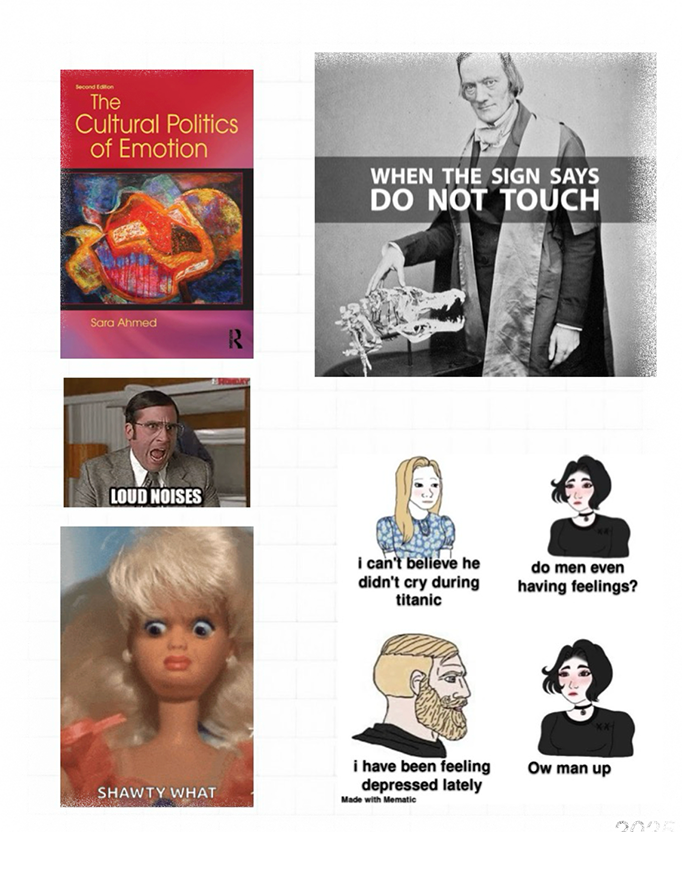
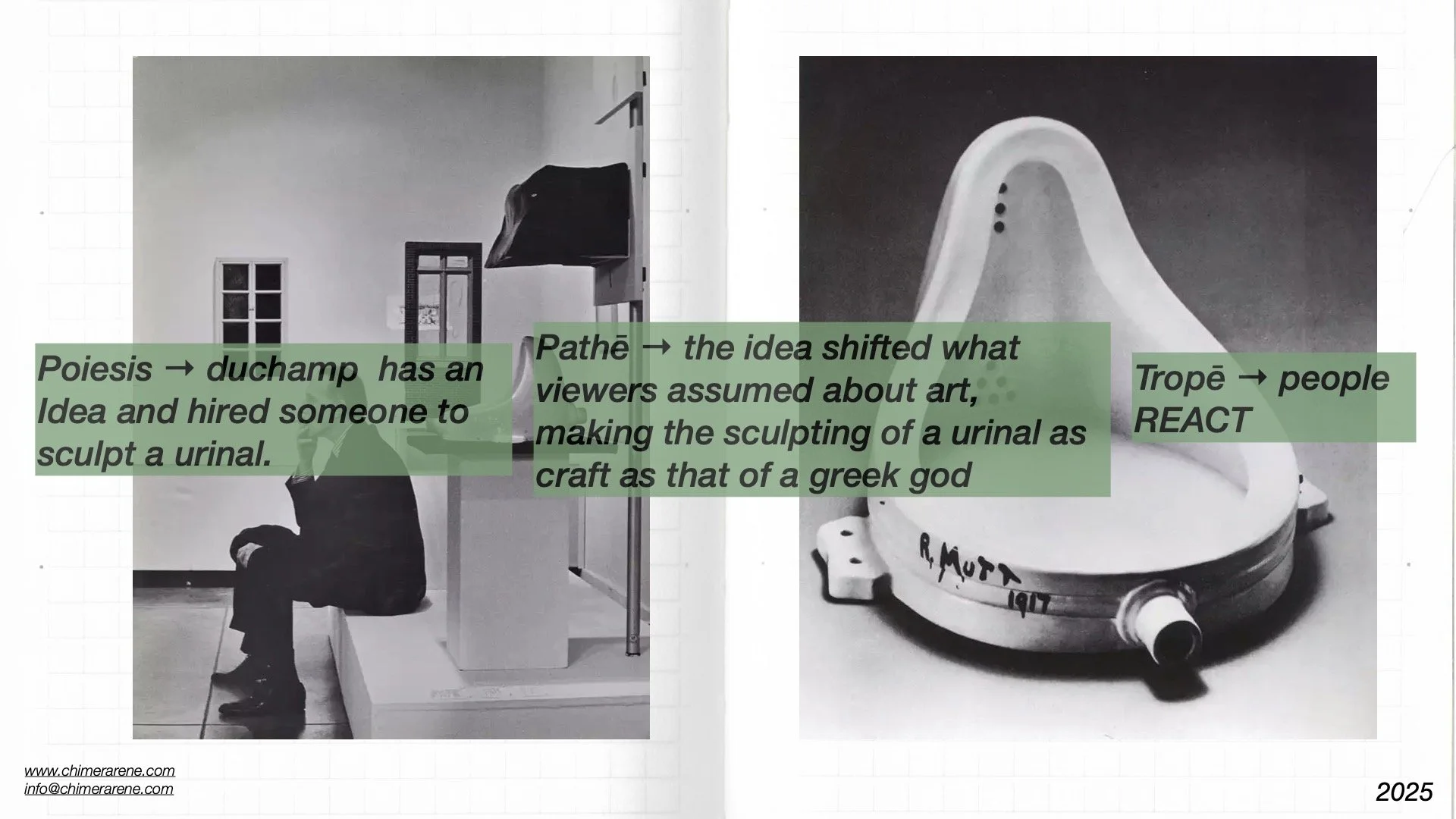
Sara Ahmed writes in The Cultural Politics of Emotions: "Emotions shape the very surfaces of bodies, which take shape through the repetition of actions over time, as well as through orientations towards and away from others."
My embodied response to Turbulent was an emotional one. The difference between a physiological and an emotional response is inextricable. The surface of my body was affected—pathē seized me. This is not only the flushed red as I cried or the scrunching of my face, but also the directional push to turn the surfaces of my body away. To turn. To stifle. Emotions are policed via social expectation.
Ahmed continues: "It is not difficult to see how emotions are bound up with the securing of social hierarchy: emotions become attributes of bodies as a way of transforming what is 'lower' or 'higher' into bodily traits... Bodies take the shape of the very contact they have with objects and others."
And we are terrified of the power this has—to unite, to divide, to motivate, to inspire. What if we emote anger, frustration, fear, grief, hysteria?
Emotive Ambient Sounds as "Lower"
The neutrality of so many curatorial spaces is, of course, not actually neutral. Sounds are often the most prominent signifiers of race, class, and gender in these rooms.
Emotions themselves are not neutral, just as the decibel from a Black American is interpreted as louder than that of a white American and a white american as louder than that of a White Frenchperson. It is not, of course, louder in any measured way. But it is perceived and symbolized as louder. So too are emotional expressions. Expressions of response to art—unless disdain, knowledge, prissiness, disgust, or stoicism—are generally, unless contained or private, considered lower than others. Unacceptable. Undesirable.
The Reverence of Sight
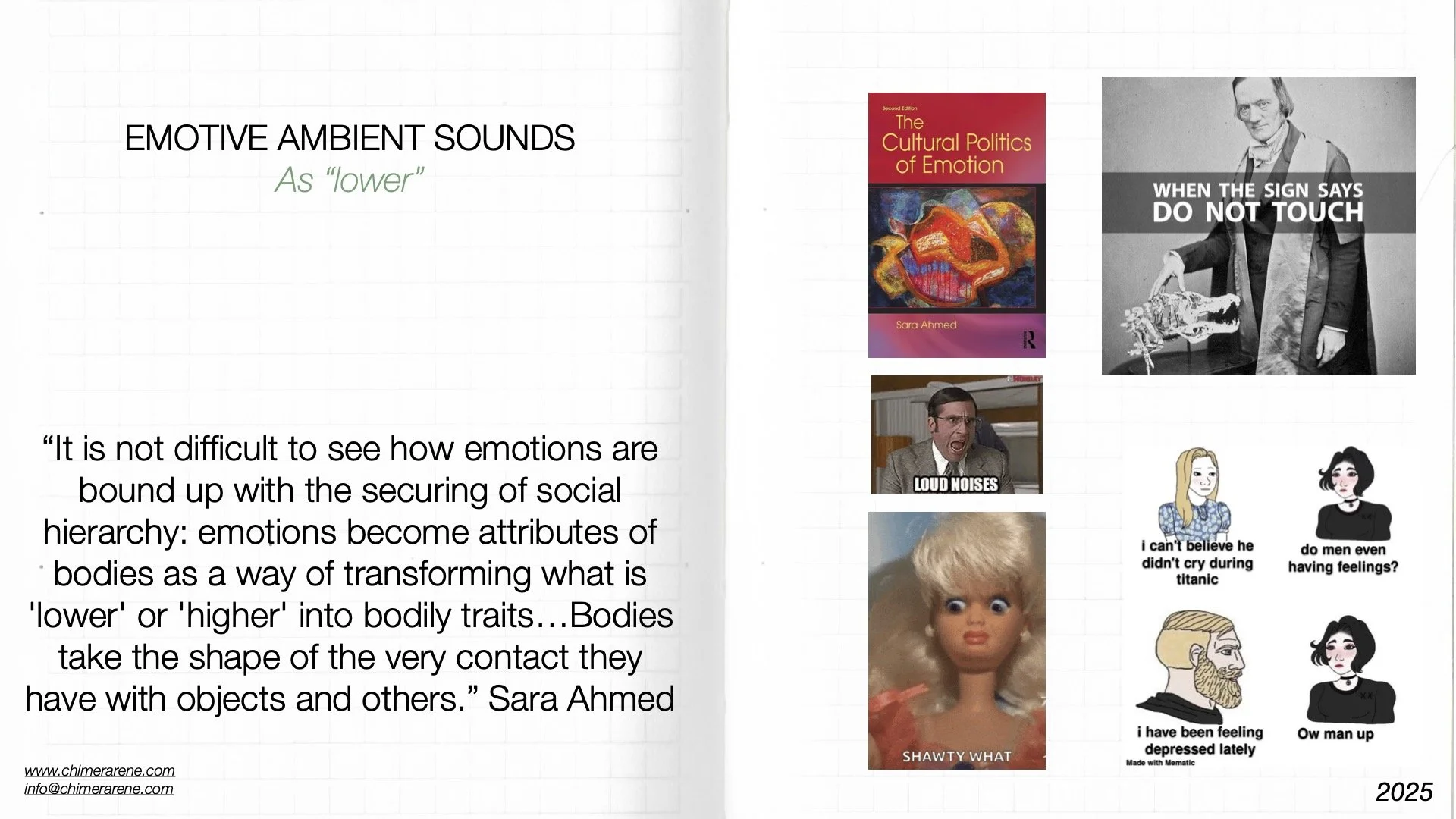
An epistemological foundation to our contemporary Western cultural knowing is categorization and therefore prioritization of sight. This Westernized epistemology has permeated academics worldwide. Oyèrónkẹ́ Oyěwùmí discusses this in her book The Invention of Women, in which she demonstrates that the category of "women" does not foundationally exist in Yoruba understanding. Even academic understanding of "third gender" is an imposition of categorical differentiation founded in our own social structuring rather than indigenous ones.
She writes: "The reason that the body has so much presence in the West is that the world is primarily perceived by sight. The differentiation of human bodies in terms of sex, skin color, and cranium size is a testament to the powers attributed to 'seeing.' The gaze is an invitation to differentiate. Different approaches to comprehending reality, then, suggest epistemological differences between societies."
This gaze extends to curation within exhibition spaces. Rather than engaging a multitude of senses, colloquially we go to museums to SEE. We "saw" the Mona Lisa, we saw Philip Guston at Hauser and Wirth. We do not smell, hear, taste, experience them.
And we certainly do not touch—perhaps the most heavily policed sense of all. Sophie Calle's Behind the Curtain offers a rare counter-example: viewers are invited to touch fabric to reveal what lies beneath. The work acknowledges that touch is part of knowing, part of being affected. Yet such invitations remain exceptional rather than foundational to how we design encounters with art.The 'Do Not Touch' sign is ubiquitous, understandable given preservation concerns, yet it further entrenches the primacy of the visual gaze. We are permitted only to look, as if sight alone could capture the full weight of art's capacity to affect us.
By limiting the other senses with false neutralities—for "no smell" is not neutral, “no vocalizations” are not neutral—a perspective, even in absences, is always on display. Our gaze becomes priority, eliminating the senses that may distract from it.
Alternate forms of exhibiting might not prioritize sight but a fuller bodymind experience, which might present very differently. There may be sound, conversation encouraged, gravelly footsteps, extensive seating—sporadic or gathered. Currently, we don't provide much seating, as we hope to allow for quicker flow, not wanting too much lingering, fearing that the space may crowd the art or each other. This is not merely aesthetic preference—it's economic logic. Museums operate under pressure to maximize throughput, to move bodies efficiently through space, to protect objects for insurance purposes, to satisfy donor expectations of order and decorum. The institutional forces that keep these spaces silent and restrictive are material, not just ideological.
It's important to distinguish between the sounds OF museums and the sounds IN museums. Sounds IN museums are curated, permitted, often literally piped in as part of artworks or audio guides. Sounds OF museums—the scrape of shoes, the whispered conversations, the bodies moving through space—are treated as noise to be minimized. This distinction reveals the power structure: institutions, and those generally White Bodies who fund them, control which sounds matter, which sounds mean, and which sounds must be suppressed. The visitor's body becomes an unwelcome sound source.
Unruly Sound: The Sonic Color Line
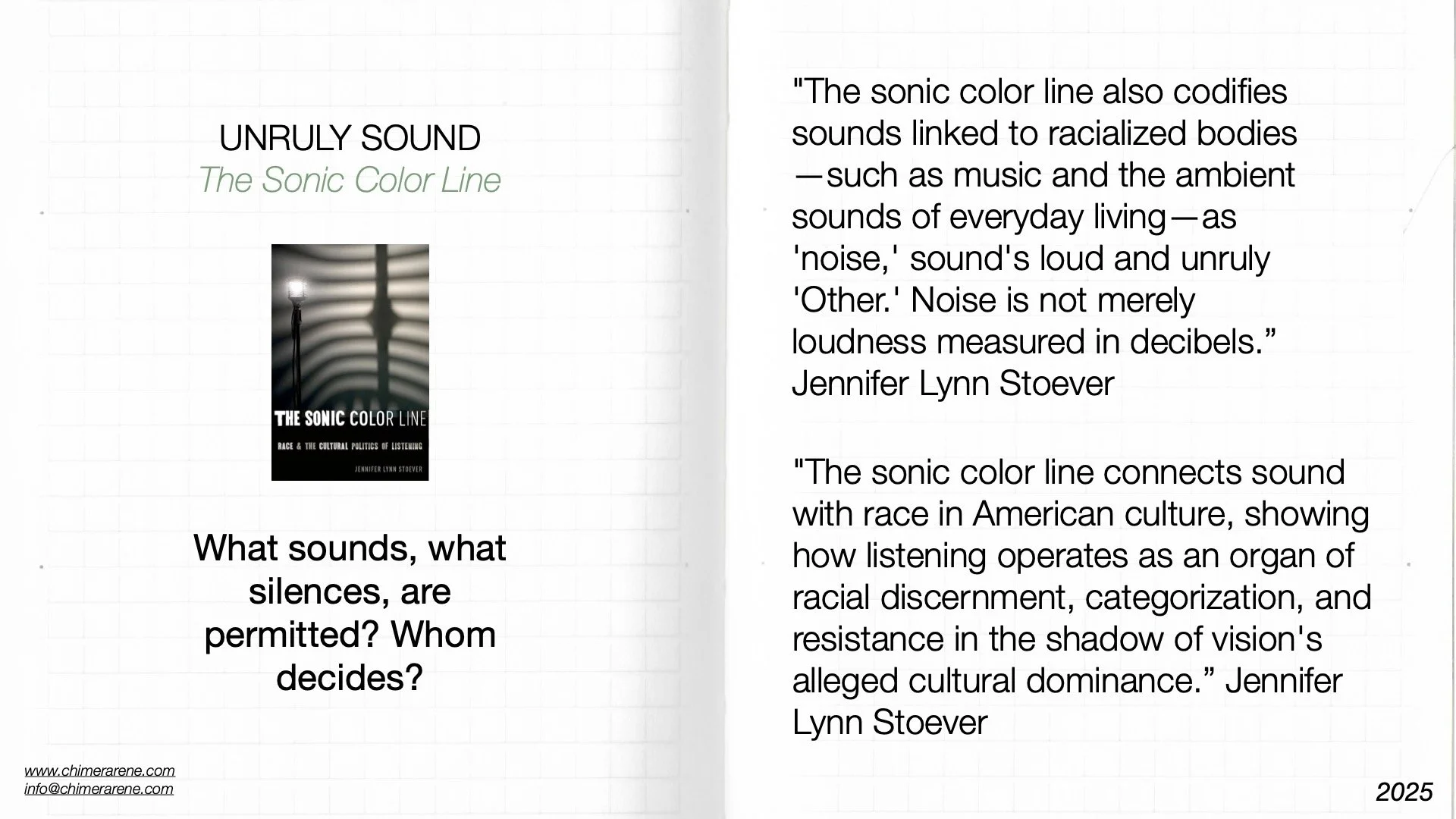
Noise is the "Other." We categorize "noise" as sound that is socially and culturally undesired. Jennifer Lynn Stoever describes in detail in The Sonic Color Line: "The sonic color line [also] codifies sounds linked to racialized bodies—such as music and the ambient sounds of everyday living—as 'noise,' sound is a loud and unruly 'Other.' Noise is not merely loudness measured in decibels."
Like weeds in a suburban American lawn, a beautiful yellow dandelion is undesired only because we have said so. It is just as beautiful as a rose, ecologically more nurturing of the soil, and edible. Laughter in a museum is only uncomfortable because we have made it so. We expect a visual reverence.
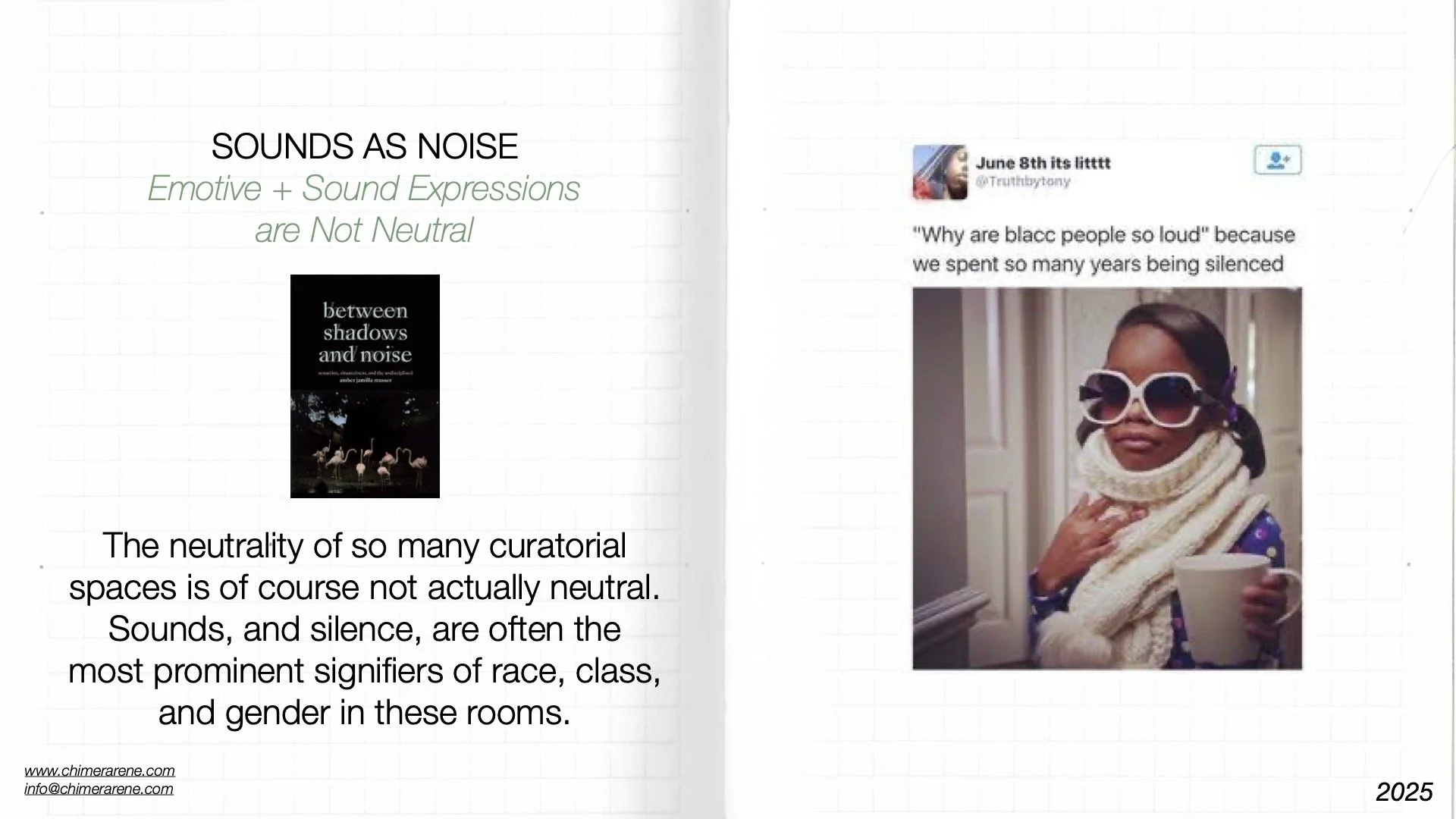
Sound, ambient noise in exhibition spaces—even laughter, tears, and conversation—are supposedly a distraction to our visual exploration and engagement. Sound draws our attention away from seeing and toward listening. Sound in museums becomes noise. And noise is not heard equally. A Black voice is unjustly heard as louder than a white one.
Stoever points out that "certain bodies are expected to produce, desire, and live amongst particular sounds." White bodies in particular expect silence, living in quieter neighborhoods, with soundproof walls, and a higher sense of the individual over the collective.
In a Westernized society in which visual categorizations remain hegemonically dominant, sound in particular becomes an unruly other, piercing the facade of civilization that rests so precariously on stacks of white canons and visual categorizations.
Noise becomes rap. It becomes laughter. It becomes whispers.
As amber jamilla musser writes: "Beyond its circulation in the sonic, noise is conceptually related to excess, abundance, and the unruly. Notably, these are terms that correlate closely with racist attempts to demean and police behavior (and, more often than not, mere existence) of people of color."
Art Moves—Movement Makes Sound
The sounds in the museum—those considered unruly or disruptive—are not only a cultural problem, but an institutional and curatorial issue. Expectations are not distributed equally. Noise becomes the monster that wakes us from the reveries of false normalcies and false neutralities.
The formation and purpose of exhibiting art has ebbed and flowed, and today through the practice of curation, art arranges artworks and their conditions of encounter. An exhibition space becomes a site for negotiating ideas and emotion—carried forward through art and artistic practices.
The conditions are as important as the art itself. Often, the conditions ontologically create art as itself and create our experience with it. Sometimes silence IS the reaction of our bodies, struck in awe. But what is needed is true permissioning—to bodily be with art. To allow its mobilizing, its destabilizing force. To allow pathē to operate through tropē.
Artists and curators increasingly occupy overlapping roles—many artists curate, many curators create. They share the work of creating conditions for encounter. Yet institutional pressures often override both artist intention and curatorial vision, defaulting to inherited conventions of silence and stillness.
Luca, presenting at this conference, uses the sounds of museum visitors themselves as tools of displacement - making audible what is usually suppressed, and in doing so, creating conditions where people feel more permitted to react. Notably, to me, he observes that the loudest moments in museums occur around children and around provocative works - moments when institutional control over bodily response temporarily falters, when pathē break through despite the architecture of silence.
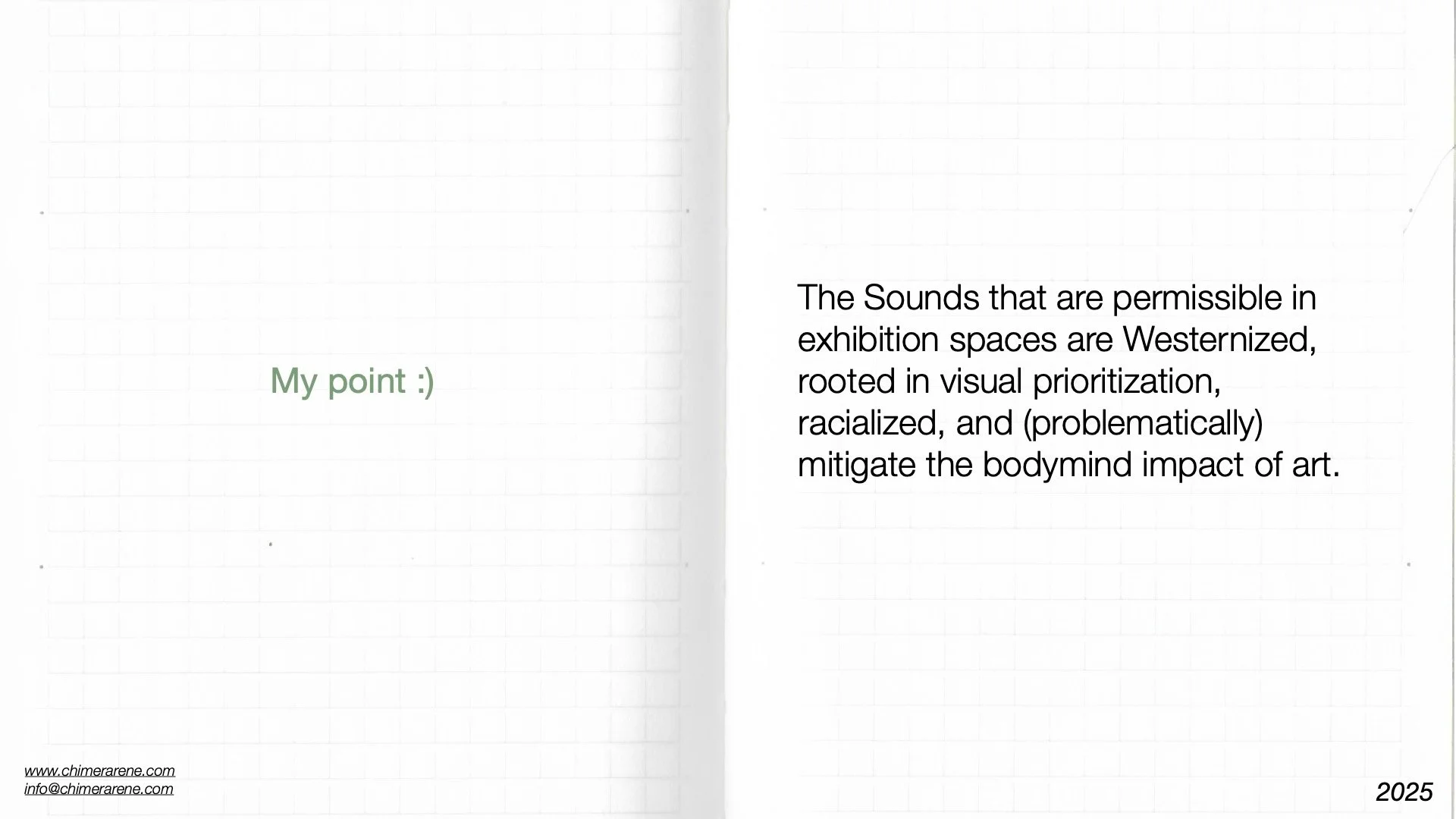
As queer theorist Paul B. Preciado claims, the body exists as a "living political archive" that contains cultural and political records, narratives, and flows of power and technology. It moves beyond the biological body to encompass the body as a site of biopolitical management, subjectification, and resistance, shaped by social, technological, and political forces.
Successful Spaces
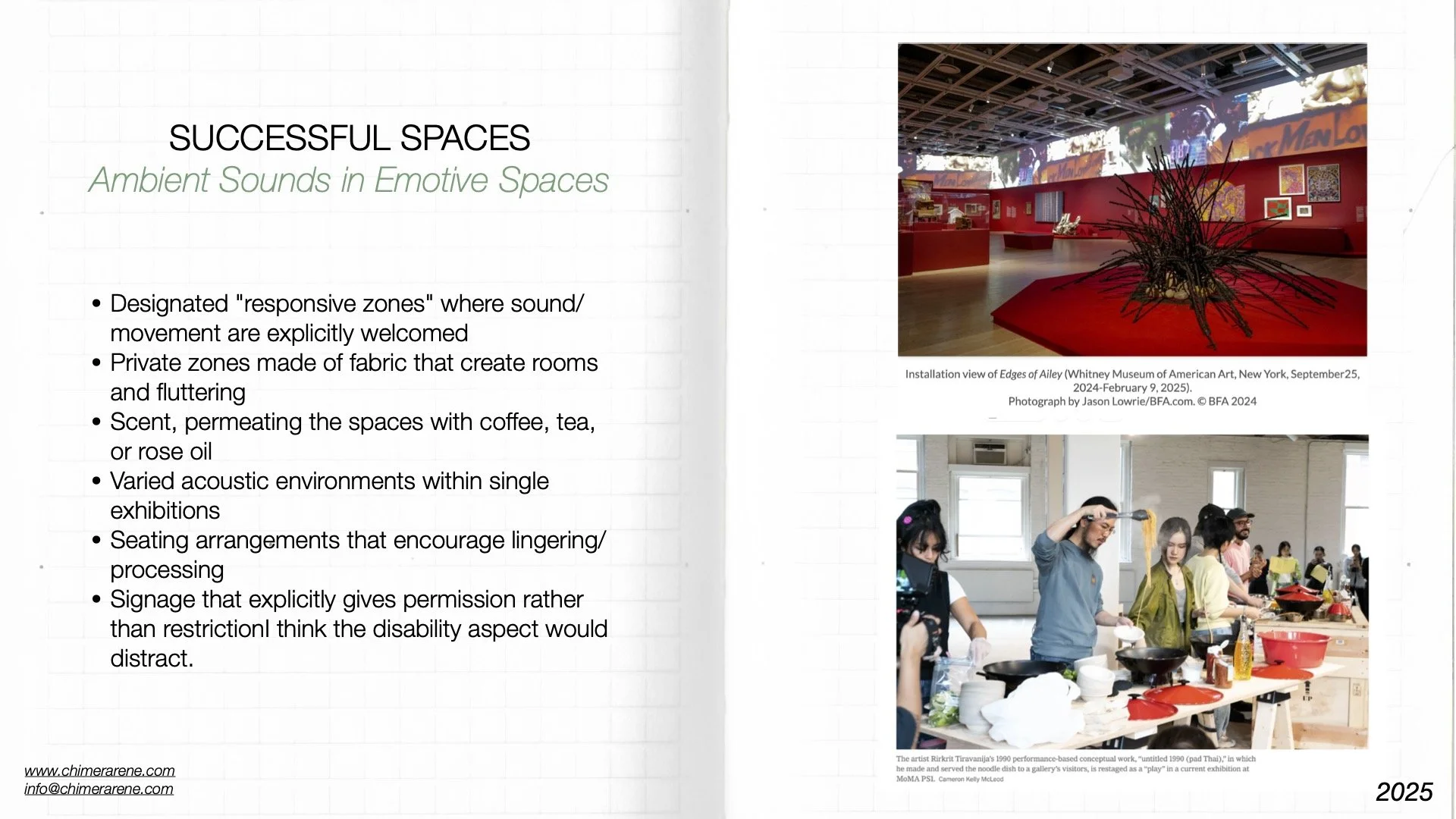
Fotografiska in NYC, before it closed, welcomed laughter and drink. Floors were carpeted blue and pink depending on the exhibit. And music played loudly for the [exhibit name], featuring a strip club in Atlanta.
I once heard a woman sharing with her child the history of the AIDS epidemic in the US during the Edges of Ailey exhibit at the Whitney Museum. This was somewhat facilitated by the loudness permitted by the curators because of his performances screened on the walls, with sound filling the entire floor.
Rirkrit Tiravanija's Untitled (Free) (1992) transformed 303 Gallery into a space where the artist cooked and served Thai curry to visitors. The work existed only in the eating, the conversation, the bodies gathered together. Sound, smell, taste, touch—all the senses suppressed in traditional exhibition—became the substance of the work itself.
Liu Chuang's Lithium Lake and Island of Polyphony II enveloped viewers for 58 minutes in layered sonic storytelling—demanding time, attention, and care. This temporal commitment runs counter to the throughput logic of most museums, but it's essential for the work to produce its pathē, its turning.
There are so many ways to do this.
Designated "responsive zones" where sound/movement are explicitly welcomed
Private zones made of fabric that create rooms and fluttering
Scent, permeating the spaces with coffee, tea, or rose oil
Varied acoustic environments within single exhibitions
Seating arrangements that encourage lingering/processing
Signage that explicitly gives permission rather than restrictionI think the disability aspect would distract.
Toward Embodied Curation
If art is poiesis that produces pathē through tropē—if art is making that moves us by turning us—then our curatorial spaces must allow for that movement, that turning, that being-affected.
The question is not whether museums should be silent or loud, sparse or abundant. The question is: can we create conditions where pathē are permitted? Where the involuntary, somatic, psychic responses that art produces in us are not policed into silence, not shamed into stillness?
This requires:
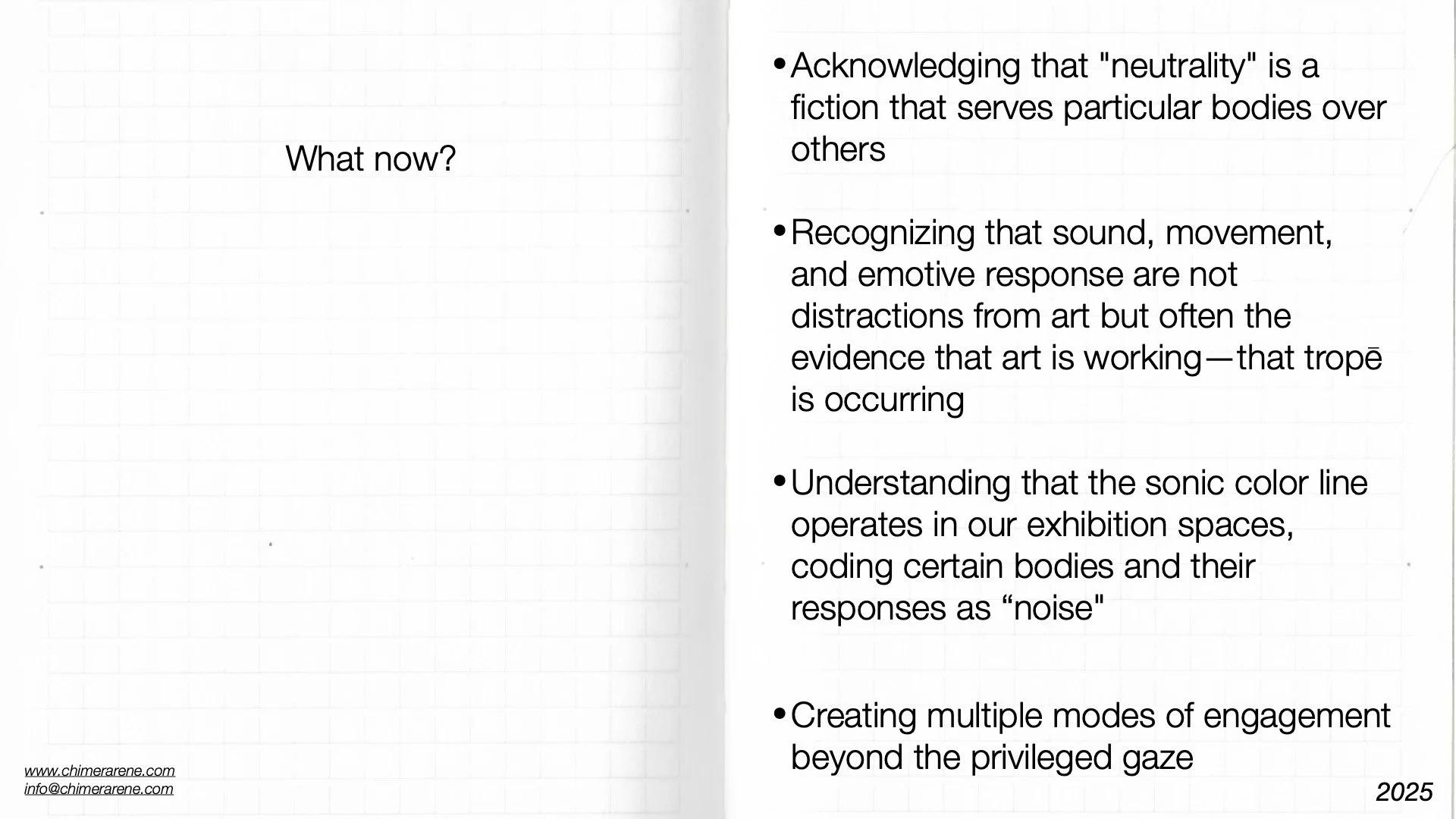
Acknowledging that "neutrality" is a fiction that serves particular bodies over others
Recognizing that sound, movement, and emotive response are not distractions from art but often the evidence that art is working—that tropē is occurring
Understanding that the sonic color line operates in our exhibition spaces, coding certain bodies and their responses as "noise"
Creating multiple modes of engagement beyond the privileged gaze
When my body crumpled before Turbulent, that was not a failure of museum etiquette. That was art doing what art does: producing pathē that reorient us, that turn us toward what we have yet to discover. The failure was in the institutional pressure that made me flee rather than stay with that turning.
We need spaces where:
A mother can whisper AIDS history to her child without shame
Laughter at the absurdity or joy in art is welcomed
Bodies can pace, stim, move in rhythm with what moves them
Silence can still exist—but as one option among many, not as a mandate
Art speaks. The question is: will we create spaces where we're permitted to speak back?
Not every space needs to be the same. But every space should ask: who does this serve? Whose bodies are made wrong here? And what might we be missing when we silence the very responses that signal art's power—its capacity to move us, to turn us, to remake us?
The work is not to make museums comfortable. The work is to make them permissive of the discomfort, the grief, the joy, the reorientation that art demands of us.
Let the tides move. Let pathē operate. Let tropē turn us.
And let our spaces—finally—make room for bodies responding to art, not just gazing at it.

The Acceleration of Digital Sags and Wrinkle Skin Pixels
irl lecture, essay
NYC Gender Symposium - 2025 - Gendered Bodies, Gendered Justice -
NYC Gender Symposium - 2025 - Gendered Bodies, Gendered Justice -
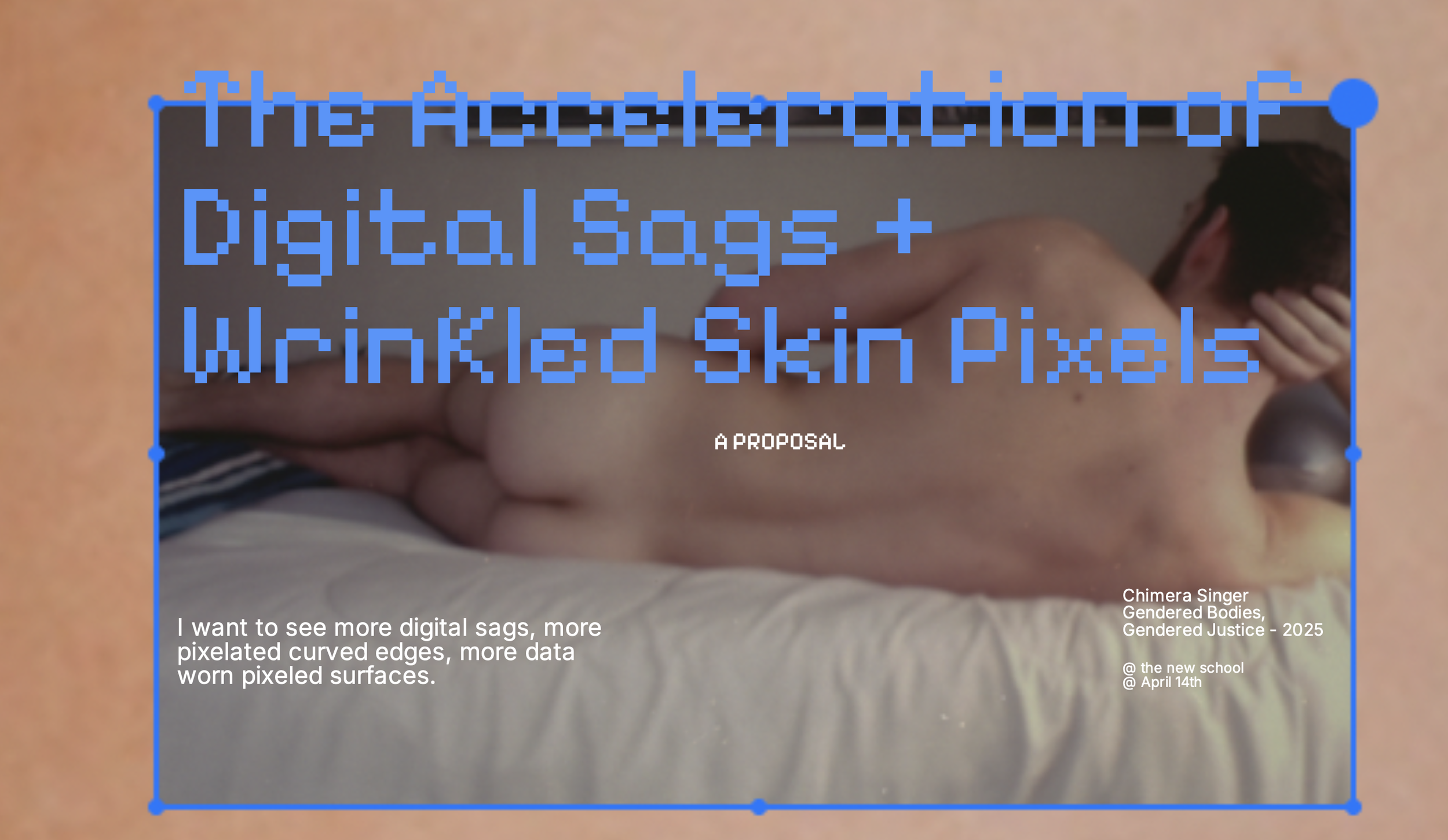
I want to see more digital sags, more pixelated curves edges, more data-worn pixel-surfaces.
I am in the business of seeing, making, and negotiating the image of bodies. I make album photos for musical artists, source material for pitch decks, outline and create websites, generate visual intimacies, scroll instagram, send TikToks, film shorts, and write about my curiosities and challenges.
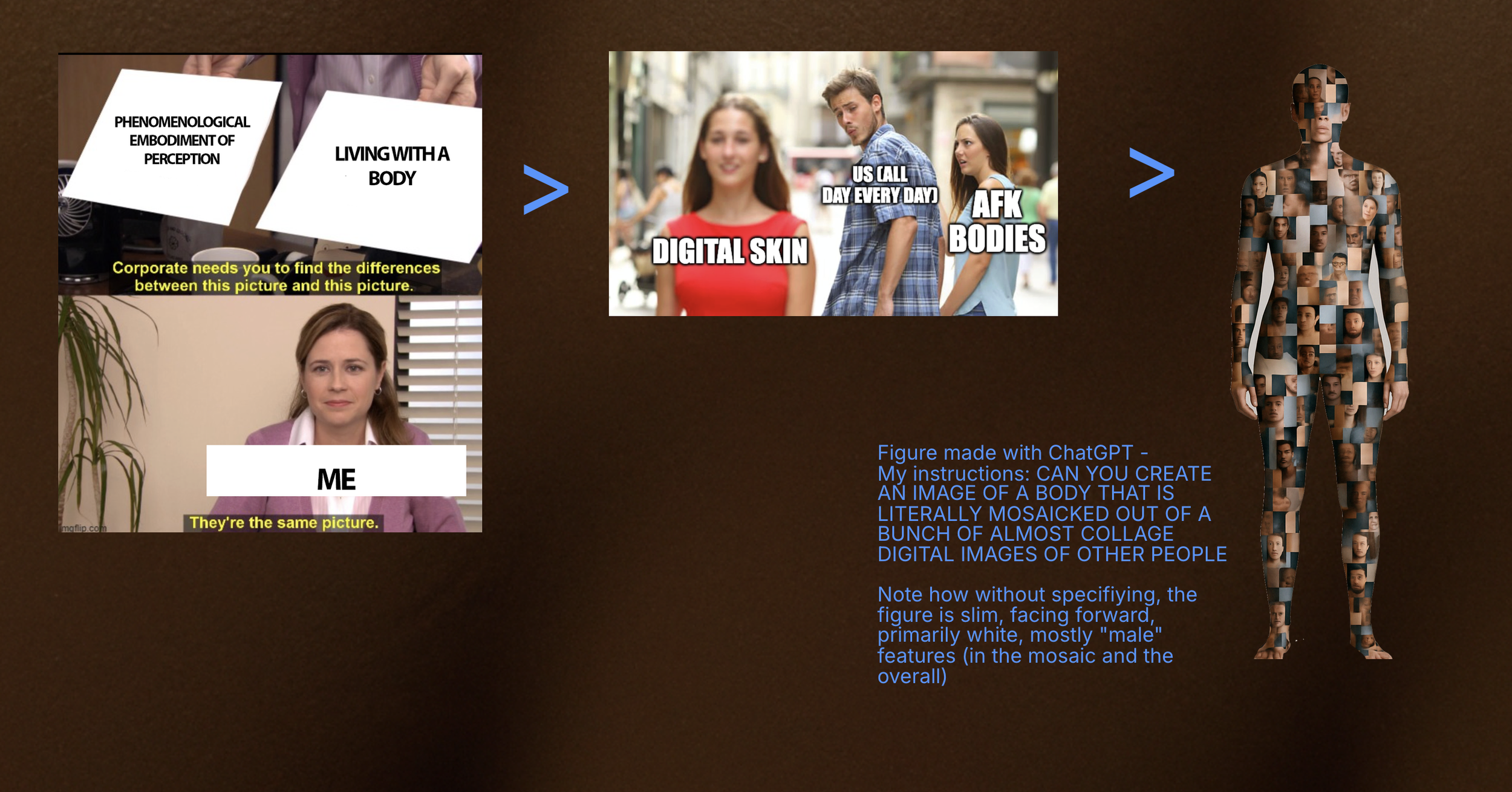
The body is the primary material, celled, meaty, subject simulated by these pixels, even if the bodies are first translated by clay, paint, or animation. The body itself, before it becomes (any layer of) simulated image, already mediates an endless array of assumption, consumption, and presumption. In Disidentification, Muñoz describes the body as a site where cultural meanings are inscribed and contested through performative acts. That is, the body houses our phenomenological perceptions, and as such, remains the primary site in which we negotiate ourselves and one another. The body contains the eyes in which we see our laptop screens, the fingers we use to type and press buttons, the chin that folds as we look to our phones – the sensory information that becomes the data activated by bodies with material and immaterial affect.
Because of this, I am in the practice of looking (and sometimes creating) that which I do not see.
I do not think that representation, especially in isolation without other considerations, is the end-all-be-all, or that it precipitates a liberatory outcome. Hypervisibility in the digital realm often creates a trap where trans, queer, and non-white bodies are more surveilled than liberated by visibility. Huxtable points to how visibility and can expose to violence, "Trans visibility isn’t enough. Hypervisibility often means hyper-vulnerability."
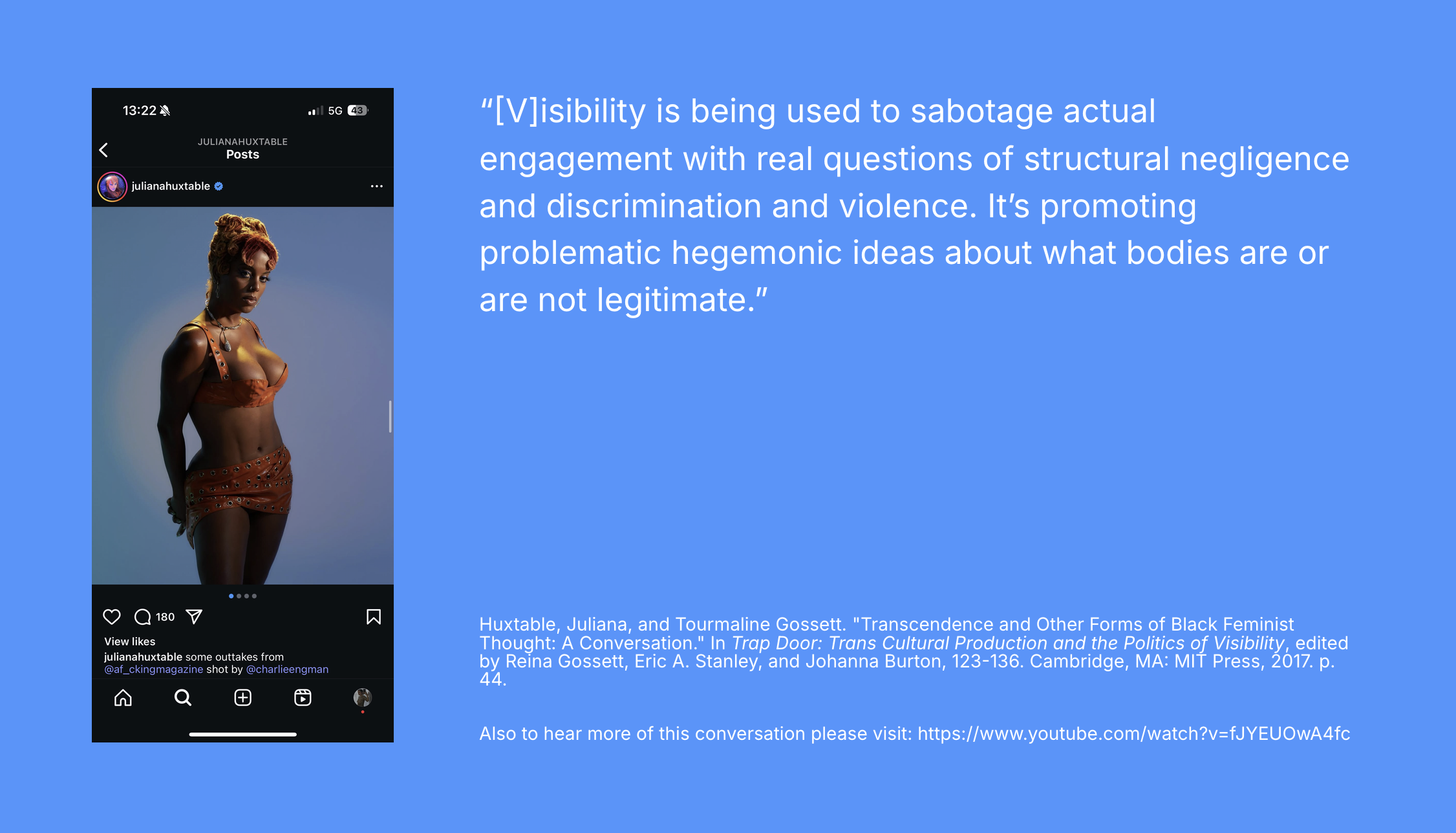
So I refer not to the need for arbitrary representation, or the mere inclusion within failing hierarchical systems of power (This would perhaps fall into using what Audre Lorde refers to as The Masters Toolkit”, and there are many liberatory feats by falling outside of inclusion - as addressed in Queer art of Failure by Jack Halberstam). Material autonomy is often co-opted and proliferated by digital representation (again, endless examples of this as addressed by Legacy Russell in Black Meme, Aria Dean in "Poor Meme, Rich Meme" & Notes on Blacceleration, Safiya Noble in Algorithms of Oppression).
In a recent conversation with Andrius Backus, he and I discussed the ways in which we personally grapple with this in our creation of multidisciplinary art - often desiring to create abstraction or narrativized bodies of flesh as we grapple with this dichotomy.
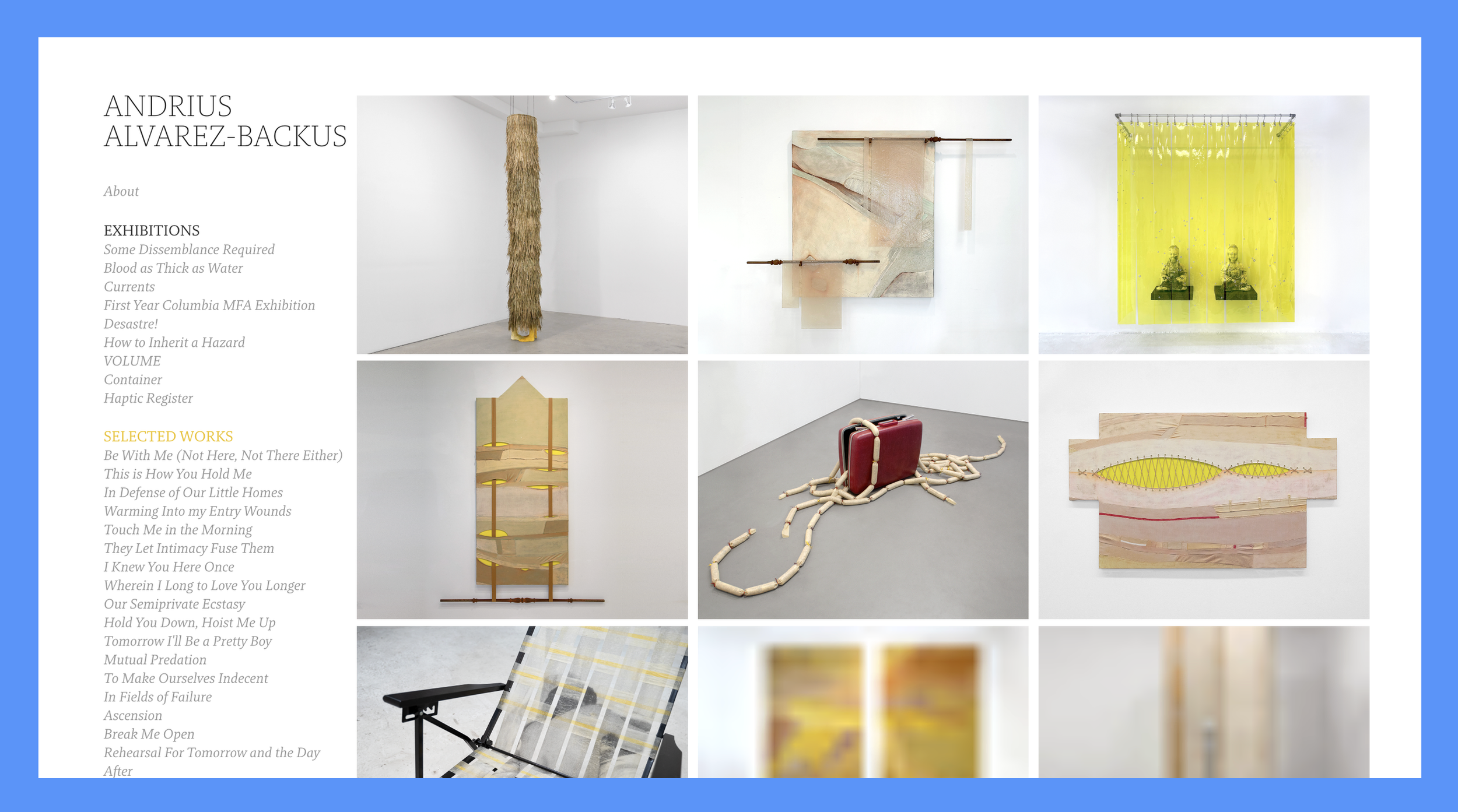
And yet. We must notice what is excluded.
And yet. I really do want to see and not just think about more wrinkles.
Perceiving in itself remains deeply important as it informs our embodied biases, erasures, assumptions, rejections, and acceptances. Asking what is missing from the barrage of daily images, or what is missing from the (perceptual - visual, sonic, textual..) descriptors more broadly, requires us to identify the areas of our own overlooking.
Overlooking (ie Individual, social and political erasure) reflects the hierarchical within the hegemonic. Much of this is obvious, but how often do we actually take the time to interrogate what we don't see, especially in comparison to the constancy of our ever constant flow of pixel-images, where galleries become digital storefronts, and google searches elicit and reflect archives of body and body-making? Many have taken on the work of identifying and challenging and navigating the countless problems that arise when bodies are represented digitally to varying degrees and with varying methodologies and in various contexts. The contexts, methods, and degree to which these bodies are circulated generate ways of being that marginalize (many of those individuals mentioned previously, alongside people like Preciado, Saidiya Hartman, Simone Browne, Hito Steyerl…)
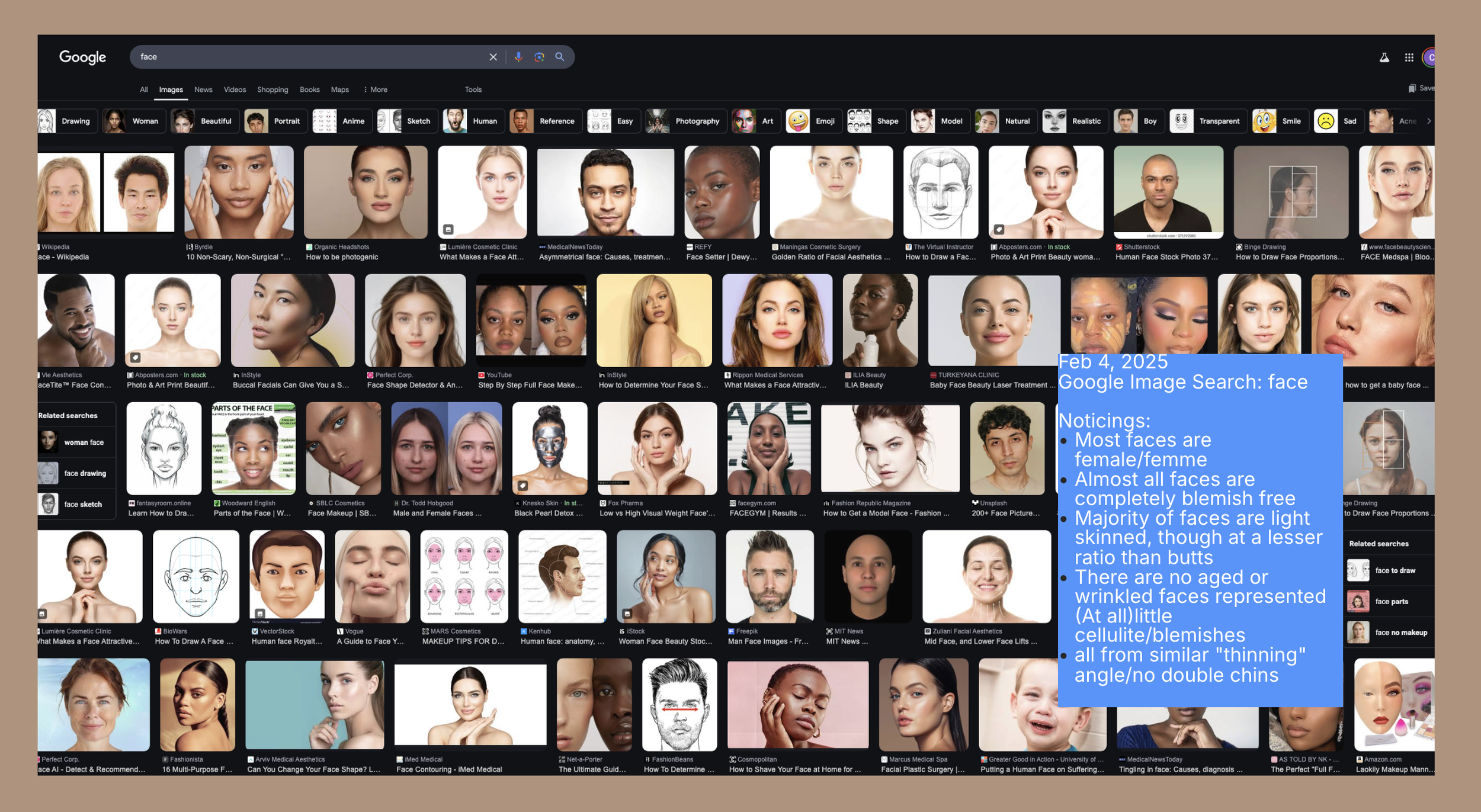
Erasures and objecthoods of personhoods proliferate – reductions and stereotyping occurs. How often algorithms could and do not work to address discrepancies that further and generate marginalizations. Potential counteractive measures instead are replaced by and become cybernetic fleshy balls that roll down hills of “x”s and “o”s at increasing speeds until someone types a metaphorical foot to stopper it, or a tiny stone is thrown to slow it down.
What astounds me, though it perhaps shouldn't because of the algorithmic balls’ escalation, are the images that I have difficulty finding even when I look for them.
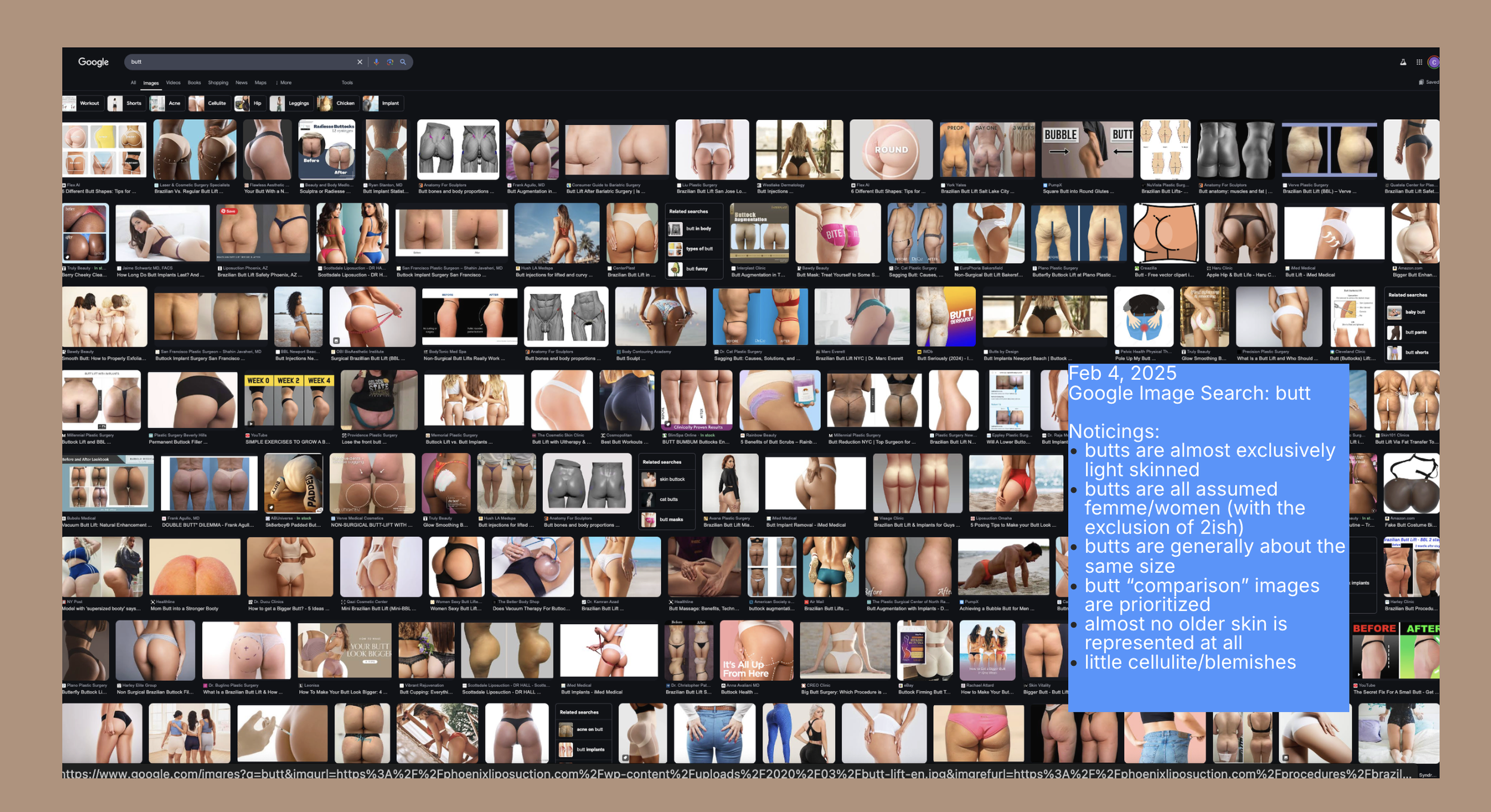
In a recent exhibit I was building a wall of mosaiced forms (check out here). I sought out aged forms, sagging forms, wrinkled forms, desiring to not relegate the body to taught, white, skin. In programs like Cosmos, Pinterest, Google image search, Wayback Machine internet archive, “butt” showed almost exclusively white thin waisted butts. Sagging skin, wrinkled breasts, flaccid penises, intersex genitals, flappy labias - missing. So many bodies, fragmented, were rarely there unless specified, and barely there even when I did. What stood out to me this time was the lack of age - something I recognize as a flaw in my work in this project as I was working mostly within my own networks, so it has been on the top of my mind.
Representations – lack of, erasures, hypervisibilities – have been written and discussed endlessly, and yet, it's something that remains so present. It remains so muc that norm that still we consistently overlook until we are in the excluded group. At this moment, I am caught up in the systemic assumption of youth, and the assumption of desired youth. How are wrinkles in the context of femininity so radical? They, of course, are not, but it would appear as such if we were to focus our gaze to look at sculptures and digitally mediated representations.
We must ask ourselves to look and look again. What is it that we don’t see? Why? In what contexts? With what frequencies? By interrogating what is missing from our visual and algorithmic landscapes, we open up new ways of seeing, resisting, and counteracting the accelerating flow of exclusionary digital images
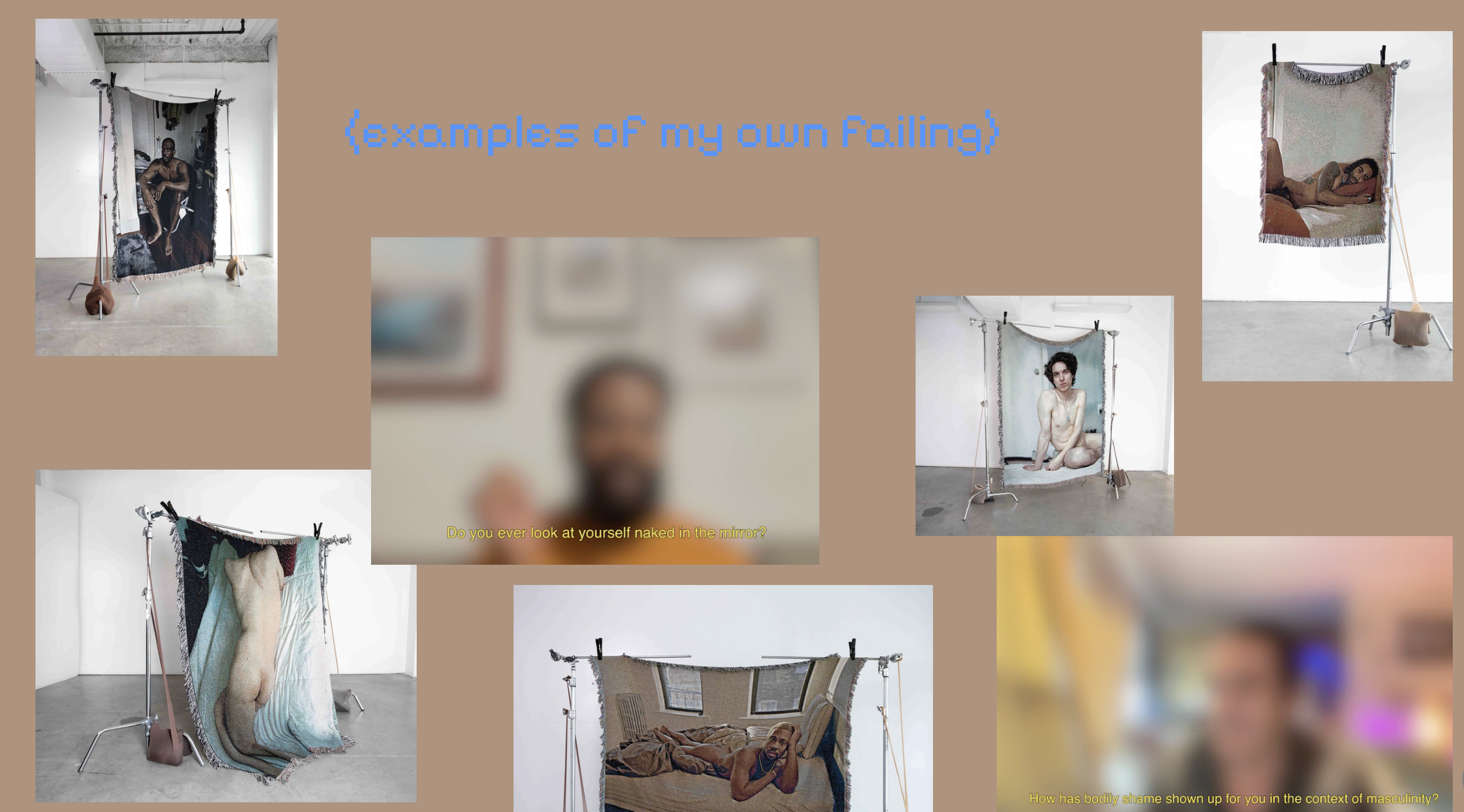
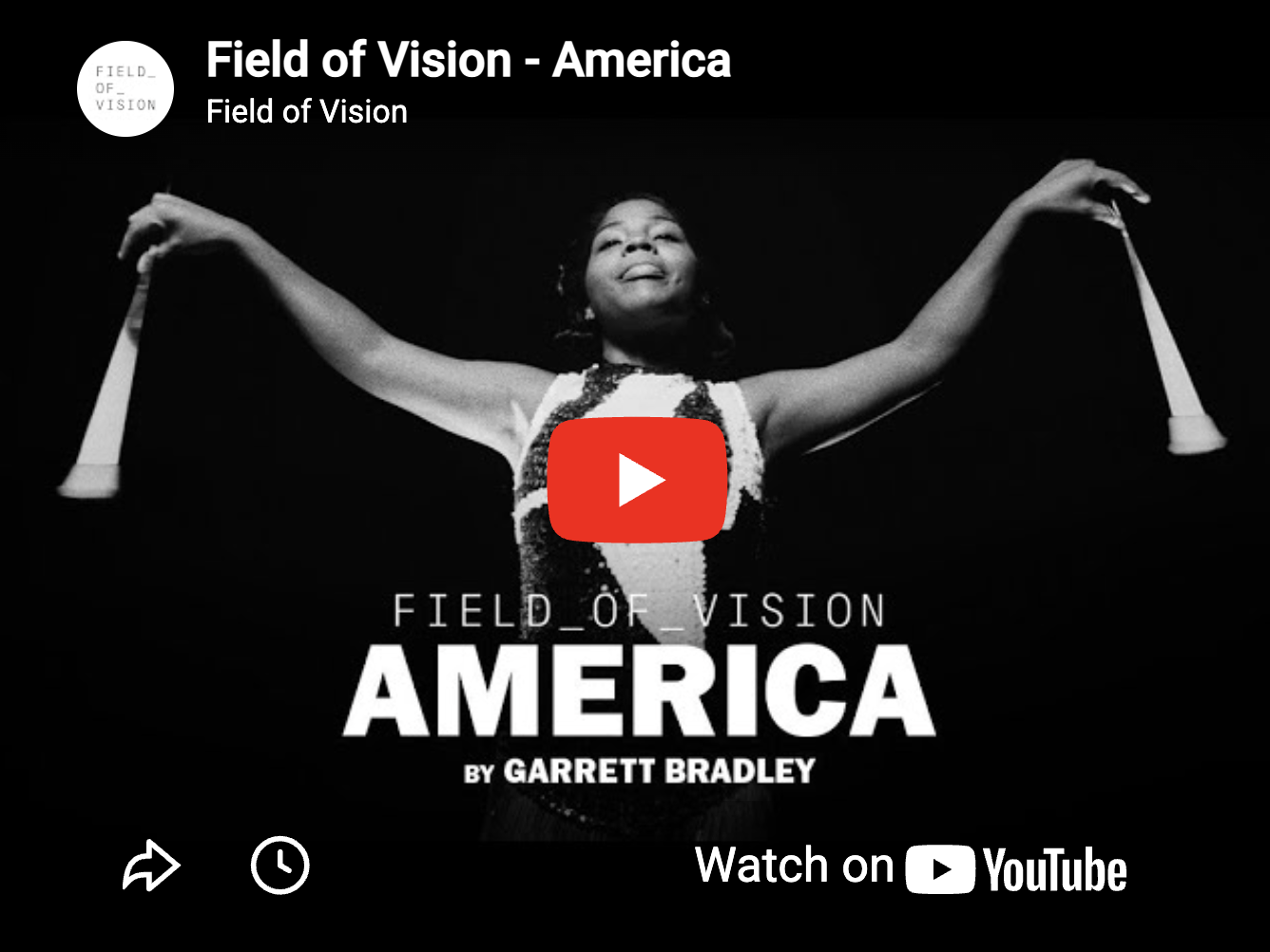
I look to people like Garrett Bradley, who sought to repopulate searches for “America” by titling their film “America,” and Legacy Russell, who points to the furtherance of digital blackface and (profit from others) of memes.
What stones can we throw to stop the ball from rolling at ever increasing speeds within digital circulation? What queer refusals can we generate? What digital feet can we build to block paths and create new pixel bodies?
Clarice Lispector + Susan Stryker
fragments
Talking Monsters.
No. 02
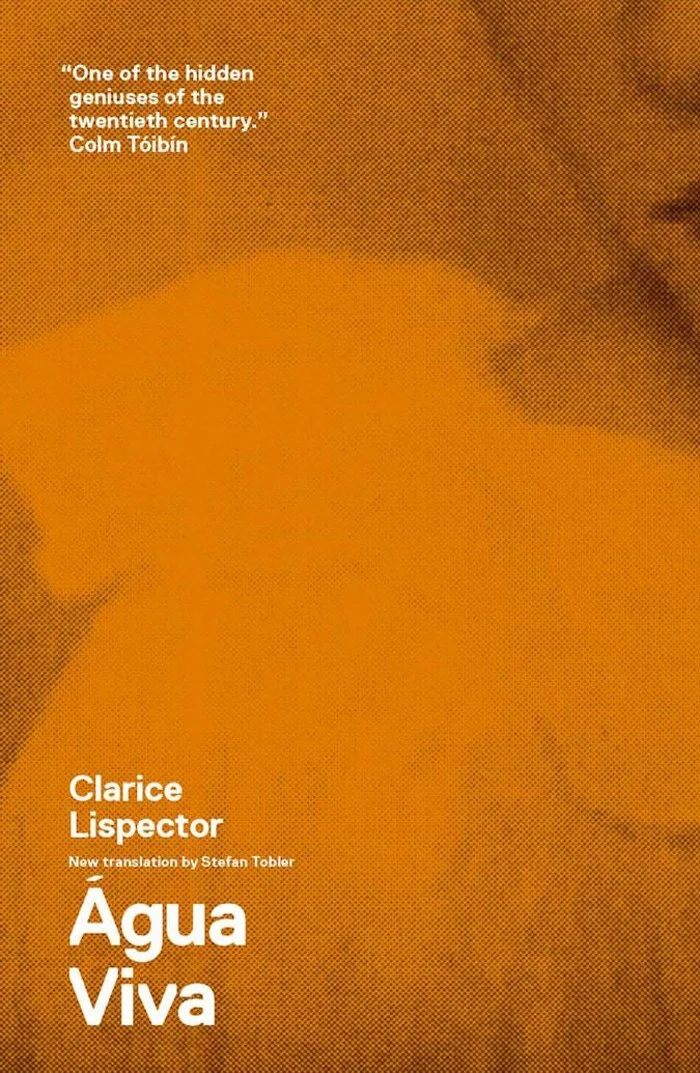
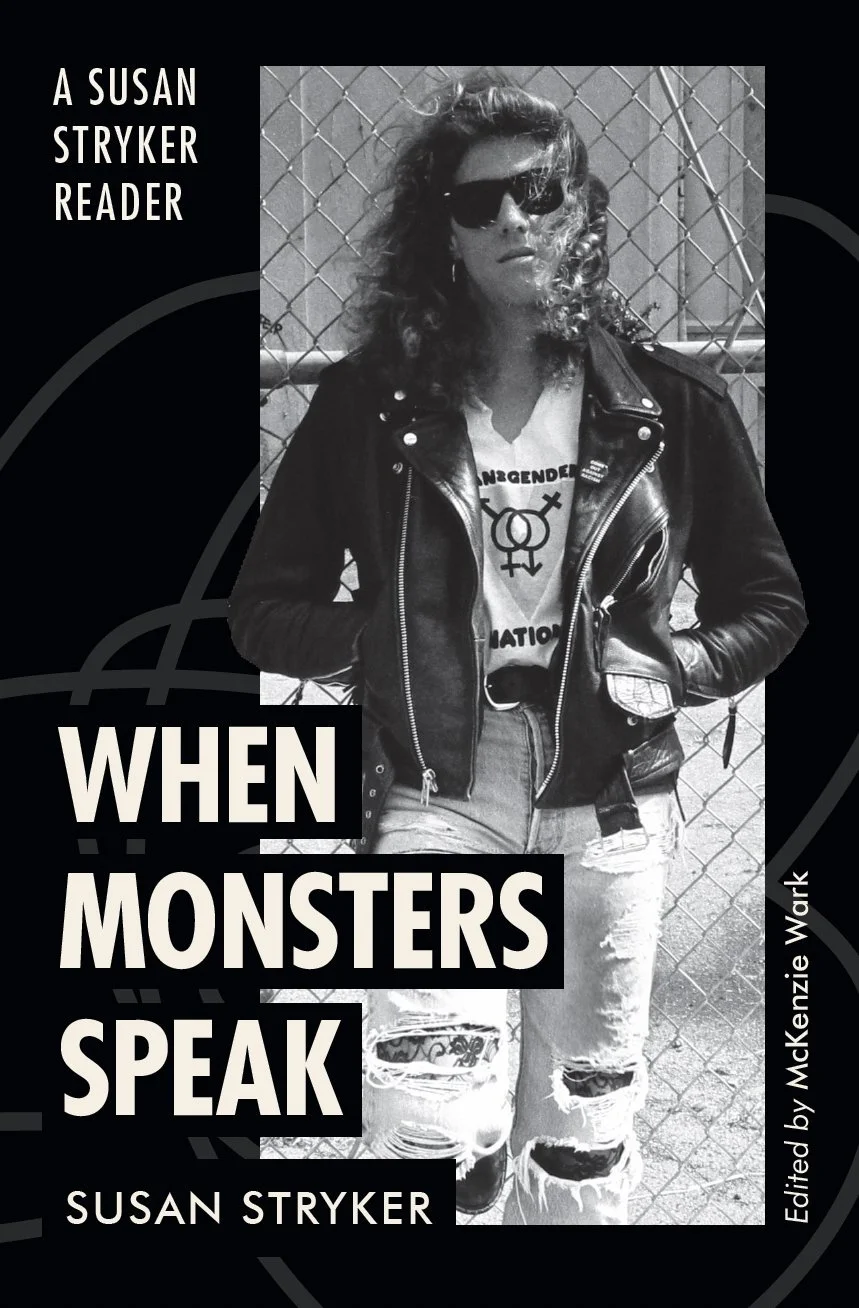
A conversation with Clarice Lispector via Agua Viva and Susan Stryker…with a touch of Mckenzie Wark.
I don’t like gender. It doesn’t feel exploratory. To be “read as ___” is boring, and falsely assumptive to me. It negates the work of learning and knowing another, it negates the necessity of curiosity. It assumes too much and does too much work that then inevitably is undone. Or if it is not it flattens and mimics. Maybe my mind will change. Most thoughts do. Or they mutate to be premised in meaninglessness. But i also need you to not need or expect me to change my mind. This is important.
Reading Stryker I wondered out loud whether monster was useful for us to identify with the Other as liberatory practice. Wark said of course. For some reason this made me angry. Stryker said it is like reclaiming whore or slut or gay. No it’s not. It’s not. Maybe it’s still useful to Be Monster, but it’s not the same. To be gay whore slut is only bad or wrong if the thing it describes is assumed bad or wrong. The terms themselves are not indicative of a description of “badness” itself. Monster - is. Monster reflects the subjective speaker. It does the work of communicating that which is harmful, ugly, and feared. It does not generate or prescribe specific actions or traits as whore slut gay do. Monster does the work of being flexible, to be specifically and exclusively defined by those who use it. Monster is the judgement itself, not the identity or practice that is judged.
I did not say any of this to her. Why would I when I wouldnt be heard. And Wark did not explain or change my mind. I was disappointed by this. I learned nothing. I changed my mind later. I changed my mind when I embraced the monster for myself because i didnt want the human described as human by those who use Monster. Which is almost exactly what Stryker said. id rather be the creature they feared. i would rather be the thing feared than the boundaried saltless human they want. To them, I am a monster and she is a monster. But, to me, so are you. And so the speaker of Monster is Monster. They just don’t know it yet. Which really means we are all human again too. It all is the same metaphor for the same creature. Mary tried to tell us.
Monster isn’t a slur to be reclaimed, it is diagnostic of the speaker, diagnostic of their prescription of “human.” But as with gender and race and most things, human and monster equally drift, shift, blur, glitch, slide, drip.
Boundarilessness is wordlessness.
Sometimes it’s hard to speak words when words mean everything and never nothing.
How can I speak when not all can hear and how can I gesture when not all can see and how can I touch when not all can feel and how can I whisper when you are so far and how can I shout when the wind snatches thought and how can i write when youre not there. And how can i share when i cannot feel. What is left to be said, communciated, shared when it is all and all everything and you already know anyway?
Like photoshop attempting to distinguish one pixel from the next to form an edge, a selection. How often it gets those pixels wrong. A corner of a nose blends with the skin of another’s stomach. Even when we tell it which pixels to look for a shirt rubs off on the moon. How can I gender when it’s boundariless and how can i race when it fictious except for how we live it in body against body atom against atom and so we speak in poems and riddles and metaphors and analogies and monsters and words. And so words become genders become races become types become categories become All of us monsters, but not all of us Narccissus. That is the secret. We are all monsters. But speaking to no one. But us.